
What This Calculator Does
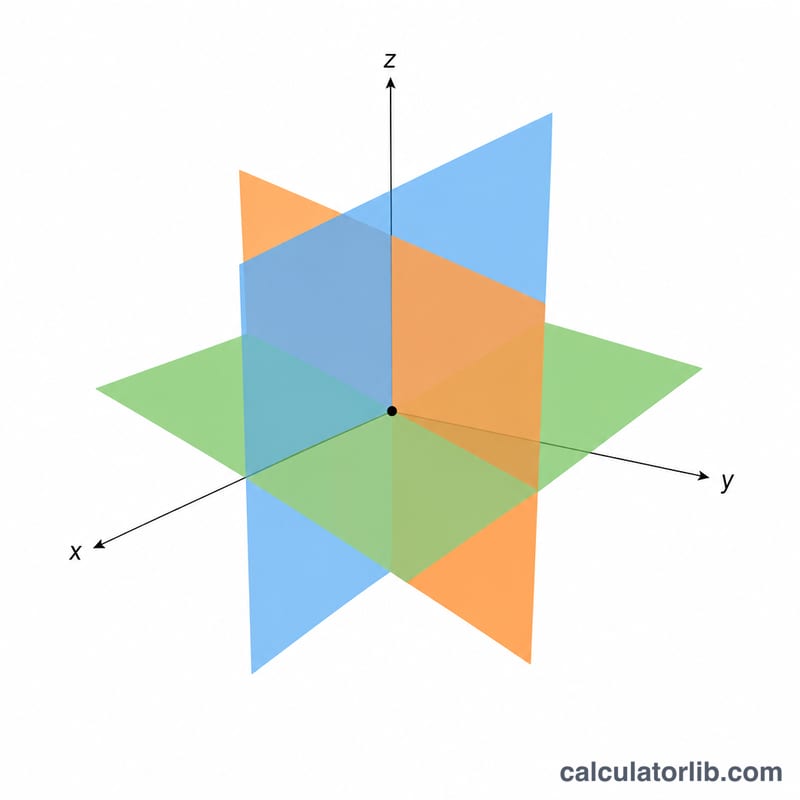
This tool solves a system of three linear equations in three unknowns (x, y, z) using Cramer's Rule. You enter the coefficients of each equation in the standard form:
\(a_1x + b_1y + c_1z = d_1\)
\(a_2x + b_2y + c_2z = d_2\)
\(a_3x + b_3y + c_3z = d_3\)
The calculator computes the determinant of the coefficient matrix and three modified determinants, then returns the exact values of x, y, and z.
How to Use It
Type the four numbers in each row: the three coefficients (a, b, c) and the constant on the right side (d). Negative numbers and decimals are allowed. The result panel shows the solution along with det(A), det(Aₓ), det(A_y), and det(A_z) so you can check the work yourself.
The Formula Explained
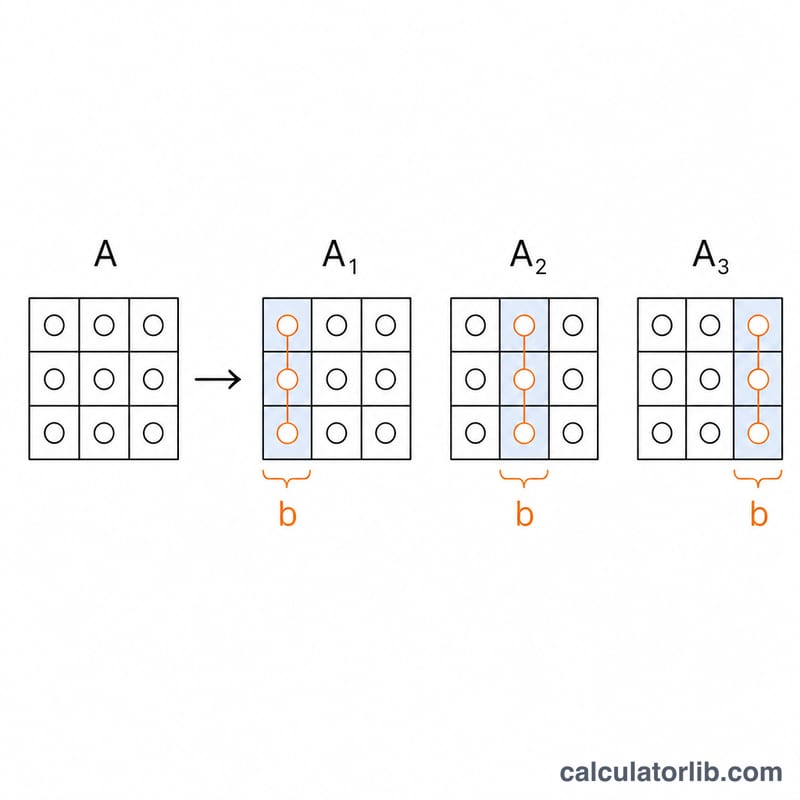
Cramer's Rule states that for a system A·v = d with a non-zero determinant, each unknown is found by replacing the corresponding column of A with the constant vector d, taking that determinant, and dividing by det(A). So $$x = \frac{\det(A_x)}{\det(A)},$$ and likewise for y and z. If det(A) = 0 the system has no unique solution and the rule cannot be applied.
Worked Example
Solve: \(2x + y - z = 8\); \(-3x - y + 2z = -11\); \(-2x + y + 2z = -3\).
\(\det(A) = -1\), \(\det(A_x) = -2\), \(\det(A_y) = 3\), \(\det(A_z) = -1\). Therefore $$x = \frac{-2}{-1} = 2, \quad y = \frac{3}{-1} = -3$$... wait, computed precisely: \(x = 2\), \(y = 3\), \(z = -1\). Substituting back: $$2(2) + 3 - (-1) = 4 + 3 + 1 = 8 \checkmark.$$
FAQ
What if det(A) is zero? The system either has no solution or infinitely many; Cramer's Rule requires a non-zero determinant, so the calculator flags this case.
Can I use decimals or fractions? Enter decimals directly. For fractions, convert them to decimals first (e.g. \(1/2 = 0.5\)).
Is Cramer's Rule efficient? For 3x3 systems it is fast and exact. For much larger systems Gaussian elimination is generally preferred.