
What This Calculator Does
This tool solves a system of two linear equations in two unknowns, written as \(a_1x + b_1y = c_1\) and \(a_2x + b_2y = c_2\). Enter the six coefficients and constants, and it returns the values of \(x\) and \(y\), or tells you when the system has no unique solution.
How to Use It
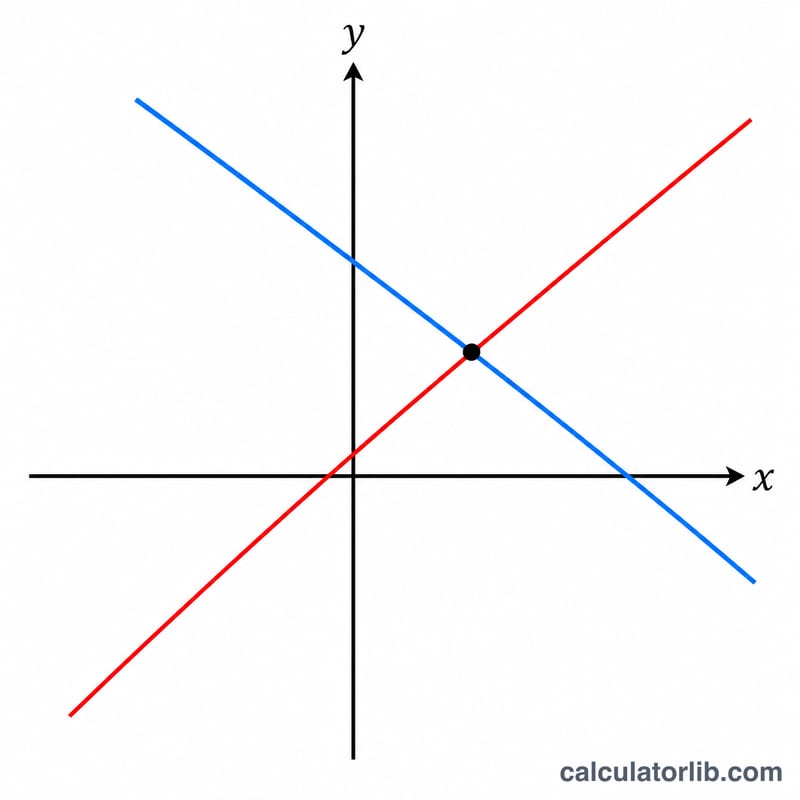
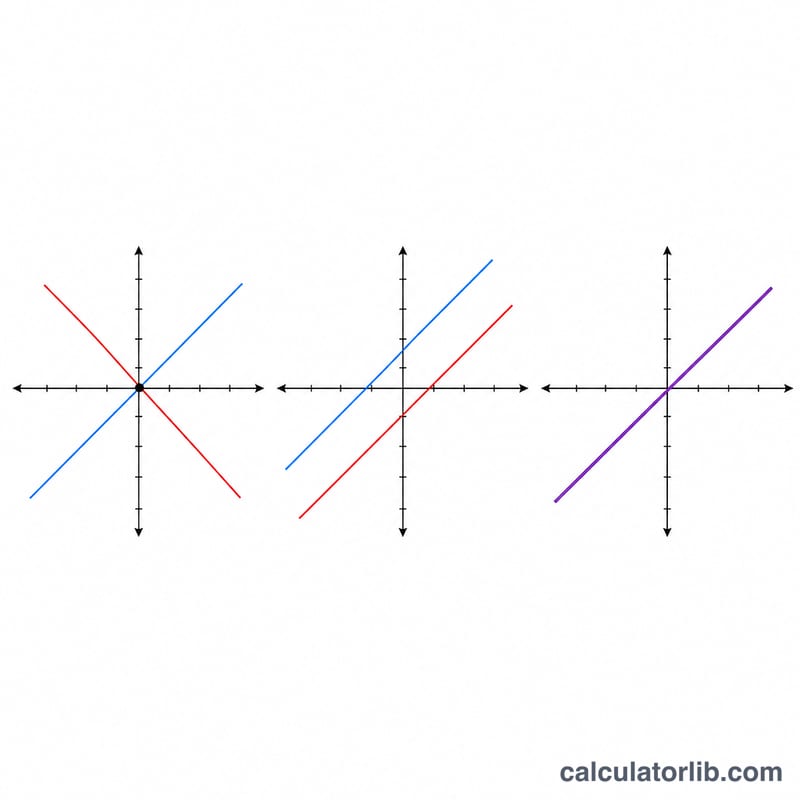
Type the coefficients \(a_1\), \(b_1\) and constant \(c_1\) for the first equation, then \(a_2\), \(b_2\) and \(c_2\) for the second. Press calculate. If the lines intersect at one point, you get the exact \(x\) and \(y\). If the lines are parallel (no solution) or identical (infinitely many solutions), the calculator reports that the determinant is zero and there is no single answer.
The Formula Explained
The method is Cramer's rule. First compute the determinant \(D = a_1b_2 - a_2b_1\). When \(D \neq 0\) the system has exactly one solution given by
$$x = \frac{c_1\,b_2 - c_2\,b_1}{D}, \qquad y = \frac{a_1\,c_2 - a_2\,c_1}{D}$$When \(D = 0\) the two equations describe parallel or overlapping lines, so no unique \((x, y)\) exists.
Worked Example
Solve \(2x + 3y = 8\) and \(x - y = -1\). Here \(a_1=2\), \(b_1=3\), \(c_1=8\), \(a_2=1\), \(b_2=-1\), \(c_2=-1\). The determinant
$$D = (2)(-1) - (1)(3) = -5$$Then
$$x = \frac{8 \cdot -1 - (-1) \cdot 3}{-5} = \frac{-8 + 3}{-5} = \frac{-5}{-5} = 1$$$$y = \frac{2 \cdot -1 - 1 \cdot 8}{-5} = \frac{-2 - 8}{-5} = \frac{-10}{-5} = 2$$So \(x = 1\) and \(y = 2\).
FAQ
What does a zero determinant mean? The two lines are parallel (no solution) or the same line (infinitely many solutions). Either way there is no single \((x, y)\) pair.
Can it handle decimals or negatives? Yes, every coefficient accepts decimal and negative values.
Is this Cramer's rule? Yes — it uses the \(2 \times 2\) determinant form of Cramer's rule, which is exact for two-variable linear systems.