
What this calculator does
This tool solves a system of three linear equations in three unknowns (x, y, z) using Gaussian elimination carried all the way to reduced row echelon form (Gauss-Jordan). It reports the unique solution when one exists, or tells you whether the system has no solution (inconsistent) or infinitely many solutions (dependent).
How to use it
Enter the nine coefficients of the matrix A and the three right-hand-side constants b. Each equation has the form \(a_{i1} x + a_{i2} y + a_{i3} z = b_i\). Press calculate and the calculator returns the solution plus the final reduced matrix so you can follow the elimination.
The method explained
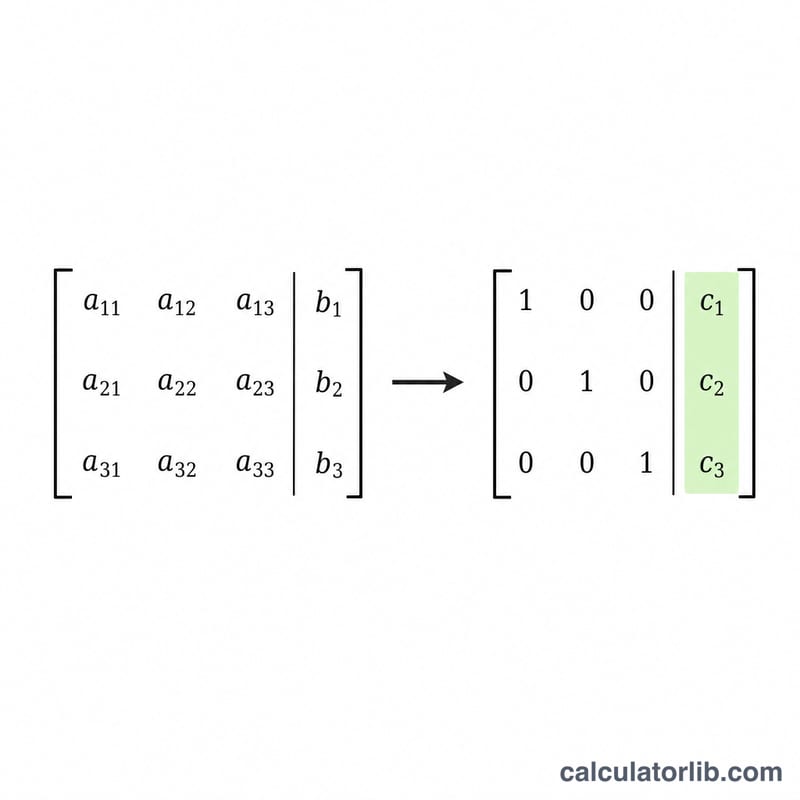
Starting from the augmented matrix \([A \mid b]\), the algorithm selects, in each column, the row with the largest absolute pivot (partial pivoting for numerical stability), normalizes that pivot row, then eliminates the entry in every other row. After processing all three columns the coefficient block becomes the identity matrix when a unique solution exists, and the last column holds (x, y, z). Comparing the rank of A with the rank of \([A \mid b]\) classifies the system.
$$\left[\begin{array}{ccc|c} a_{11} & a_{12} & a_{13} & b_{1} \\ a_{21} & a_{22} & a_{23} & b_{2} \\ a_{31} & a_{32} & a_{33} & b_{3} \end{array}\right] \;\xrightarrow{\text{Gauss-Jordan}}\; \left[\begin{array}{ccc|c} 1 & 0 & 0 & x \\ 0 & 1 & 0 & y \\ 0 & 0 & 1 & z \end{array}\right]$$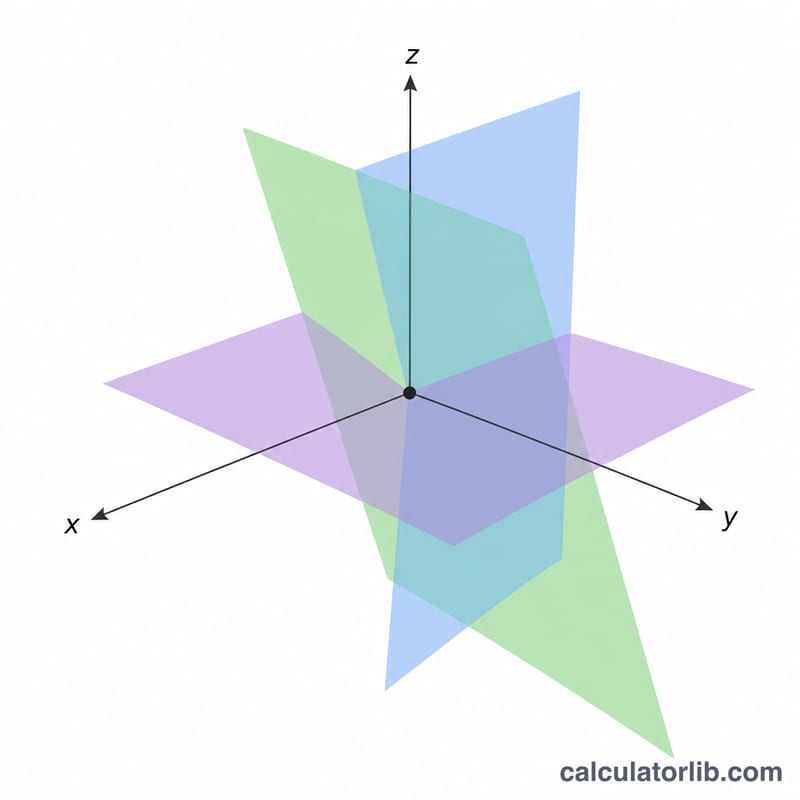
Worked example
Take \(2x + y - z = 8\), \(-3x - y + 2z = -11\), \(-2x + y + 2z = -3\). Elimination yields \(x = 2\), \(y = 3\), \(z = -1\). You can verify:
$$2(2)+3-(-1)=8$$correct.
FAQ
What if there is no unique solution? The result panel will say "No Solution" or "Infinitely Many Solutions" and the status field reflects that.
Does the order of equations matter? No. Partial pivoting reorders rows internally, so the answer is the same regardless of input order.
Can coefficients be decimals or negatives? Yes, any real numbers are allowed.