
What this calculator does
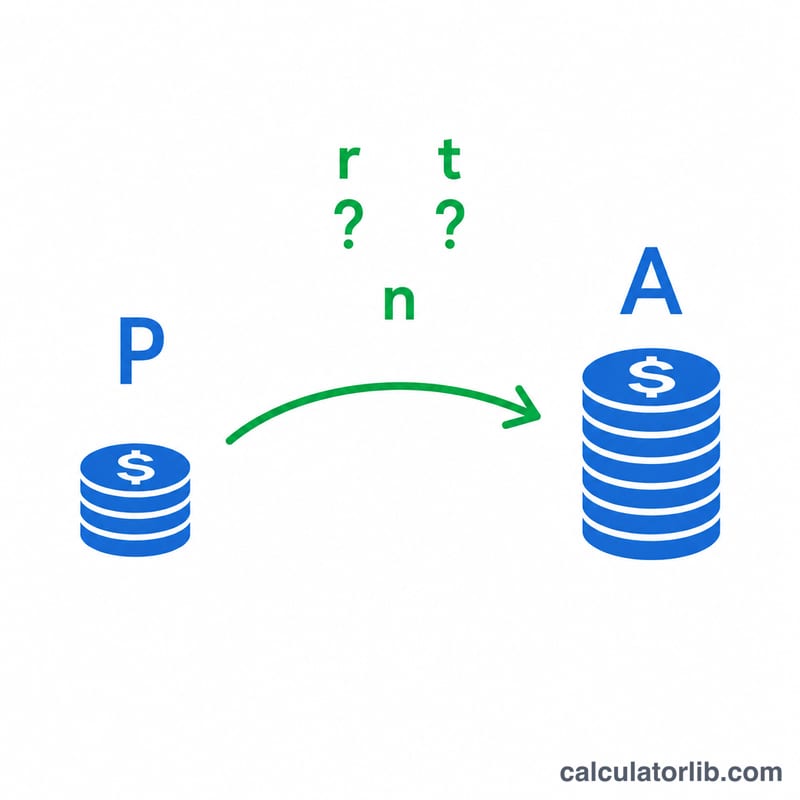
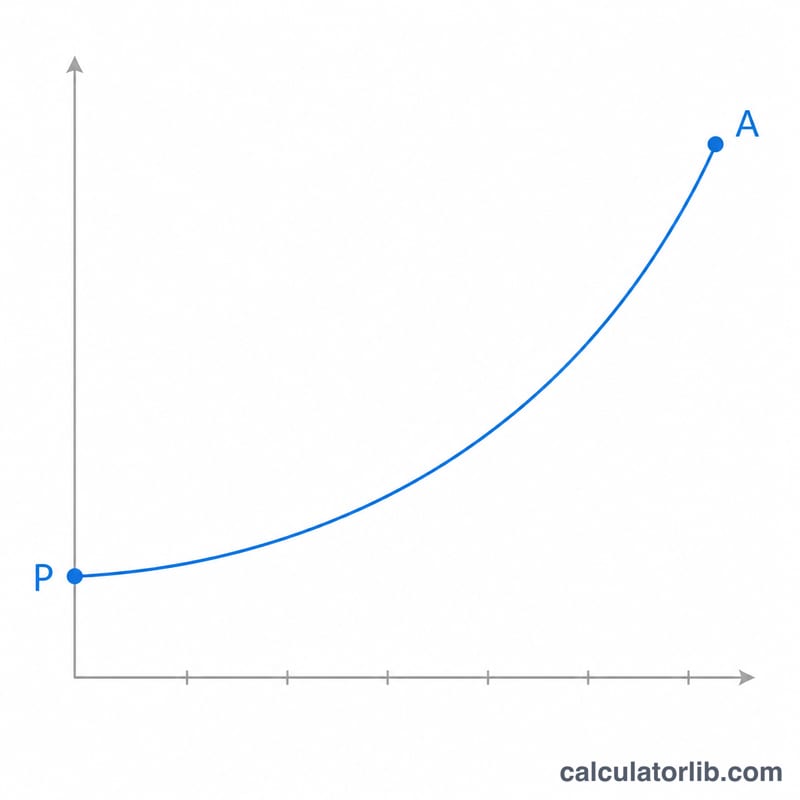
The standard compound interest formula is \( A = P(1 + r/n)^{nt} \), where A is the future amount, P the principal, r the nominal annual rate, n the number of compounding periods per year, and t the number of years. Often you already know two of the growth values and want the missing one. This tool rearranges the equation algebraically so you can solve for either the required interest rate (r) or the time (t).
How to use it
Choose whether you want to solve for the interest rate or for time. Enter the principal (P) and the target future amount (A), and pick how often interest compounds per year (n). If solving for rate, also enter the time in years. If solving for time, enter the annual rate as a percentage. The calculator returns the unknown value.
The formula explained
To solve for the rate, divide A by P, take the (1/(nt))-th root, subtract one, then multiply by n: $$ r = n\left( \left( \frac{A}{P} \right)^{\frac{1}{nt}} - 1 \right) $$ To solve for time, use natural logarithms: $$ t = \frac{\ln(A/P)}{n \cdot \ln(1 + r/n)} $$ Both come directly from rearranging \( A = P(1 + r/n)^{nt} \).
Worked example
Suppose 1,000 grows to 2,000 with monthly compounding (n = 12) over 10 years. The rate is $$ r = 12 \times \left( (2000/1000)^{1/120} - 1 \right) = 12 \times \left( 2^{1/120} - 1 \right) \approx 0.06949 $$ or about 6.95% per year.
FAQ
Is the rate nominal or effective? It is the nominal annual rate compounded n times per year, the same r used in \( (1 + r/n)^{nt} \).
Why must A be greater than P to solve for time? Logarithms require positive arguments; if A equals P the time is zero, and growth only occurs when A exceeds P with a positive rate.
Does this account for deposits or fees? No — it models a single lump sum with no contributions, withdrawals, taxes or fees.