
What is the Sum of Odd Numbers Calculator?
This tool computes the sum of the first n consecutive odd numbers: 1, 3, 5, 7, … up to the n-th odd number. Instead of adding them one by one, it uses a beautiful and well-known result from mathematics: the sum of the first n odd numbers is always a perfect square, exactly equal to \(n^{2}\).
How to use it
Enter how many odd numbers you want to add (n) and press calculate. The calculator returns the total along with the count and the value of the last odd number used (\(2n - 1\)). For example, with n = 5 you are summing \(1 + 3 + 5 + 7 + 9\).
The formula explained
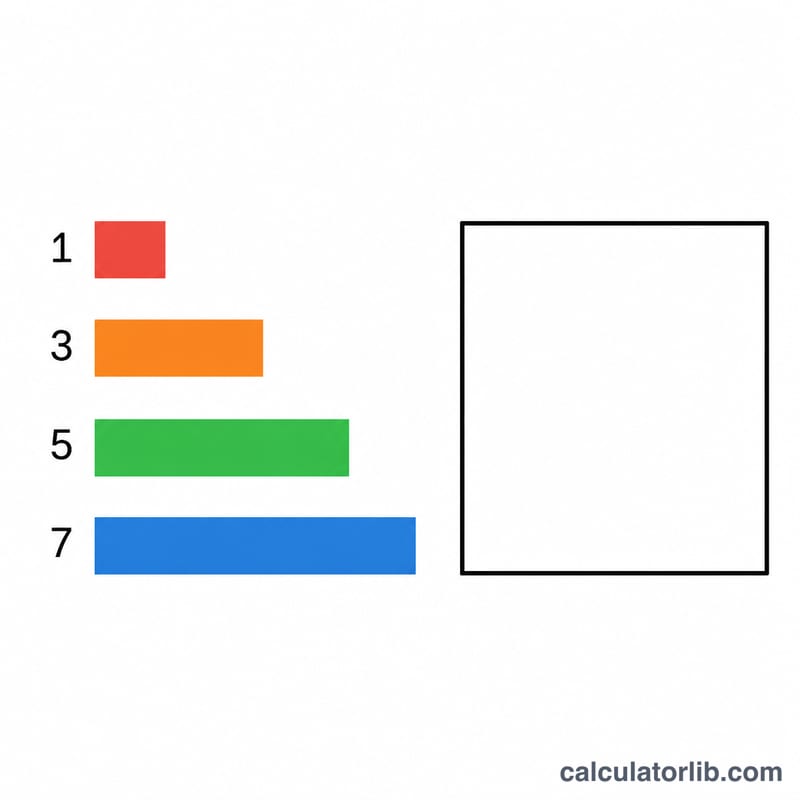
The identity is written as $$\sum_{k=1}^{n} (2k-1) = n^{2}$$ The k-th odd number is \(2k - 1\), so the series begins at 1 (k=1) and the last term is \(2n - 1\). A neat geometric proof: each new odd number adds an L-shaped layer to a growing square, so after n layers you have an n×n square — exactly \(n^{2}\) unit cells.

Worked example
Take n = 10. The first ten odd numbers are 1, 3, 5, 7, 9, 11, 13, 15, 17, 19. Adding them directly gives 100. Using the shortcut, $$n^{2} = 10^{2} = 100.$$ The last odd number is \(2(10) - 1 = 19\). Both methods agree.
FAQ
Does this work for the sum of even numbers? No — the sum of the first n even numbers is \(n(n + 1)\), a different formula.
What if n = 0? The sum of zero odd numbers is 0, since \(0^{2} = 0\).
Why is the answer always a perfect square? Because \(n^{2}\) is by definition a perfect square; this identity is one of the classic visual proofs in mathematics.