
What is the sum of a geometric sequence?
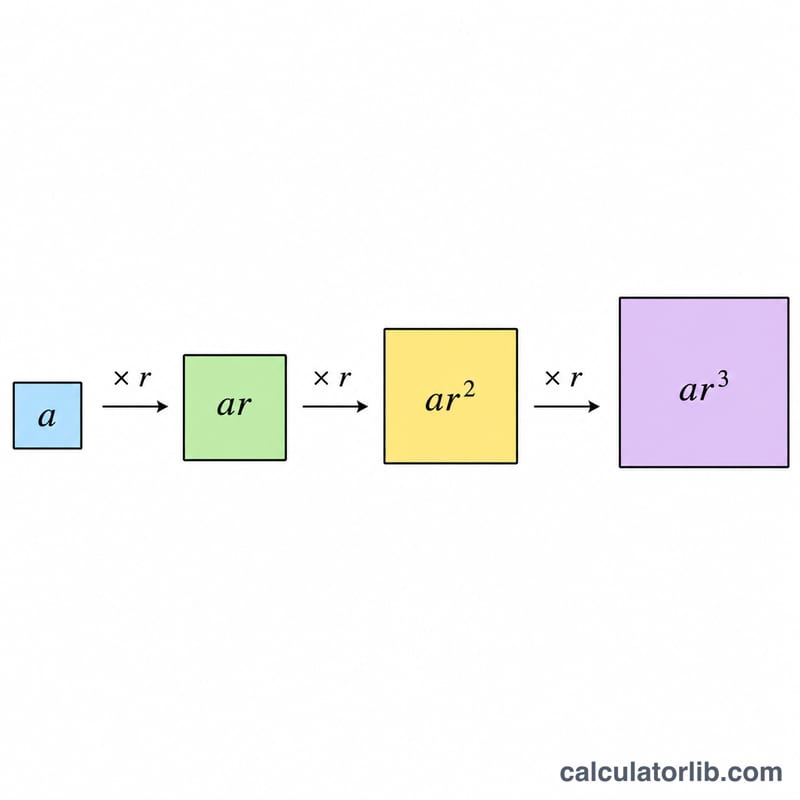
A geometric sequence is a list of numbers where each term is found by multiplying the previous term by a fixed number called the common ratio (\(r\)). For example, 2, 6, 18, 54 is geometric with first term \(a_1 = 2\) and ratio \(r = 3\). The sum of the first n terms is called a partial sum, written \(S_n\). This calculator computes \(S_n\) instantly from \(a_1\), \(r\), and \(n\).
How to use this calculator
Enter three values: the first term (\(a_1\)), the common ratio (\(r\)), and the number of terms you want to add (\(n\)). The calculator returns the total sum, the last term \(a_n\), and confirms how many terms were summed. Both positive and negative ratios, as well as fractions and decimals, are supported.
The formula explained
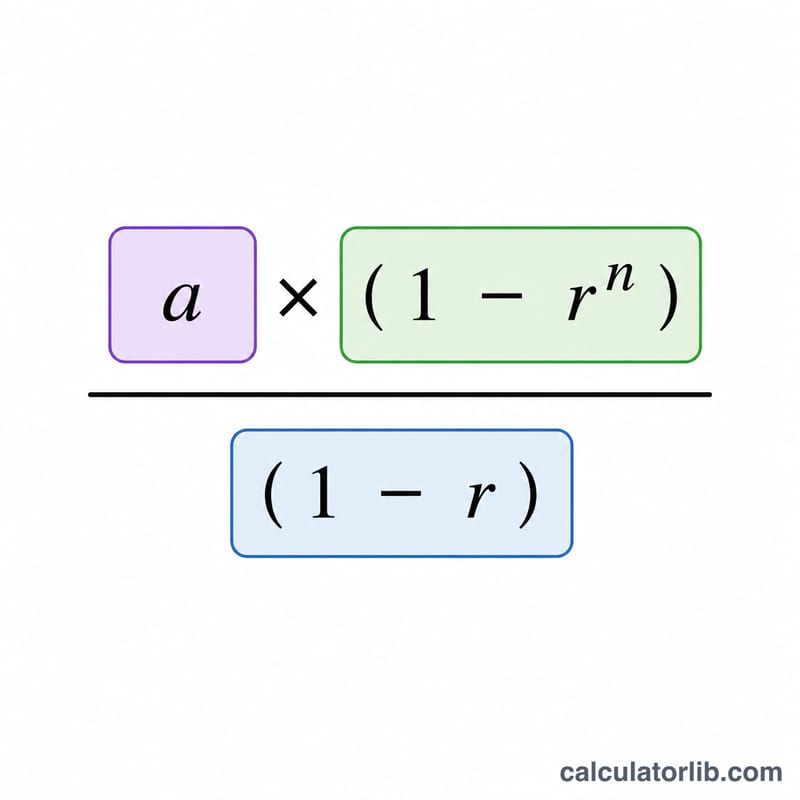
When \(r \neq 1\), the closed-form formula is $$S_n = a_1 \cdot \frac{1 - r^n}{1 - r}$$ It is derived by writing the sum, multiplying it by \(r\), and subtracting the two expressions so that almost every term cancels. When \(r = 1\), every term is identical to \(a_1\), so the sum is simply \(S_n = a_1 \times n\) and the standard formula cannot be used (it would divide by zero). This calculator automatically handles the \(r = 1\) case.
Worked example
Suppose \(a_1 = 2\), \(r = 3\), and \(n = 5\). Then \(r^n = 3^5 = 243\), so $$S_n = \frac{2(1 - 243)}{1 - 3} = \frac{2(-242)}{-2} = 242$$ You can verify by adding the terms: \(2 + 6 + 18 + 54 + 162 = 242\). The last term \(a_n = 2 \times 3^4 = 162\).
FAQ
What if the ratio is between −1 and 1? The formula still works for any finite \(n\). For an infinite sum with \(|r| < 1\), use \(S = \frac{a_1}{1 - r}\) instead.
Can the ratio be negative? Yes. A negative ratio produces an alternating sequence, and the formula handles it correctly.
What happens when r = 1? The sequence is constant, so \(S_n = a_1 \times n\). The calculator detects this automatically to avoid dividing by zero.