
What Is Compound Interest?
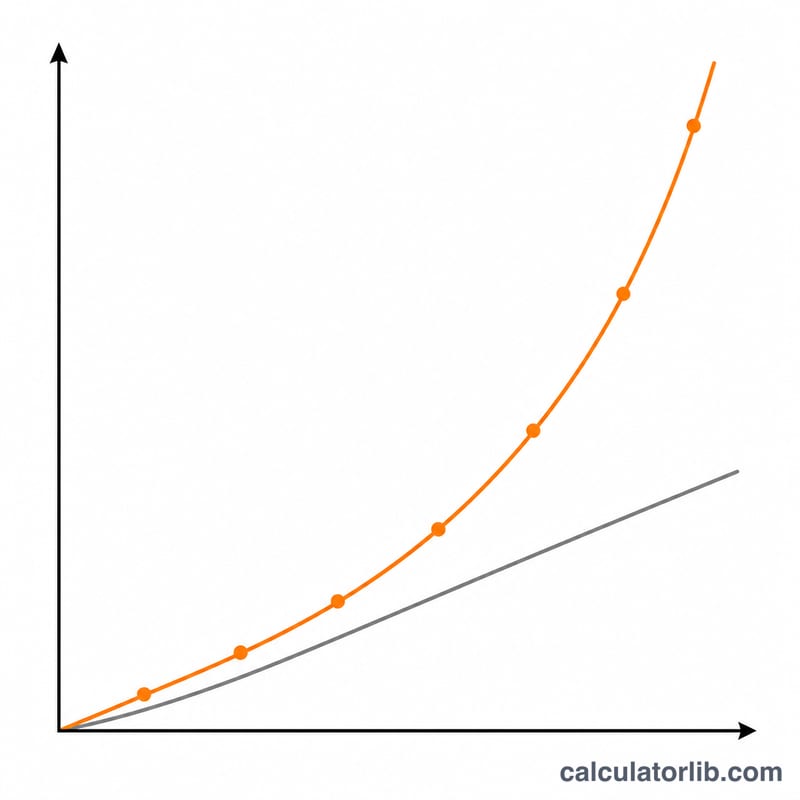
Compound interest is interest calculated on both your original deposit and the interest that has already accumulated. Because each period's interest is added back to the balance, your savings grow faster than with simple interest — the "interest on interest" effect. This calculator works for any currency and is not tied to a specific country.
How to Use This Calculator
Enter your initial deposit (principal), the annual interest rate as a percentage, the number of years you plan to save, and how often interest compounds (monthly, daily, annually, etc.). The tool returns your future balance and the total interest you will have earned.
The Formula Explained
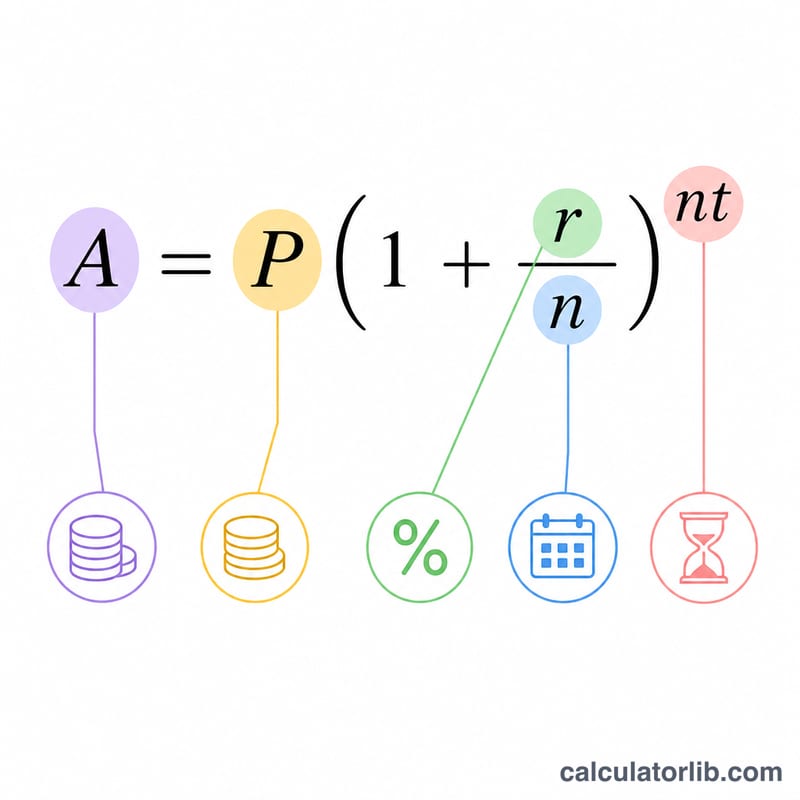
The standard compound interest formula is $$A = P \times \left(1 + \frac{r}{n}\right)^{n\cdot t}$$ where A is the final amount, P is the principal, r is the annual rate written as a decimal (5% = 0.05), n is the number of compounding periods per year, and t is the time in years. The interest earned is simply \(I = A - P\). A higher compounding frequency (\(n\)) produces a slightly larger balance for the same rate.
Worked Example
Suppose you deposit $10,000 at 5% annual interest, compounded monthly, for 10 years. Here \(n = 12\) and \(r = 0.05\). Then $$A = 10{,}000 \times \left(1 + \frac{0.05}{12}\right)^{12\times 10} = 10{,}000 \times (1.0041667)^{120} \approx \$16{,}470.09$$ The interest earned is about $6,470.09 on top of your original $10,000.
FAQ
Does more frequent compounding always pay more? Yes, but with diminishing returns. Daily versus monthly compounding makes only a small difference at typical savings rates.
What rate should I enter? Use the nominal annual interest rate (APR). The calculator converts it to a per-period rate using your chosen frequency.
Does this include regular contributions? No — this version assumes a single lump-sum deposit with no additional payments.