
What this calculator does
The Multiply Fractions Calculator multiplies two fractions and returns the answer in lowest terms, along with the unsimplified product and a decimal approximation. Multiplying fractions is one of the simplest fraction operations because — unlike addition — you do not need a common denominator.
How to use it
Enter the numerator and denominator of each fraction, then read the result. The tool accepts negative whole numbers too, so it works for signed fractions. Denominators must not be zero (a zero denominator is undefined), so the calculator guards against it.
The formula explained
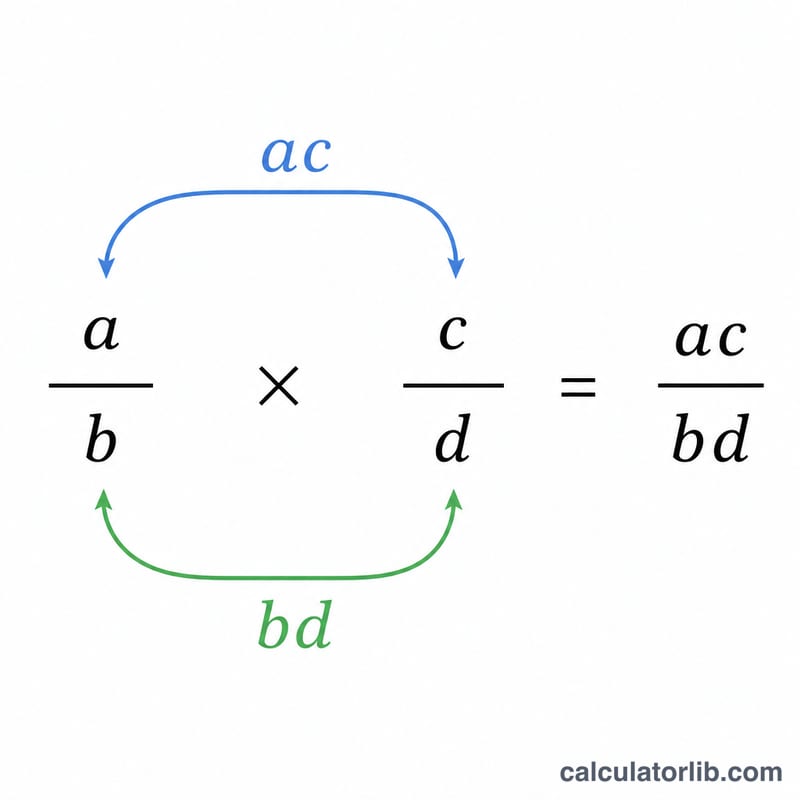
To multiply two fractions, multiply the top numbers (numerators) together and the bottom numbers (denominators) together:
$$\frac{a}{b} \times \frac{c}{d} = \frac{a \cdot c}{b \cdot d}$$
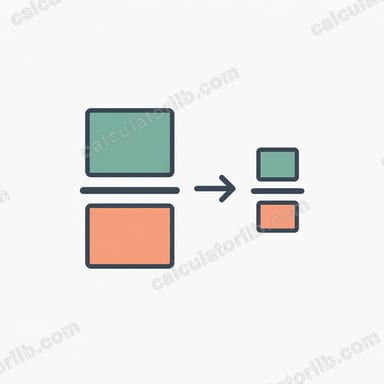
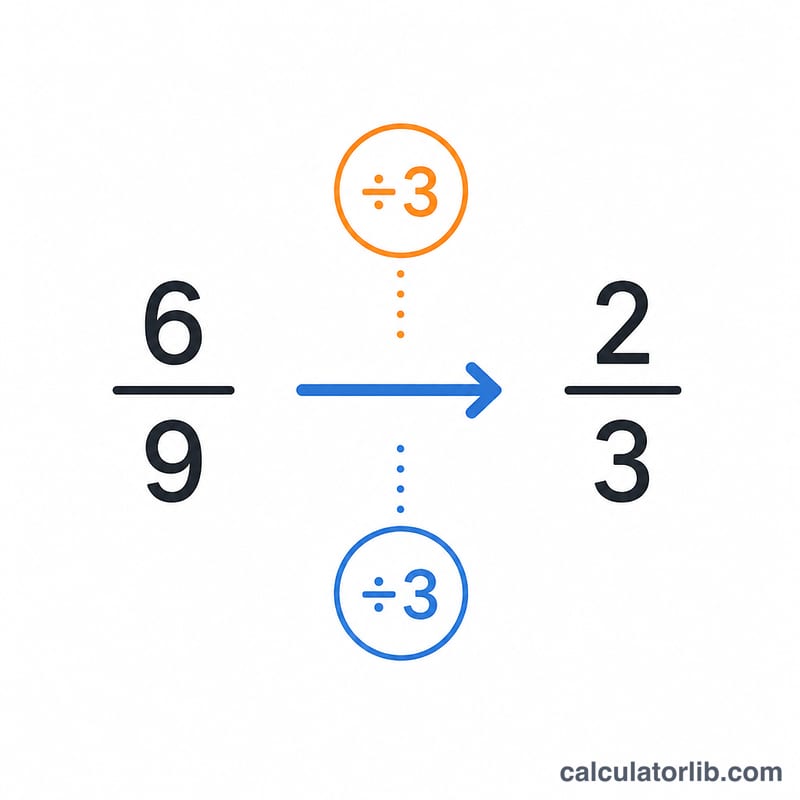
Then simplify by dividing both the new numerator and denominator by their greatest common divisor (GCD). The sign of the result is positive if both fractions have the same sign and negative otherwise.
Worked example
Multiply \(\frac{2}{3} \times \frac{3}{4}\). Numerators: \(2 \times 3 = 6\). Denominators: \(3 \times 4 = 12\). The raw product is \(\frac{6}{12}\). The GCD of 6 and 12 is 6, so dividing both gives \(\frac{1}{2}\). As a decimal that is \(0.5\).
FAQ
Do I need a common denominator to multiply fractions? No. Common denominators are only required for addition and subtraction. For multiplication you simply multiply straight across.
How is the answer simplified? The calculator computes the greatest common divisor of the product's numerator and denominator and divides both by it, giving the fraction in lowest terms.
What about mixed numbers? Convert a mixed number to an improper fraction first. For example, \(1\tfrac{1}{2}\) becomes \(\frac{3}{2}\), then enter 3 and 2.