
What is the circle area moment of inertia?
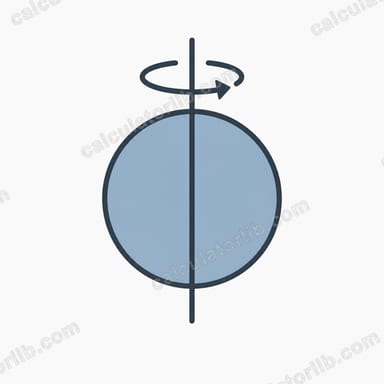
The area moment of inertia (also called the second moment of area) describes how the cross-sectional area of a shape is distributed about an axis. For a solid circular cross-section — such as a round shaft, pin, or rod — it governs the section's resistance to bending and deflection. This calculator computes the moment of inertia about a centroidal axis (a diameter line through the center).
How to use this calculator
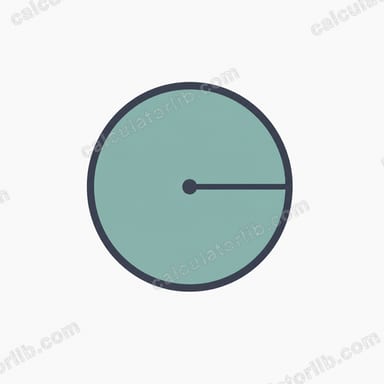
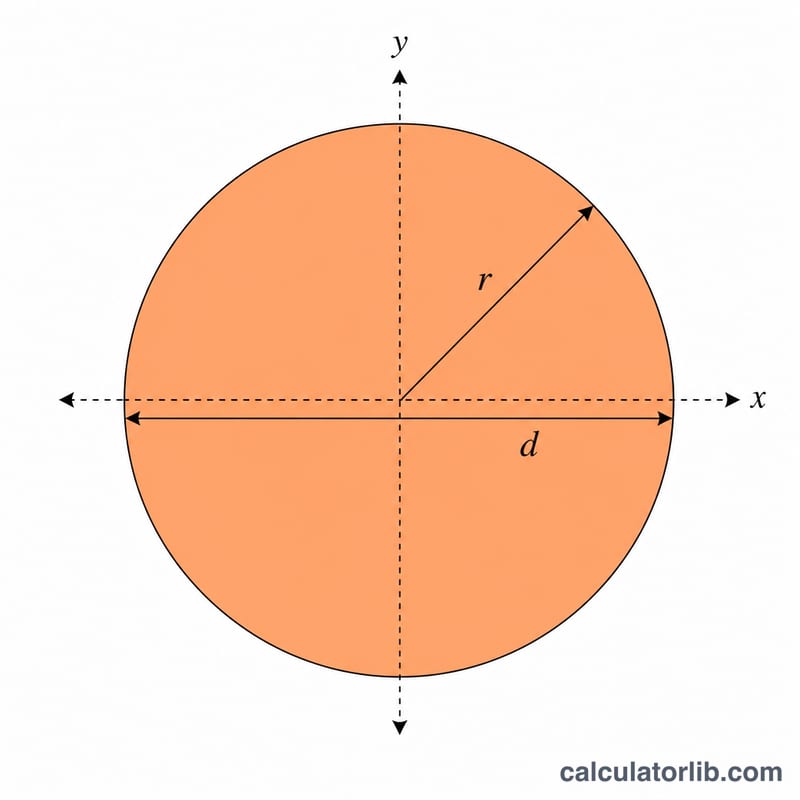
Choose whether you want to enter the radius or the diameter of the circle, type the dimension in millimetres, and submit. The tool returns the area moment of inertia in mm⁴, along with the matching radius, diameter, and the section modulus \(S = I/r\), which is handy for bending-stress checks.
The formula explained
For a solid circle, the moment of inertia about any centroidal axis is:
$$I = \frac{\pi r^{4}}{4} = \frac{\pi d^{4}}{64}$$
Because the radius is raised to the fourth power, the value is extremely sensitive to size: doubling the radius increases I by a factor of 16. The two forms are identical since \(d = 2r\), so \(d^{4} = 16r^{4}\) and \(\pi(16r^{4})/64 = \pi r^{4}/4\).
Worked example
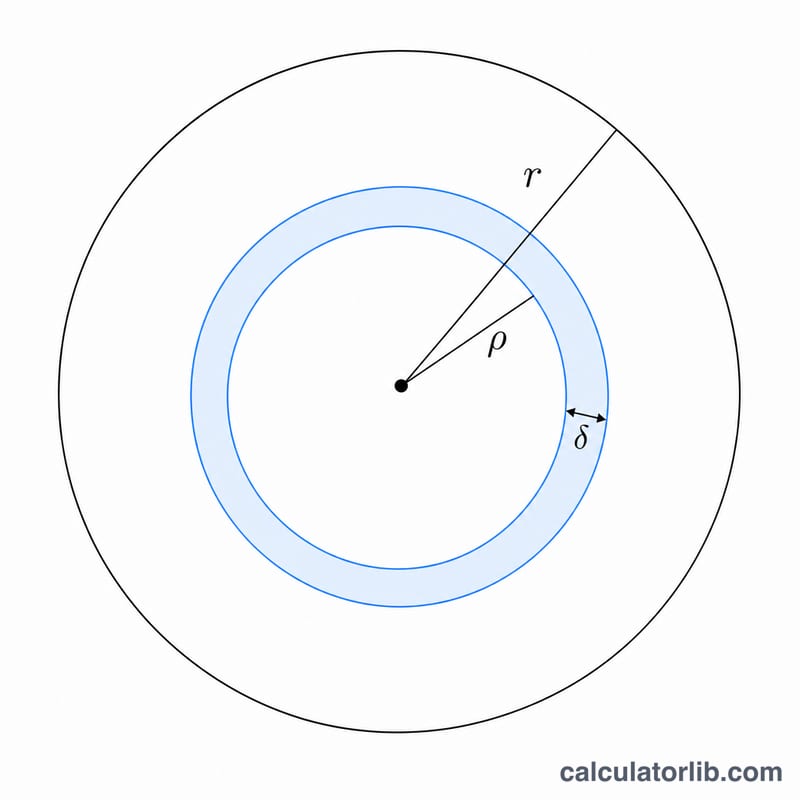
Take a shaft with radius \(r = 50\) mm. Then $$I = \frac{\pi \times 50^{4}}{4} = \frac{\pi \times 6{,}250{,}000}{4} \approx 4{,}908{,}738.5 \text{ mm}^4.$$ The section modulus is \(S = I / r \approx 98{,}174.8\) mm³.
FAQ
Is this the area or mass moment of inertia? This is the area moment of inertia (units mm⁴), used in beam-bending and structural analysis — not the mass moment of inertia (units kg·m²) used in rotational dynamics.
What axis is it about? A centroidal axis passing through the circle's center. For a circle, I is the same about every diameter due to symmetry.
How do I get the polar moment of inertia J? For a circle, \(J = 2I = \frac{\pi r^{4}}{2} = \frac{\pi d^{4}}{32}\), used for torsion calculations.