
What this calculator does
The Multiplying Fractions Calculator multiplies two fractions and returns the product reduced to its lowest terms, along with the equivalent decimal value. It works with positive and negative integer numerators and denominators, making it handy for homework, recipes, woodworking measurements, and any task that mixes fractional quantities.
How to use it
Enter the first fraction as a numerator (a) over a denominator (b), then the second fraction as numerator (c) over denominator (d). Press calculate and you'll see the raw product, the simplified fraction, and the decimal equivalent. Denominators cannot be zero — a zero denominator makes a fraction undefined.
The formula explained
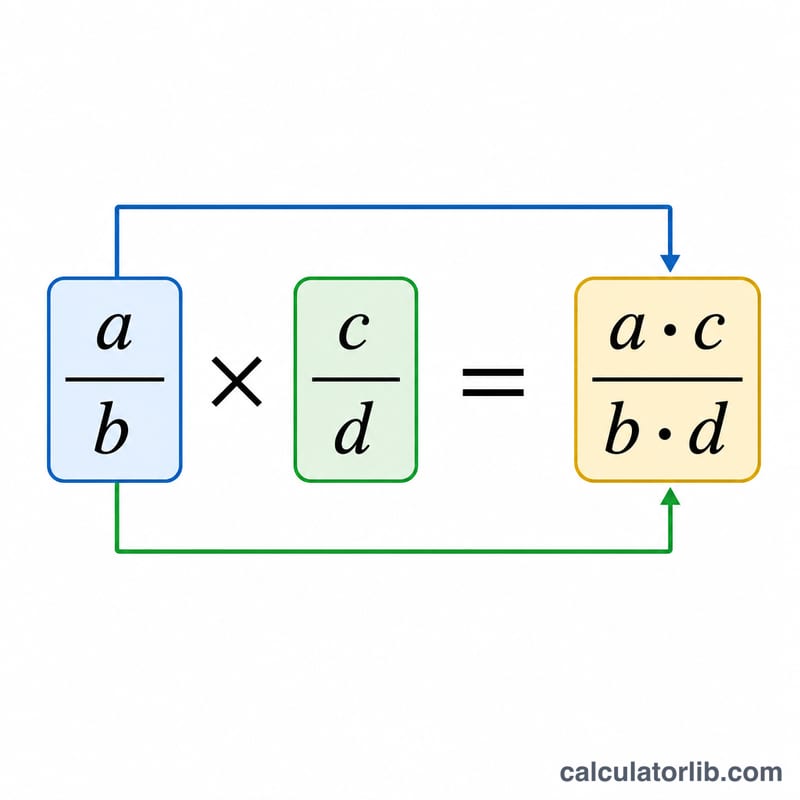
Multiplying fractions is the simplest of the four fraction operations: you multiply straight across. The new numerator is the product of the two numerators \(a \cdot c\) and the new denominator is the product of the two denominators \(b \cdot d\). The result is then simplified by dividing both parts by their greatest common divisor (GCD):
$$\frac{a}{b} \times \frac{c}{d} = \frac{a \cdot c}{b \cdot d}$$, then reduce by the GCD.
Worked example
Multiply 2/3 by 3/4. Multiply across: numerators \(2 \times 3 = 6\), denominators \(3 \times 4 = 12\), giving 6/12. The GCD of 6 and 12 is 6, so divide both by 6 to get 1/2, which equals 0.5 as a decimal.
$$\frac{2}{3} \times \frac{3}{4} = \frac{2 \times 3}{3 \times 4} = \frac{6}{12} = \frac{1}{2} = 0.5$$
FAQ
Do I need a common denominator? No — unlike adding or subtracting fractions, multiplication does not require a common denominator. You multiply numerators and denominators directly.
How are negative fractions handled? A negative sign on either fraction makes the product negative. The calculator keeps the sign on the numerator and shows a positive denominator.
What about whole numbers? Write a whole number \(n\) as \(\frac{n}{1}\). For example, \(5 \times \frac{2}{3} = \frac{5}{1} \times \frac{2}{3} = \frac{10}{3}\).