
What this calculator does
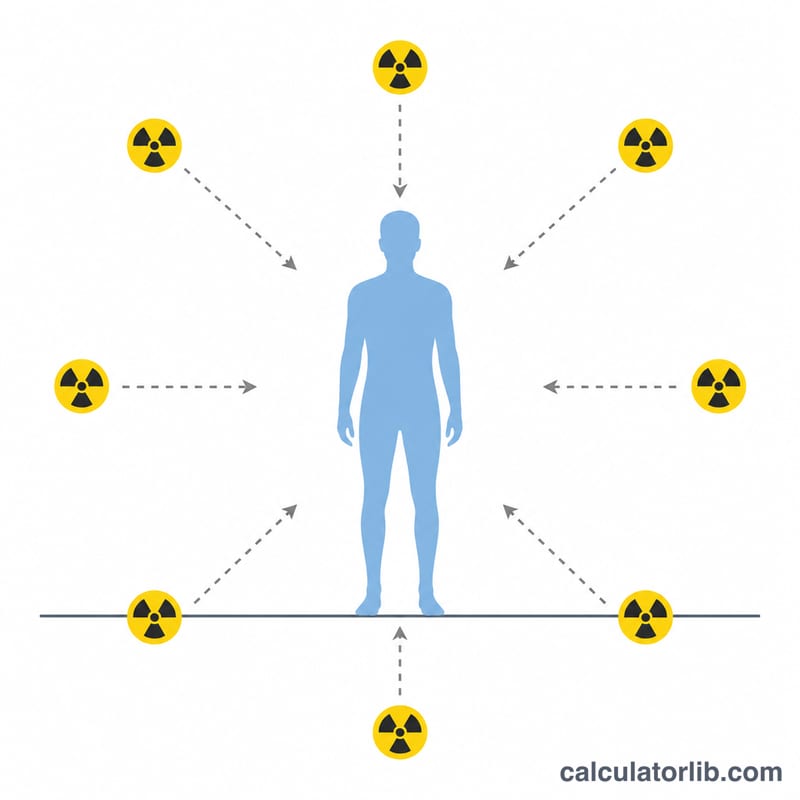
This tool converts a measured ambient radiation dose rate (for example from radioactivity in the air or on the ground surface) into an accumulated external effective dose over a chosen number of days. It became widely used after the 2011 Fukushima accident, but the underlying dosimetry is universal. Because these conditions are gamma external exposure, the radiation-weighting factor is taken as 1, so 1 gray of air dose equals 1 sievert of effective dose.
How to use it
Enter your measured dose rate and pick its unit (microsievert per hour is the usual reading from a survey meter). Enter the number of days over which the exposure builds up. Finally choose how many hours per day you spend outdoors. Each option is an occupancy factor that already includes the assumption that indoor dose is about 40% of the outdoor dose, which reflects a typical wooden house.
The formula explained
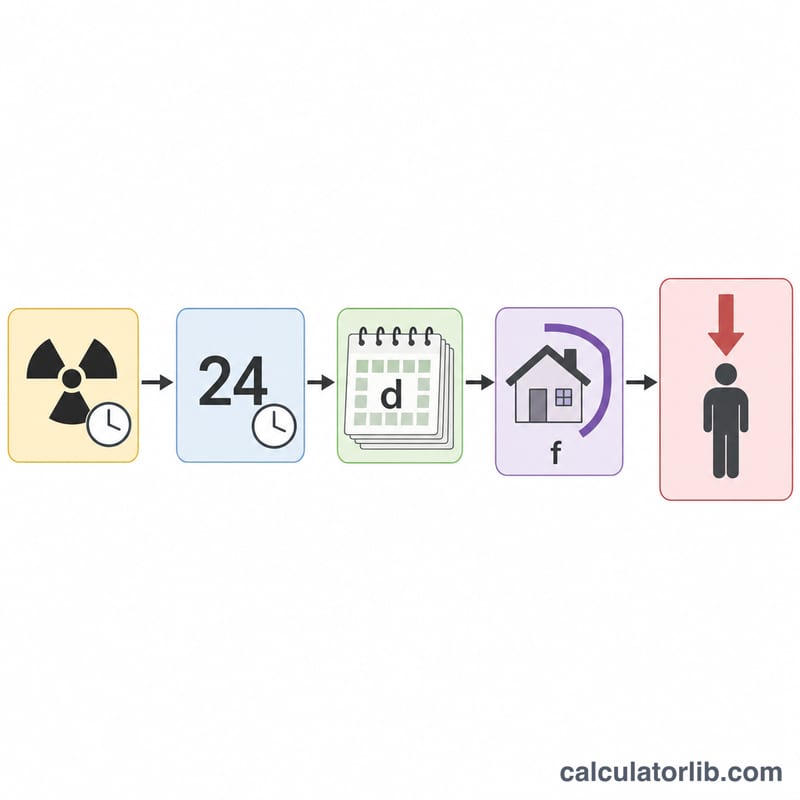
The base dose for hypothetical 24-hour-a-day outdoor occupancy is \(\text{rate} \times 24 \times \text{days}\). We then scale it by the occupancy factor \(f\). The four presets are 1.0 (24 h outdoors), 0.7 (12 h), 0.6 (8 h) and 0.5 (4 h). They come from $$f = \frac{h + 0.4(24 - h)}{24},$$ so 12 hours gives \((12 + 0.4 \times 12)/24 = 0.70\) and 8 hours gives \((8 + 0.4 \times 16)/24 = 0.60\).
Worked example
Suppose the dose rate is 0.2 microSv/h, over 30 days, spending about 8 hours a day outdoors (factor 0.6). The rate in Sv/h is \(2.0 \times 10^{-7}\). The 24h raw dose is $$2.0 \times 10^{-7} \times 24 \times 30 = 1.44 \times 10^{-4}\ \text{Sv} = 0.144\ \text{mSv}.$$ Applying 0.6 gives \(8.64 \times 10^{-5}\ \text{Sv} = 0.0864\ \text{mSv} = 86.4\ \text{microSv}\).
FAQ
How do I get a yearly dose? Set the number of days to 365. A continuous 0.2 microSv/h with factor 1.0 gives about 1.75 mSv/year, the well-known rule of thumb.
Why is the result so small? External doses from low ambient rates accumulate slowly, so we also show the value in millisieverts and microsieverts to avoid scientific-notation-only display.
Can I edit the 40% indoor figure? No, the four presets bake it in. If you need a custom split, use $$f = \frac{h + 0.4(24 - h)}{24}.$$