
What is the Revised Trauma Score?
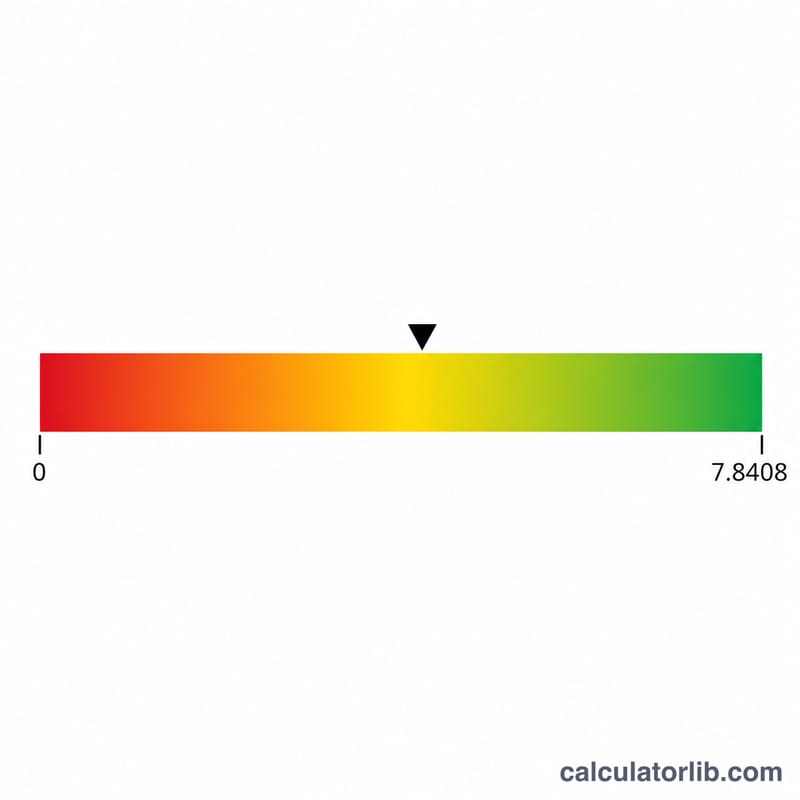
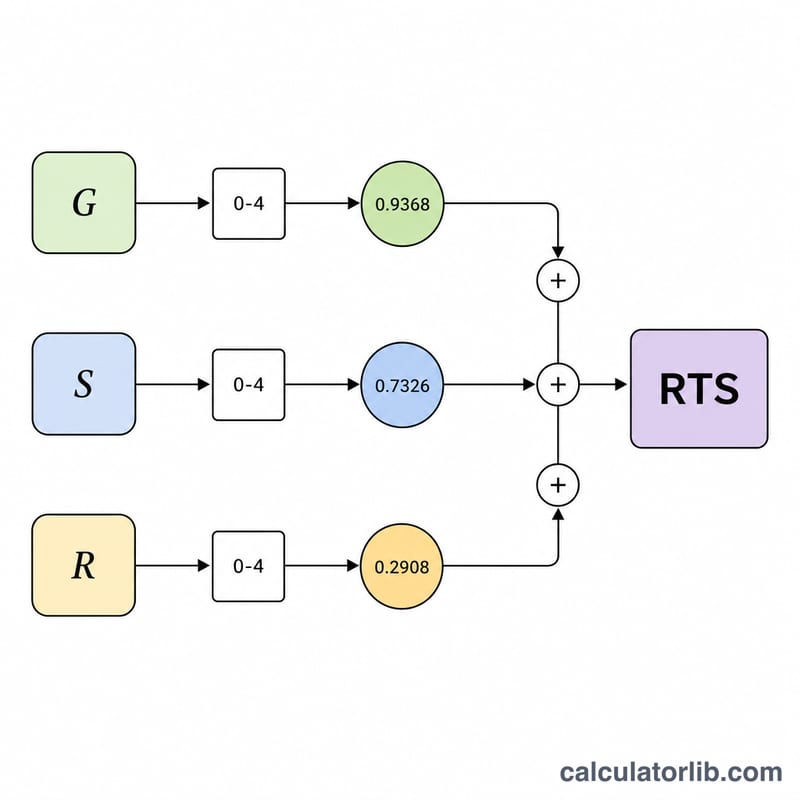
The Revised Trauma Score (RTS) is a physiologic scoring system used in emergency medicine and trauma triage to quantify the severity of injury based on three vital parameters: the Glasgow Coma Scale (GCS), systolic blood pressure (SBP), and respiratory rate (RR). Each parameter is converted to a coded value from 0 to 4, then combined into a weighted sum. The score ranges from 0 (worst, incompatible with life) to 7.8408 (best, normal physiology).
How to use this calculator
Enter the patient's Glasgow Coma Scale (3–15), systolic blood pressure in mmHg, and respiratory rate in breaths per minute. The calculator assigns each value a coded score from 0 to 4 using standard RTS thresholds and then computes the weighted total. Higher scores indicate a better prognosis.
The formula explained
$$\text{RTS} = 0.9368 \cdot c_{\text{GCS}} + 0.7326 \cdot c_{\text{SBP}} + 0.2908 \cdot c_{\text{RR}}$$ The coding tables are: GCS 13–15→4, 9–12→3, 6–8→2, 4–5→1, 3→0; SBP >89→4, 76–89→3, 50–75→2, 1–49→1, 0→0; RR 10–29→4, >29→3, 6–9→2, 1–5→1, 0→0. The weights reflect each variable's relative contribution to survival outcomes.
Worked example
A severe-trauma patient has GCS 7, SBP 70 mmHg, and RR 35 breaths/min. GCS 7 codes to 2, SBP 70 codes to 2, RR 35 codes to 3. $$\text{RTS} = 0.9368 \times 2 + 0.7326 \times 2 + 0.2908 \times 3 = 1.8736 + 1.4652 + 0.8724 = \mathbf{4.2112}$$ A normal patient (GCS 15, SBP 120, RR 18) scores 4+4+4 → \(0.9368 \times 4 + 0.7326 \times 4 + 0.2908 \times 4 = 7.8408\).
FAQ
Is a higher or lower RTS better? A higher RTS is better — 7.8408 is normal physiology and 0 is the worst possible state.
What's the difference between RTS and the Triage RTS? The Triage RTS (T-RTS) simply sums the three coded values (0–12) for rapid field triage, while the weighted RTS shown here is used for outcome prediction and research.
Can this replace clinical judgment? No. The RTS is a decision-support tool and should be used alongside full clinical assessment, not as a substitute for it.