
What is the MEWS Score?
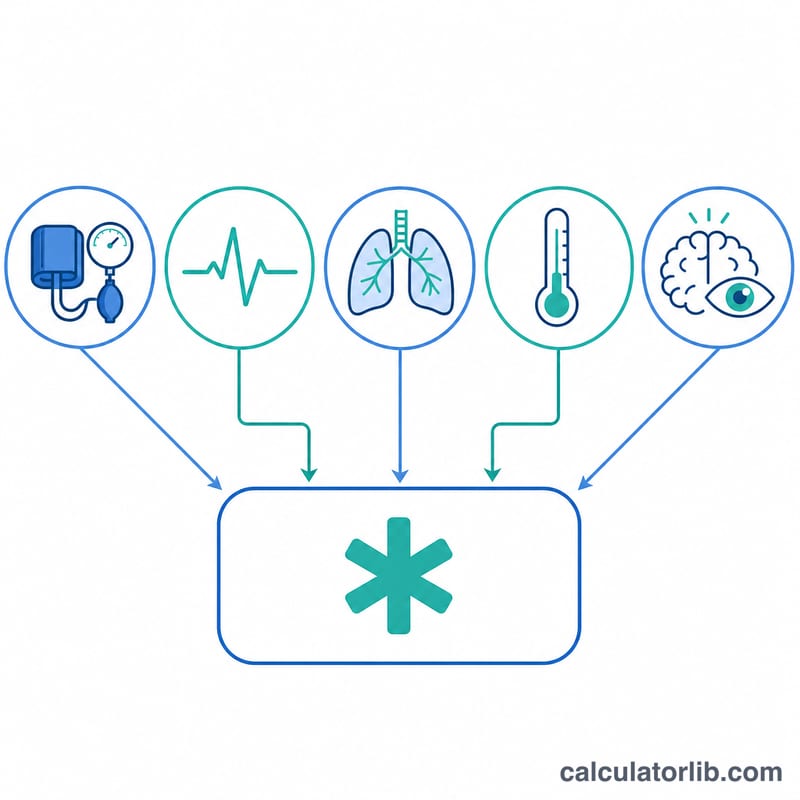
The Modified Early Warning Score (MEWS) is a bedside physiological scoring tool used by clinical staff to identify patients at risk of deterioration. It assigns points (0–3) to five routine observations — systolic blood pressure, heart rate, respiratory rate, temperature and conscious level (AVPU) — and sums them. A higher total flags greater clinical concern and may trigger escalation to a senior clinician or critical-care outreach team. MEWS is widely used internationally and is not specific to any one country.
How to use this calculator
Enter the patient's most recent vital signs and select their AVPU conscious level. The calculator bands each value, displays the points awarded for every parameter, and totals them into the MEWS score. Use it alongside your local escalation protocol — many hospitals act on a total of 4–5 or more, or on any single parameter scoring 3.
The formula
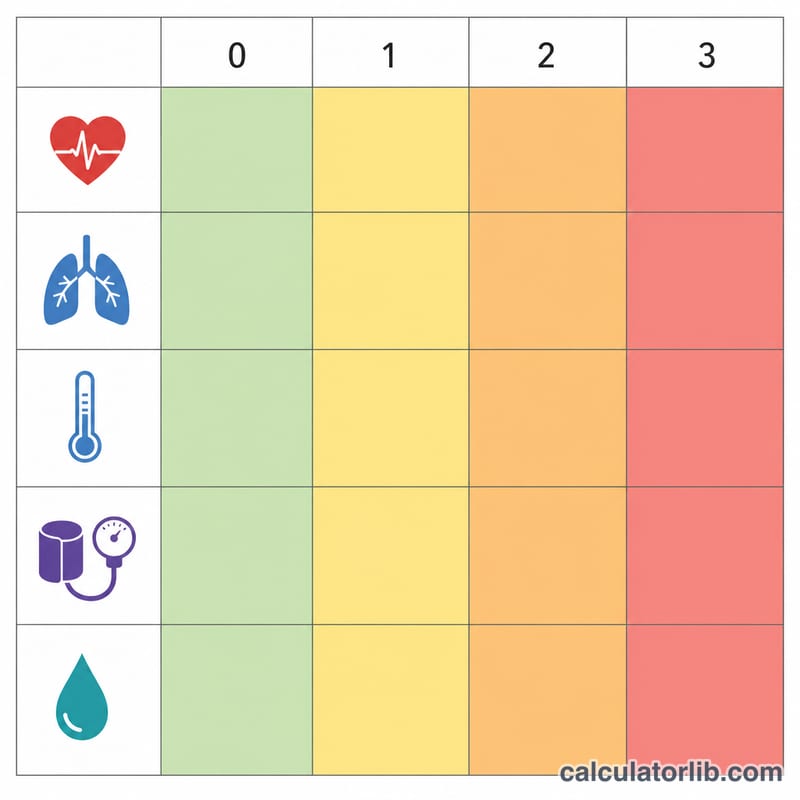
$$\text{MEWS} = P_{\text{SBP}} + P_{\text{HR}} + P_{\text{RR}} + P_{\text{Temp}} + P_{\text{AVPU}}$$ Each parameter is scored against published bands. For example heart rate scores 0 for 51–100, 1 for 41–50 or 101–110, 2 for <40 or 111–129, and 3 for ≥130.
Worked example
A critically unwell, unresponsive patient: SBP 65 (3 points), HR 132 (3 points), RR 32 (3 points), Temp 34.5 °C (2 points), AVPU = Unresponsive (3 points). Wait — total = \(3+3+3+2+3 = 14\)? Using HR 120 instead (2 points) gives \(3+2+3+2+3 = 13\), a more typical severe presentation. Always recheck individual banding.
FAQ
What MEWS score is dangerous? Thresholds vary, but a total of 4–5 or higher, or any single parameter of 3, commonly prompts urgent review.
Does MEWS replace clinical judgement? No. It is a screening aid; act on clinical concern even if the score is low.
Which version is this? A common 5-parameter MEWS using AVPU. Local variants (e.g. NEWS2) may differ in bands and parameters.