
What Is the MELD Score?
The MELD (Model for End-Stage Liver Disease) score is a numerical scale, originally from 6 to 40, used to assess the severity of chronic liver disease. It was adopted by transplant organizations such as UNOS to prioritize patients on liver transplant waiting lists. A higher MELD score indicates more severe disease and a higher estimated short-term mortality risk. This calculator implements the original MELD formula based on three laboratory values.
How to Use It
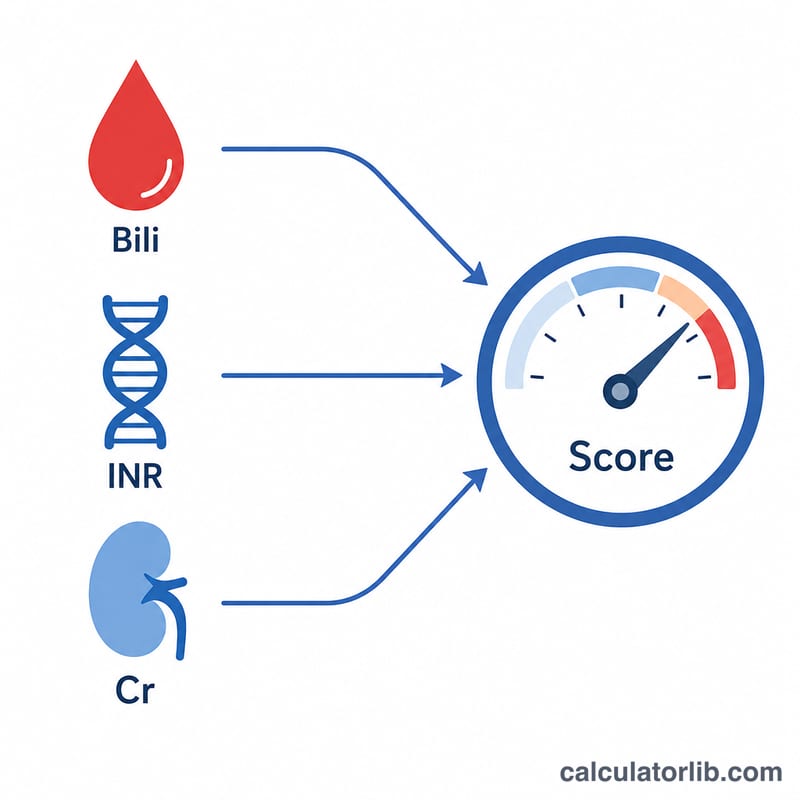
Enter the patient's total serum bilirubin (mg/dL), INR (international normalized ratio for prothrombin time), and serum creatinine (mg/dL). Press calculate to get the rounded MELD score. By convention, any lab value below 1.0 is set to 1.0 to avoid negative logarithms, creatinine is capped at 4.0 mg/dL, and the final score is bounded between 6 and 40.
The Formula Explained
$$\text{MELD} = 3.78\ln\!\left(\text{bilirubin}\right) + 11.2\ln\!\left(\text{INR}\right) + 9.57\ln\!\left(\text{creatinine}\right) + 6.43$$ The natural logarithm (\(\ln\)) dampens the effect of very high values, and the weighting coefficients reflect each variable's contribution to mortality risk derived from the original survival model.
Worked Example
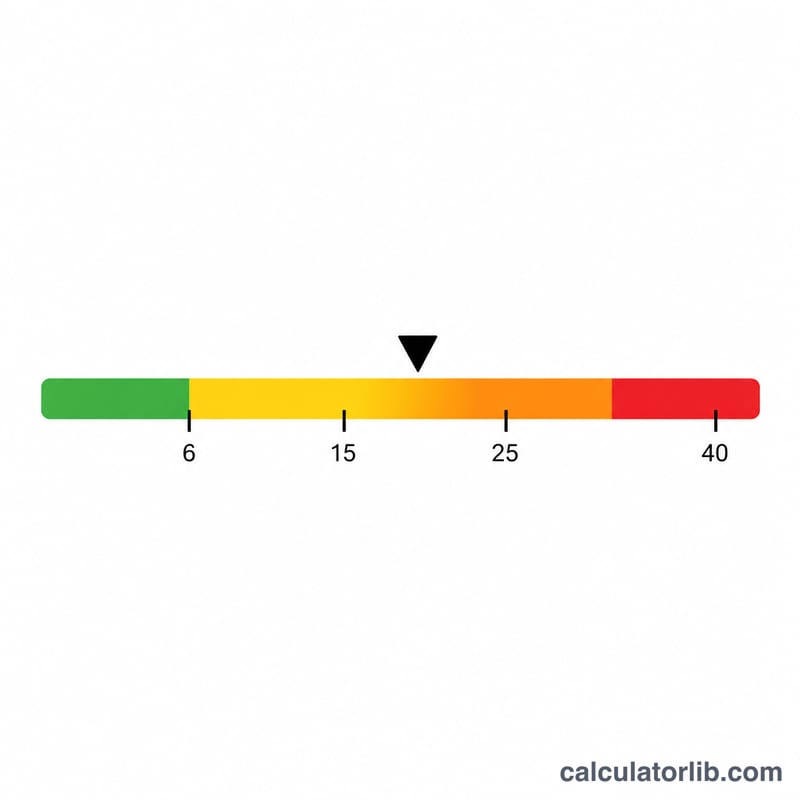
For bilirubin = 1.9, INR = 1.2, creatinine = 1.3: $$\text{MELD} = 3.78 \times \ln(1.9) + 11.2 \times \ln(1.2) + 9.57 \times \ln(1.3) + 6.43 = 3.78 \times 0.6419 + 11.2 \times 0.1823 + 9.57 \times 0.2624 + 6.43 = 2.426 + 2.042 + 2.511 + 6.43 = 13.41$$ which rounds to a MELD score of 13.
FAQ
Is this MELD-Na? No. This calculator uses the original MELD formula and does not include the sodium correction used in MELD-Na.
Why are values floored at 1.0? The natural log of a number below 1 is negative, which would distort the score, so the convention sets minimum lab values to 1.0.
Can I use this for clinical decisions? This tool is for educational purposes. Always rely on clinical judgment and validated institutional protocols.