
What is the Duke Treadmill Score?
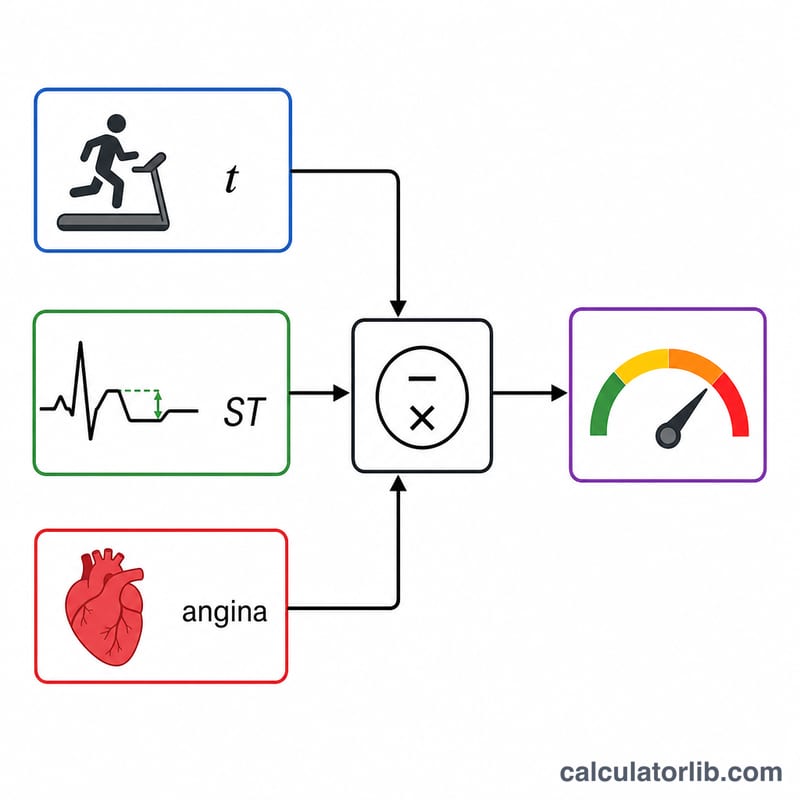
The Duke Treadmill Score (DTS) is a validated prognostic index derived from a standard Bruce-protocol exercise treadmill test. It combines three readily measured variables — exercise duration, the maximum ST-segment deviation seen on the ECG during or after exercise, and an angina index — into a single number that stratifies patients into low, moderate, and high cardiovascular risk groups. It is widely used to support decisions about further testing such as coronary angiography.
How to use this calculator
Enter the total exercise time in minutes achieved on the Bruce protocol, the maximum ST-segment deviation in millimeters (excluding lead aVR), and select the exercise angina index: 0 for no angina, 1 for non-limiting angina, and 2 for angina that forced the test to stop. The calculator returns the score and the corresponding risk category.
The formula explained
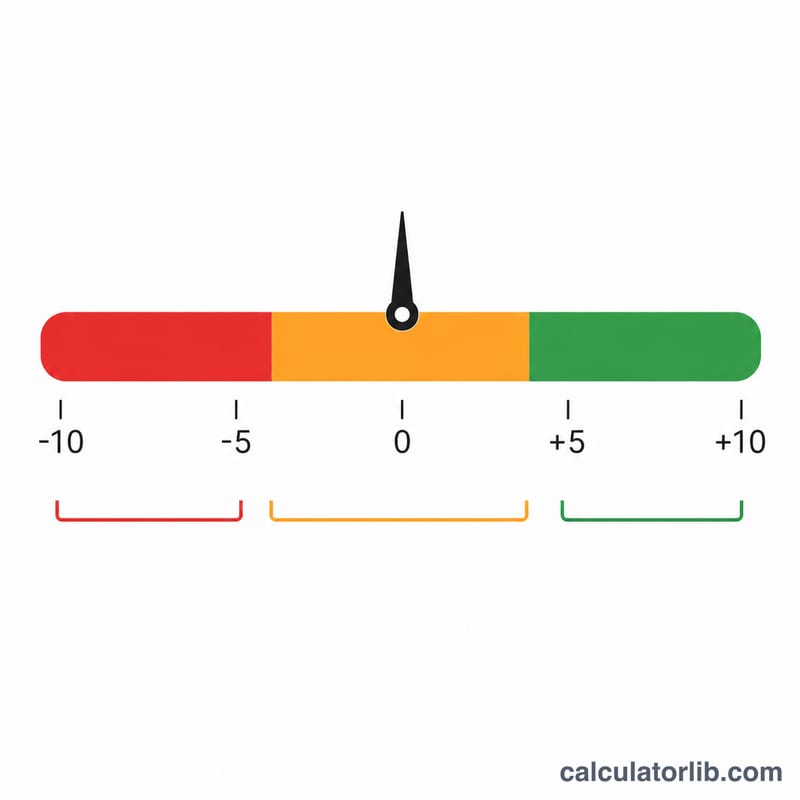
The score is computed as $$\text{DTS} = \text{exercise minutes} - (5 \times \text{ST deviation in mm}) - (4 \times \text{angina index})$$ Longer exercise time increases the score (better prognosis), while greater ST deviation and more severe angina lower it. Interpretation: ≥ +5 = low risk (about 0.25% annual mortality), −10 to +4 = moderate risk (~1.25%), and ≤ −11 = high risk (~5% annual mortality).
Worked example
A patient exercises for 9 minutes, has 1 mm of ST depression, and develops non-limiting angina (index 1). The score is $$9 - (5 \times 1) - (4 \times 1) = 9 - 5 - 4 = 0$$ A score of 0 falls in the −10 to +4 range, placing the patient in the moderate-risk group.
FAQ
What protocol does the score assume? The standard Bruce treadmill protocol; using a different protocol changes how exercise minutes map to workload.
Is the ST deviation depression or elevation? Use the maximum net ST deviation in millimeters, whether depression or elevation, excluding lead aVR.
Does a high score guarantee good outcome? No. The DTS is a population-based estimate and should be interpreted alongside the full clinical picture by a qualified clinician.