
What Is the Revised Cardiac Risk Index?
The Revised Cardiac Risk Index (RCRI), also known as the Lee Index, is a widely used clinical tool that estimates a patient's risk of major cardiac complications (myocardial infarction, pulmonary edema, ventricular fibrillation, cardiac arrest, or complete heart block) after non-cardiac surgery. Developed by Lee and colleagues in 1999, it remains one of the most validated perioperative risk scores in medicine.
How to Use the Calculator
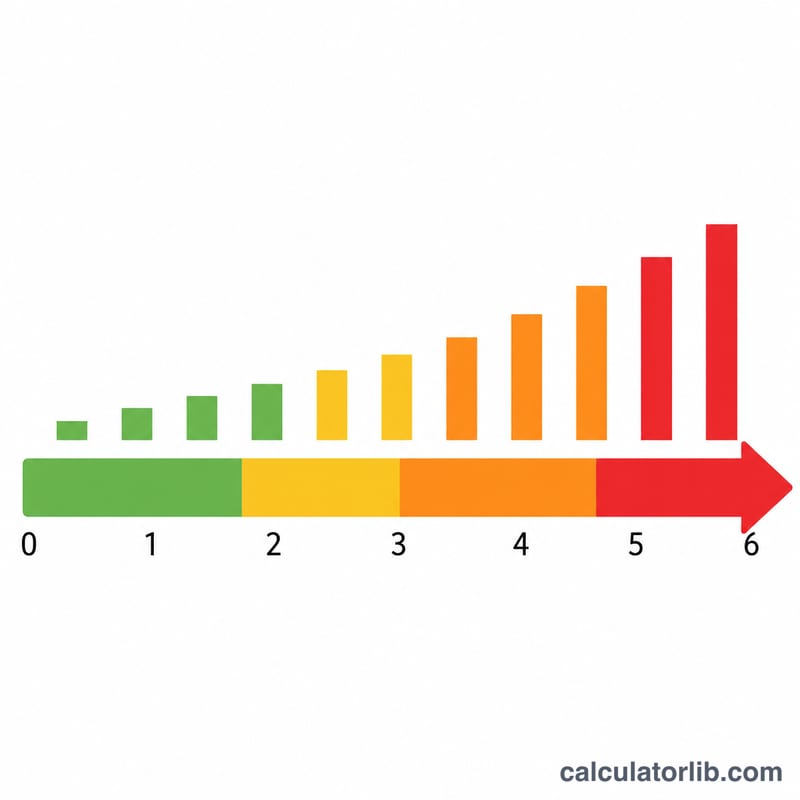
Check each of the six risk factors that apply to your patient. Each checked factor adds 1 point to the total score, which ranges from 0 to 6. The calculator then maps the score to an estimated risk class and percentage of a major cardiac event.
The Six Risk Factors
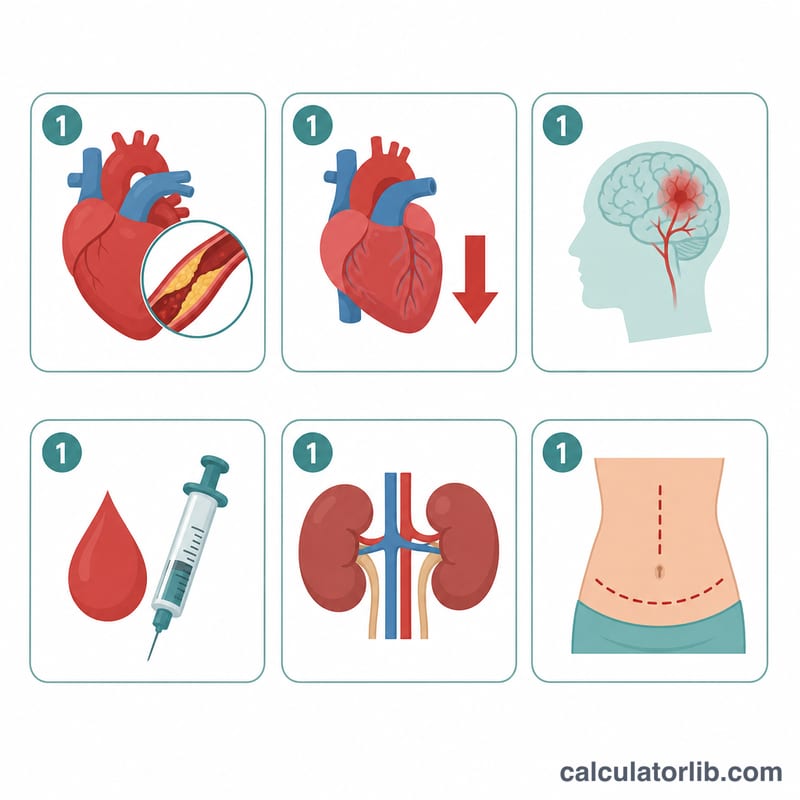
1) High-risk surgery (intraperitoneal, intrathoracic, or suprainguinal vascular procedures); 2) History of ischemic heart disease; 3) History of congestive heart failure; 4) History of cerebrovascular disease (stroke or TIA); 5) Preoperative treatment with insulin; 6) Preoperative serum creatinine greater than 2.0 mg/dL. Each factor is weighted equally at one point.
The Formula Explained
The score is simply the sum of the factors present.
$$\text{RCRI} = \sum_{i=1}^{6} f_i, \quad f_i \in \{0,1\}$$
The original derivation cohort reported the following rates of major cardiac complications: Class I (0 points) ≈ 0.4%, Class II (1 point) ≈ 0.9%, Class III (2 points) ≈ 6.6%, and Class IV (≥3 points) ≈ 11%.
Worked Example
A patient scheduled for a suprainguinal vascular procedure (1 point) with a history of ischemic heart disease (1 point) and insulin-treated diabetes (1 point) has a total RCRI of 3.
$$\text{RCRI} = 1 + 1 + 1 = 3$$
This places them in Class IV with an estimated major cardiac event risk of about 11%.
FAQ
Is the RCRI specific to one country? No — it is a universal clinical risk index validated internationally and used worldwide.
Does the RCRI replace clinical judgment? No. It is a screening aid and should be combined with functional capacity assessment and physician judgment.
What creatinine threshold is used? A preoperative serum creatinine above 2.0 mg/dL (about 177 µmol/L) counts as one point.