
What Is the APGAR Score?
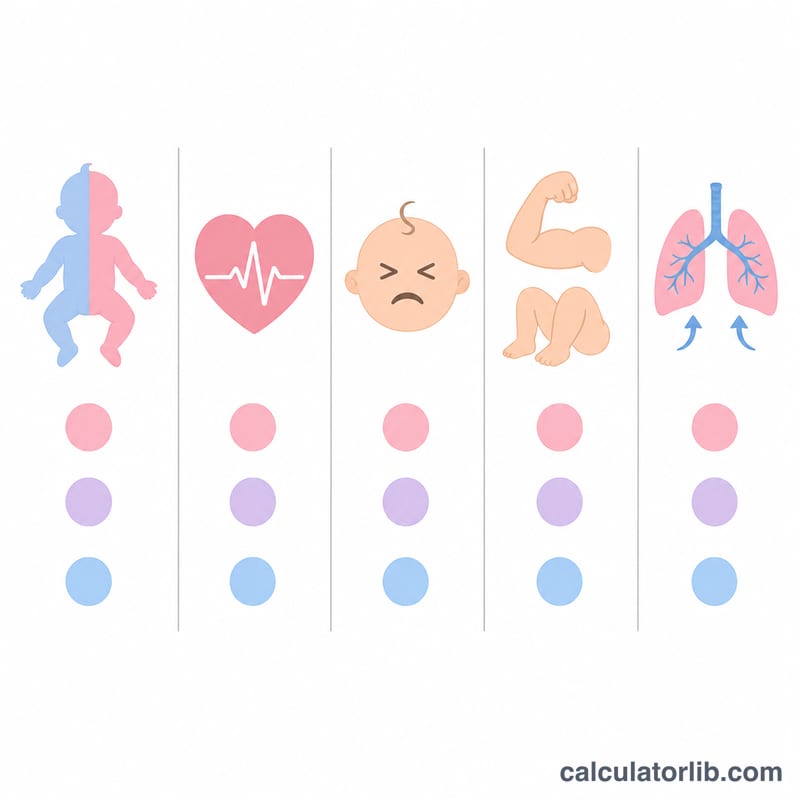
The APGAR score is a quick, standardized method used worldwide to evaluate the physical condition of a newborn baby immediately after birth, typically at 1 minute and 5 minutes of age. Developed by anesthesiologist Dr. Virginia Apgar in 1952, it helps clinicians decide whether a baby needs immediate medical attention. The acronym summarizes five vital signs: Appearance, Pulse, Grimace, Activity, and Respiration.
How to Use This Calculator
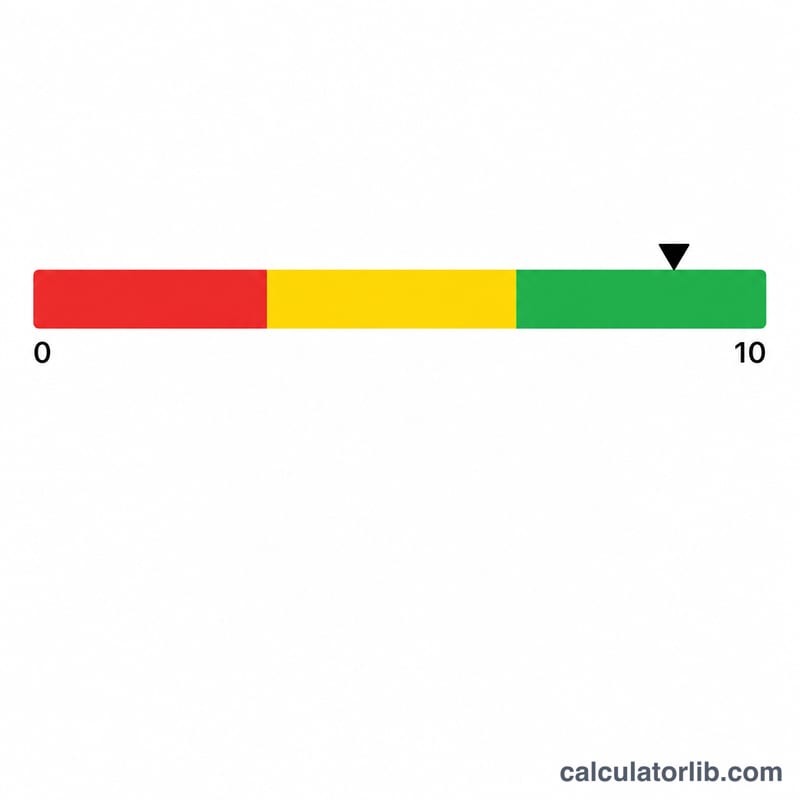
For each of the five signs, choose the observation that best matches the newborn (0, 1, or 2 points). The calculator adds them to give a total between 0 and 10. As a general guide: a score of 7-10 is reassuring, 4-6 is moderately abnormal and may require some intervention, and 0-3 is critically low and requires urgent resuscitation. The score should always be interpreted by a qualified clinician.
The Formula Explained
Each sign is rated on a simple three-point scale: 0 (sign absent), 1 (sign diminished), or 2 (sign fully present). The total APGAR score is simply the sum of all five values. Because each component contributes a maximum of 2 points, the highest possible score is 10 and the lowest is 0.
$$\text{APGAR} = \text{A} + \text{P} + \text{G} + \text{A} + \text{R}$$
$$\text{Score} = \sum_{i=1}^{5} s_i, \quad s_i \in \{0,1,2\}$$
Worked Example
Suppose a newborn shows: Appearance = 2 (completely pink), Pulse = 2 (over 100 bpm), Grimace = 1 (weak cry when stimulated), Activity = 2 (active motion), and Respiration = 2 (strong cry). The total is $$2 + 2 + 1 + 2 + 2 = 9$$ an excellent, reassuring score.
APGAR Scoring Criteria for Each Sign
The APGAR score assigns 0, 1 or 2 points to each of five clinical signs, observed at 1 minute and again at 5 minutes after birth. The five scores are added together to give a total from 0 to 10:
$$\text{APGAR} = \text{A} + \text{P} + \text{G} + \text{A} + \text{R}$$| Sign | Score 0 | Score 1 | Score 2 |
|---|---|---|---|
| Appearance (skin color) | Blue or pale all over | Body pink, extremities blue (acrocyanosis) | Completely pink all over |
| Pulse (heart rate) | Absent | Below 100 bpm | 100 bpm or above |
| Grimace (reflex irritability) | No response to stimulation | Grimace or weak cry when stimulated | Cry, cough, sneeze or pulls away |
| Activity (muscle tone) | Limp, no movement | Some flexion of arms and legs | Active, spontaneous movement |
| Respiration (breathing effort) | Absent | Slow, irregular, or weak cry | Good, strong cry |
For example, a baby who is completely pink (2), has a heart rate of 130 bpm (2), cries when stimulated (2), moves actively (2) and cries strongly (2) scores a perfect 10. A baby with acrocyanosis (1), heart rate 110 bpm (2), grimace only (1), some flexion (1) and a slow irregular breath (1) scores 6.
Interpreting Your APGAR Score
The total APGAR score is a quick, standardized snapshot of a newborn's condition immediately after birth. It is not a measure of long-term health or intelligence. The total falls into three general ranges:
- 7–10 — Reassuring (normal): The baby is generally in good condition and usually needs only routine care.
- 4–6 — Moderately abnormal: The baby may need some assistance, such as stimulation, airway clearing, or supplemental oxygen, and should be reassessed closely.
- 0–3 — Critically low: Indicates a baby in serious distress requiring urgent resuscitation and immediate medical attention.
The score is recorded at 1 minute and at 5 minutes; additional scores at 10, 15 and 20 minutes may be recorded if the baby remains compromised. The 5-minute score is considered more predictive of outcome than the 1-minute score, because it reflects how the newborn responds to any care given in those first minutes. A low 1-minute score that rises by 5 minutes is common and often reassuring.
Many normal newborns score below 10 at 1 minute simply because of acrocyanosis (blue hands and feet), which is a very common transient finding. The APGAR score must always be assigned and interpreted by a qualified clinician in the full clinical context. This page is general educational information only and is not medical advice; for any concern about a newborn, consult the attending healthcare provider.
Key Terms Explained
- Appearance (color)
- The skin color of the newborn, reflecting oxygenation. Scored from blue/pale (0) through pink body with blue extremities (1) to fully pink (2).
- Pulse (heart rate)
- The newborn's heart rate in beats per minute, usually counted at the base of the umbilical cord or by auscultation. Absent (0), below 100 bpm (1), or 100 bpm and above (2).
- Grimace (reflex irritability)
- The baby's response to stimulation, such as gentle suction or a flick to the sole of the foot. Ranges from no response (0) to a vigorous cry, cough or sneeze (2).
- Activity (muscle tone)
- The degree of muscle tone and spontaneous movement, from limp (0) to some flexion of the limbs (1) to active, vigorous movement (2).
- Respiration (breathing effort)
- The quality of breathing, from absent (0) to slow or irregular with a weak cry (1) to a strong, robust cry (2).
- Acrocyanosis
- A bluish discoloration limited to the hands and feet while the trunk remains pink. It is a common, usually harmless finding in healthy newborns and corresponds to an Appearance score of 1.
- Resuscitation
- Emergency medical measures—such as airway clearing, ventilation, chest compressions or medication—used to restore adequate breathing and circulation in a newborn in distress.
Frequently Asked Questions
When is the APGAR measured? Usually at 1 and 5 minutes after birth; if the 5-minute score is below 7 it may be repeated every 5 minutes up to 20 minutes.
Does a low score predict long-term health? No. The APGAR is a snapshot of immediate condition and is not designed to predict future development or long-term outcomes.
Can a healthy baby score below 10? Yes — many normal newborns score 8 or 9, commonly losing a point for slightly bluish hands and feet (acrocyanosis).