What is the Medicine 3 Times a Day Calculator?
"Three times a day" on a prescription label usually means spacing doses across your waking hours rather than strictly every 8 hours around the clock. This calculator takes the time you wake (your first dose) and the time you go to bed (your last dose) and spreads the requested number of doses evenly in between, so you avoid taking medicine while asleep yet keep the gaps as consistent as possible.
How to use it
Enter the hour of your first dose, the hour of your last awake dose, and how many doses you take per day (3 by default). The calculator returns the number of hours between each dose plus a full clock schedule. Times use a 24-hour input but display in friendly AM/PM format.
The formula explained
The waking window is the last awake time minus the first dose time. Because the first and last doses sit at the two ends of that window, there are doses − 1 gaps between them. So the interval is the waking window divided by (doses − 1), and each dose lands at start + i × interval.
$$\text{interval} = \dfrac{\text{waking hours}}{\text{doses} - 1}$$
$$\text{interval} = \dfrac{\text{end} - \text{start}}{\text{doses} - 1}$$
$$\text{dose}_i = \text{start} + i \times \text{interval}$$
Worked example
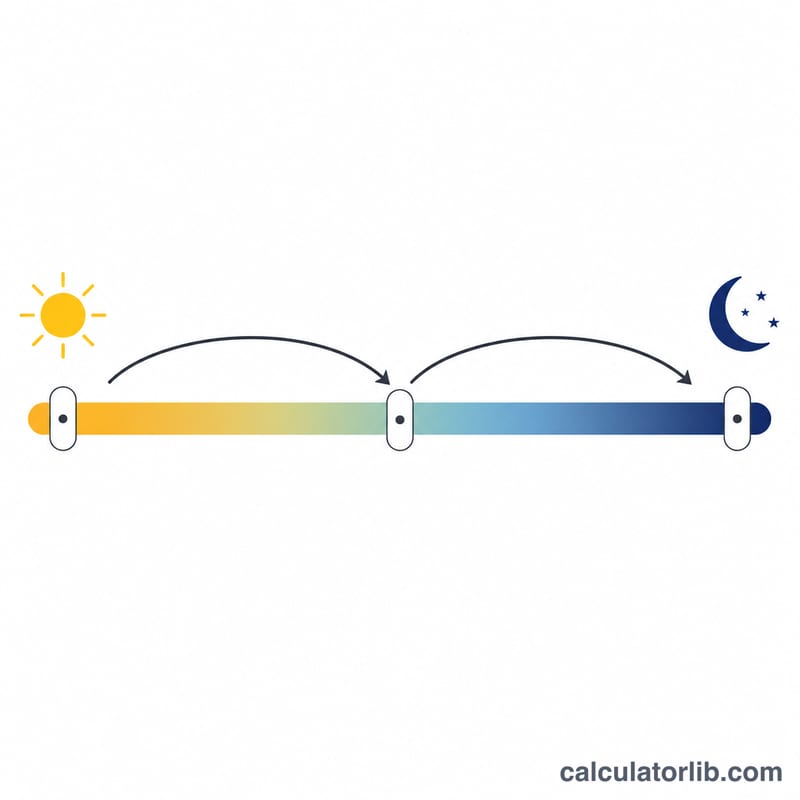
Suppose you wake at 8 (8 AM) and your last dose is at 22 (10 PM), taking medicine 3 times a day. The waking window is \(22 - 8 = 14\) hours, divided by \(3 - 1 = 2\) gaps, giving a 7-hour interval. Your doses fall at 8:00 AM, 3:00 PM, and 10:00 PM.
Dose Schedules for Different Waking Windows and Dose Counts
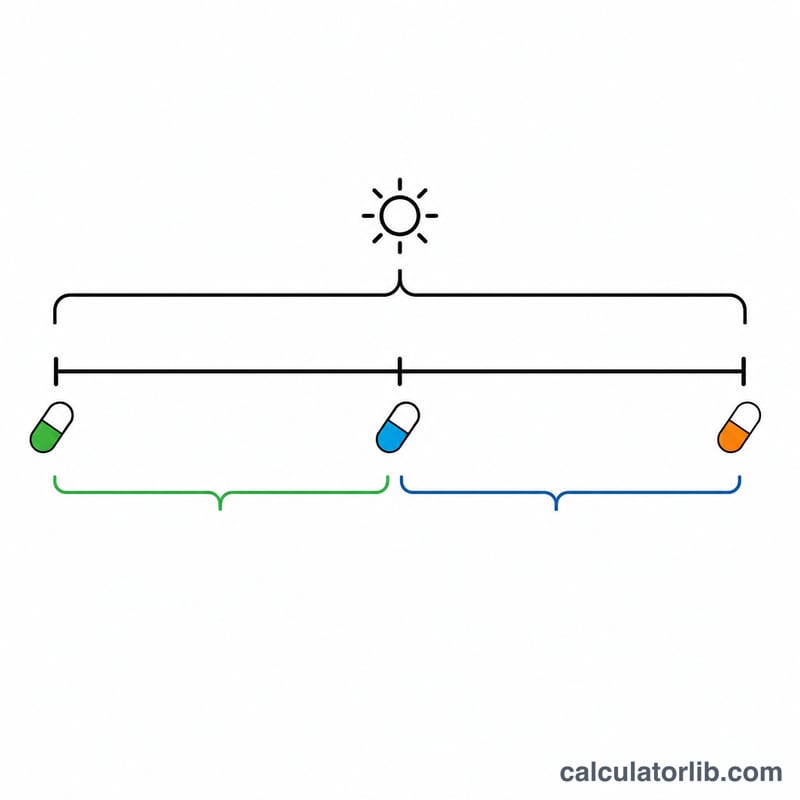
The calculator spaces doses evenly between the first dose hour and the last awake hour using:
$$\text{Interval} = \frac{\text{end} - \text{start}}{\text{doses} - 1}$$
The table uses a 24-hour clock for the window. The overnight gap is the time from the last dose of one day to the first dose of the next.
| Scenario | Window | Calculation | Interval | Dose times | Overnight gap |
|---|---|---|---|---|---|
| 3 doses | 7:00–21:00 | (21 − 7) / (3 − 1) | 7 h | 7:00 AM, 2:00 PM, 9:00 PM | 10 h |
| 3 doses | 8:00–22:00 | (22 − 8) / (3 − 1) | 7 h | 8:00 AM, 3:00 PM, 10:00 PM | 10 h |
| 3 doses | 9:00–19:00 | (19 − 9) / (3 − 1) | 5 h | 9:00 AM, 2:00 PM, 7:00 PM | 14 h |
| 2 doses | 8:00–22:00 | (22 − 8) / (2 − 1) | 14 h | 8:00 AM, 10:00 PM | 10 h |
| 4 doses | 8:00–22:00 | (22 − 8) / (4 − 1) | about 4.67 h (4 h 40 min) | 8:00 AM, 12:40 PM, 5:20 PM, 10:00 PM | 10 h |
| Strict every 8 hours (for comparison) | Around the clock | 24 / 3 | 8 h | 6:00 AM, 2:00 PM, 10:00 PM | 8 h (no longer gap) |
Spreading three doses across a 14-hour day gives 7-hour gaps. A strict every-8-hours plan gives equal gaps, but it needs a dose during sleep hours or an early start.
Interpreting Your Dose Schedule
"Three times a day" (TID) versus "every 8 hours" (q8h). These labels are not the same instruction. "Three times a day" generally means three doses spread across the day, usually while awake, and the gaps do not have to be equal. "Every 8 hours" means evenly spaced doses around the clock, such as 6 AM, 2 PM and 10 PM. Some medicines need steady spacing, and others do not.
Why waking-hours schedules leave a longer overnight gap. This calculator spaces doses evenly between your first dose and your last awake hour, so the time between the last dose of one day and the first dose of the next is not part of the interval. For example, with doses at 8:00 AM, 3:00 PM and 10:00 PM, the daytime gaps are 7 hours each, but the overnight gap from 10:00 PM to 8:00 AM is 10 hours. With a shorter window such as 9:00 AM to 7:00 PM, the gaps are 5 hours by day and 14 hours overnight.
What the result is and is not. The output is a scheduling aid that shows evenly spaced clock times. It does not know your medicine. Whether a dose must be taken with food or on an empty stomach, the minimum time allowed between doses, and whether a medicine needs strict round-the-clock timing are all set by the prescriber, the pharmacist and the product label. If your instructions conflict with the calculated times, follow your instructions and ask your pharmacist or prescriber. This is general information, not medical advice.
Dosing Terms Glossary
- TID (three times daily)
- From the Latin ter in die. A medicine taken three times in a day, usually spread over waking hours unless the label says otherwise.
- BID (twice daily)
- From bis in die. A medicine taken two times in a day.
- QID (four times daily)
- From quater in die. A medicine taken four times in a day.
- q8h (every 8 hours)
- A medicine taken at fixed 8-hour intervals, for example 6 AM, 2 PM and 10 PM, including overnight.
- Dosing interval
- The length of time between one dose and the next.
- Waking window
- The hours of the day you are normally awake, from your first dose hour to your last awake hour. The calculator spaces doses across it.
- First dose
- The earliest dose of the day. It sets the start of the schedule.
- Last dose
- The final dose of the day, placed at the end of your waking window in this calculator.
- Adherence
- How closely a person follows the prescribed regimen, including dose, timing and duration. Regular, easy-to-remember times help adherence.
- Missed dose
- A scheduled dose that was not taken on time. What to do depends on the specific medicine, so check the label or ask a pharmacist or prescriber.
FAQ
Does this replace doctor advice? No. Always follow your prescription and pharmacist instructions; some medicines must be taken with food or strictly every 8 hours.
Why spread across waking hours? For many everyday medicines, dosing while awake improves adherence and reduces missed doses without waking you at night.
Can I use it for more than 3 doses? Yes — set any value from 2 to 12 doses per day and the schedule recalculates automatically.