
What this calculator does
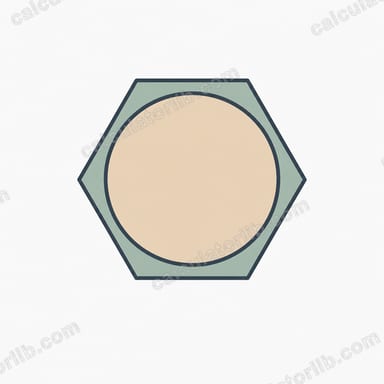
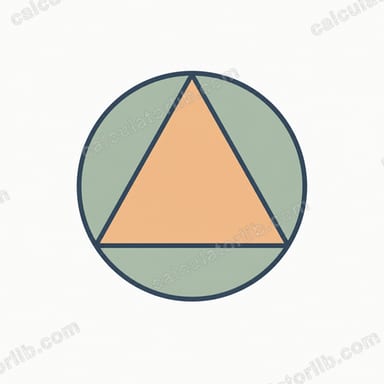
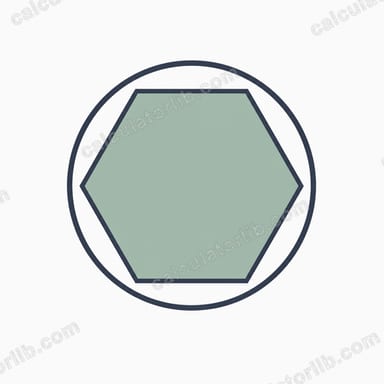
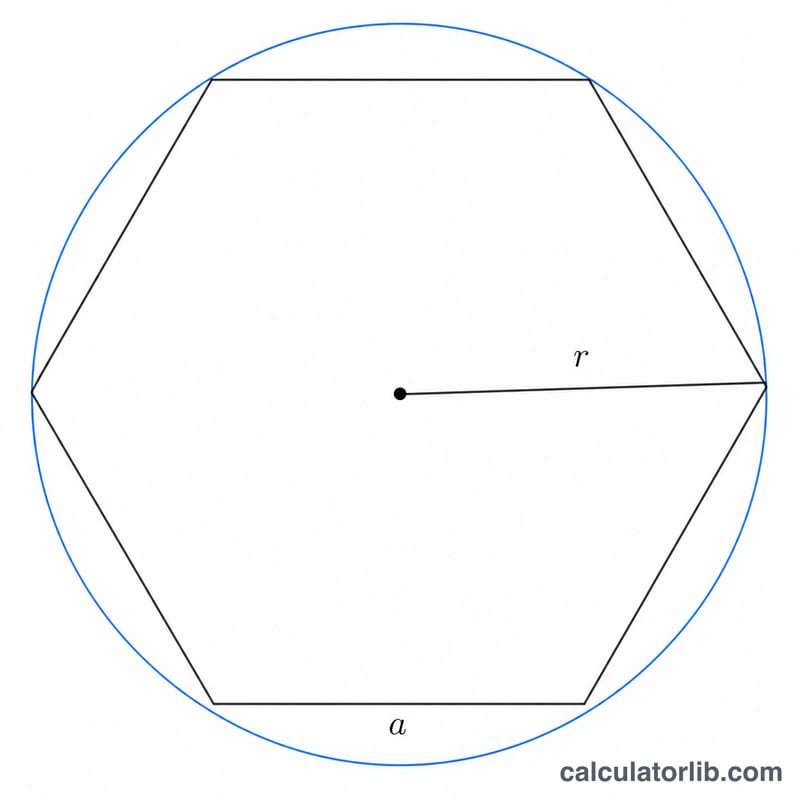
This tool works with a regular polygon (an n-gon with all sides and angles equal). Given the side length a and a range of side counts n, it computes the radius of the circumscribed circle (the circle that passes through every vertex), the area of that circle, and the area of the polygon itself. It builds a table with one row per integer n from your chosen minimum to maximum, so you can compare shapes side by side. This is pure plane geometry and applies identically everywhere — no units or jurisdiction matter, and all areas are simply in the square of whatever length unit you use for a.
How to use it
Enter the side length a (must be greater than 0), then a smallest and largest number of sides. Each n must be a whole number of at least 3, since a polygon needs three or more sides. The table is capped at 200 rows. To get a single shape, set the "from" and "to" values to the same number.
The formulas explained
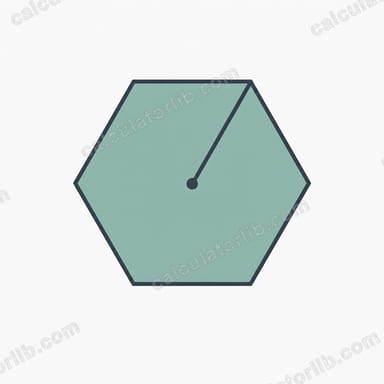
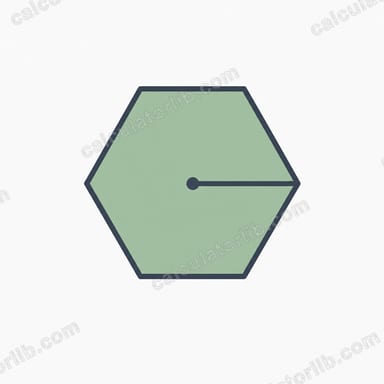
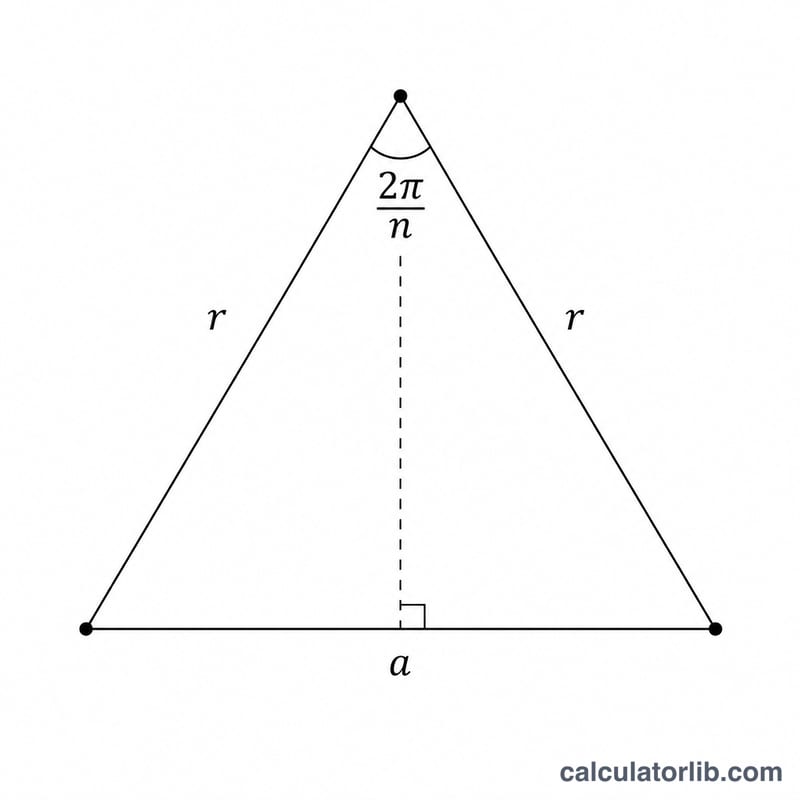
The circumradius comes from splitting the polygon into n isosceles triangles meeting at the center; each side subtends a central angle of \(2\pi/n\), giving $$r = \frac{a}{2\sin(\pi/n)}.$$ The circumscribed circle area is the standard $$S_c = \pi r^2.$$ The polygon area is $$S_p = \frac{n\,a^2}{4\tan(\pi/n)}.$$ As n grows, the polygon hugs its circle ever more tightly, so \(S_p\) approaches \(S_c\) — a handy sanity check.
Worked example
Take a regular hexagon (n = 6) with side a = 1. Then \(\pi/6 \approx 0.5236\) rad, \(\sin(\pi/6) = 0.5\), so $$r = \frac{1}{2\times 0.5} = 1.$$ The circle area is $$S_c = \pi\times 1^2 \approx 3.14159,$$ and with \(\tan(\pi/6) \approx 0.57735\), the polygon area is $$S_p = \frac{6}{4\times 0.57735} \approx 2.59808.$$
FAQ
Is the circumradius the same as the apothem? No. The circumradius reaches the vertices; the apothem reaches the midpoint of a side and is shorter.
Why must n be at least 3? Fewer than three sides cannot enclose an area, and the tangent term would break for n = 1 or 2.
What units are the areas in? If a is in centimeters, the areas are in square centimeters — the tool is unit-agnostic and keeps everything consistent.