
What this calculator does
This tool estimates a single weight-based dose of paracetamol (known as acetaminophen in the US, Canada and Japan) for children, then converts that milligram dose into a practical liquid volume in millilitres. Pediatric dosing is best done by weight rather than age because children of the same age can differ widely in size. The standard weight-based dose is 10–15 mg per kilogram of body weight, given no more often than every 4–6 hours.
How to use it
Enter your child's weight in kilograms, choose a dose-per-kg value (15 mg/kg is the common single-dose target, 10–12 mg/kg is more conservative), and pick the liquid concentration printed on your bottle. Common products are 160 mg per 5 mL (32 mg/mL) and concentrated infant drops at 100 mg/mL. The calculator returns the dose in mg, the matching mL to measure, and the maximum amount over 24 hours assuming four doses.
The formula explained
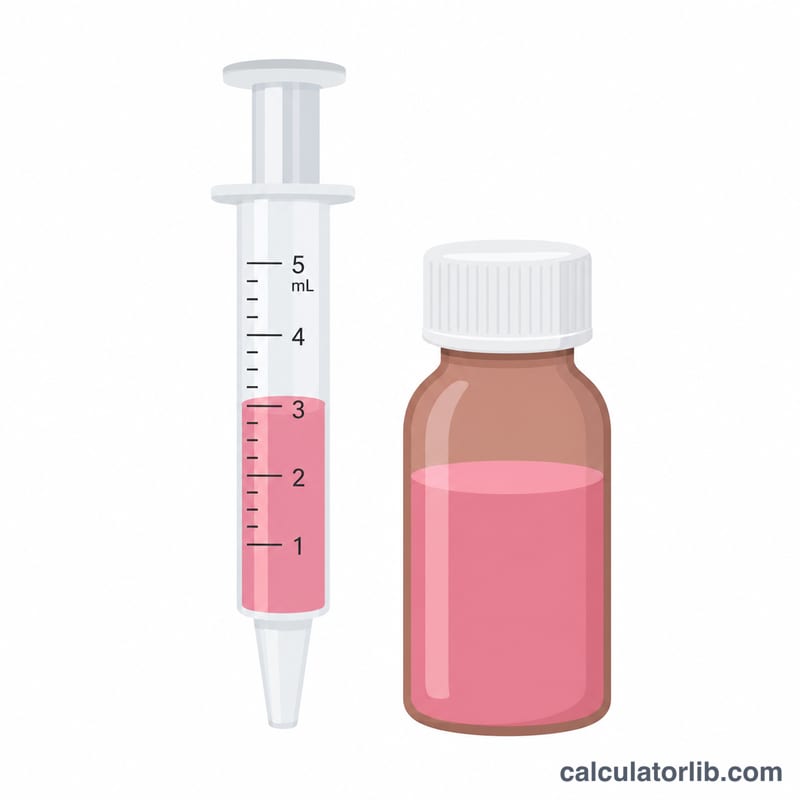
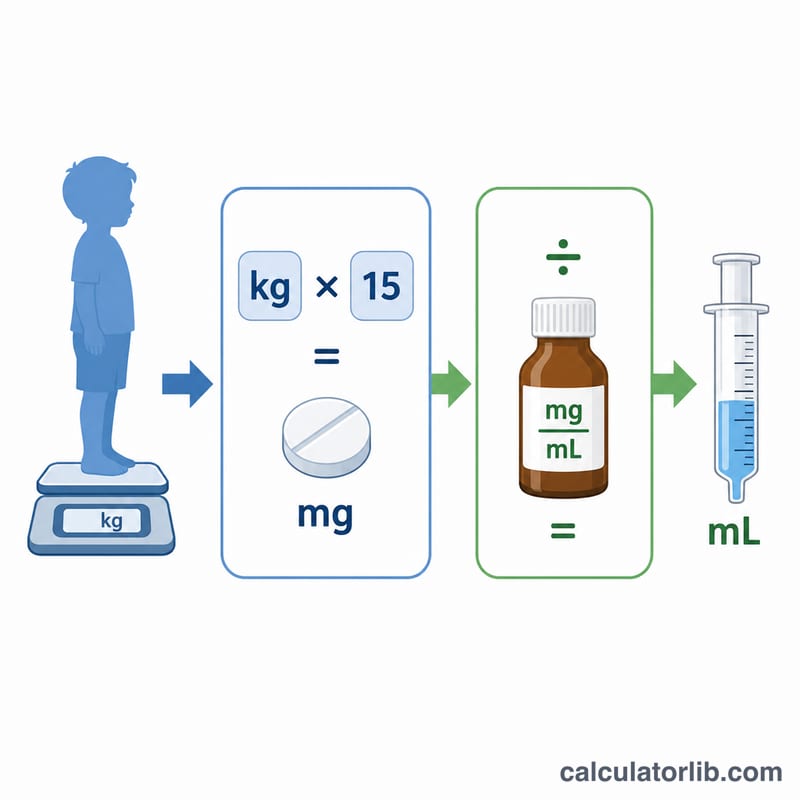
The dose in milligrams is simply dose per kg × weight. To find how much liquid to give, divide that dose by the concentration:
$$\text{Volume}_{mL} = \frac{\text{Dose}_{mg}}{\text{concentration}_{mg/mL}}$$For example, a 15 kg child at 15 mg/kg needs 225 mg. With a 32 mg/mL syrup that is \(225 \div 32 \approx 7.03\) mL per dose.
Weight-Based Dosing Reference Table
The table below uses a single dose of 15 mg/kg, the upper end of the standard 10–15 mg/kg paediatric range. It shows the milligram dose, the equivalent volume of 160 mg/5 mL syrup (32 mg/mL) and of 100 mg/mL infant drops, and a 24-hour ceiling estimated as 5 doses (75 mg/kg, capped at the 4000 mg adult maximum).
| Weight (kg) | Dose at 15 mg/kg (mg) | Syrup 160 mg/5 mL (mL) | Drops 100 mg/mL (mL) | 24-hour max (mg) |
|---|---|---|---|---|
| 5 | 75 | 2.3 | 0.75 | 375 |
| 7.5 | 112.5 | 3.5 | 1.1 | 562.5 |
| 10 | 150 | 4.7 | 1.5 | 750 |
| 12.5 | 187.5 | 5.9 | 1.9 | 937.5 |
| 15 | 225 | 7.0 | 2.25 | 1125 |
| 20 | 300 | 9.4 | 3.0 | 1500 |
| 25 | 375 | 11.7 | 3.75 | 1875 |
| 30 | 450 | 14.1 | 4.5 | 2250 |
Volume is calculated as \(\text{mL} = \dfrac{\text{dose per kg} \times \text{weight}}{\text{concentration}}\). For example, a 15 kg child needs \(\dfrac{15 \times 15}{32} = 7.0\) mL of 32 mg/mL syrup.
Dose Across Common Scenarios
These worked cases show how the same formula behaves with different weights, dose-per-kg choices and concentrations. Each milligram figure is \(\text{dose per kg} \times \text{weight}\), and the volume divides that by the product concentration.
| Scenario | Weight (kg) | Dose/kg (mg) | Dose (mg) | Concentration | Volume (mL) |
|---|---|---|---|---|---|
| Infant on drops | 8 | 15 | 120 | 100 mg/mL drops | 1.2 |
| Toddler on syrup | 15 | 15 | 225 | 160 mg/5 mL (32 mg/mL) | 7.0 |
| Child, lower dose | 25 | 10 | 250 | 160 mg/5 mL (32 mg/mL) | 7.8 |
| Child, higher dose | 25 | 15 | 375 | 160 mg/5 mL (32 mg/mL) | 11.7 |
The two 25 kg rows illustrate the 10–15 mg/kg band: the same child could receive 250 mg or 375 mg per dose depending on which end of the range is chosen. If you also weigh in pounds, convert first — for instance, 55 lb is about 24.9 kg.
FAQ
How often can the dose be repeated? Typically every 4–6 hours, with no more than 5 doses in 24 hours. Follow the product label and your clinician's advice.
Should I dose by age or weight? Weight-based dosing is more accurate; use age-based charts only when the weight is unknown.
Is this medical advice? No. This calculator is for educational estimation only. Always verify with a pharmacist or pediatrician and never exceed the maximum daily limit.