What this calculator does
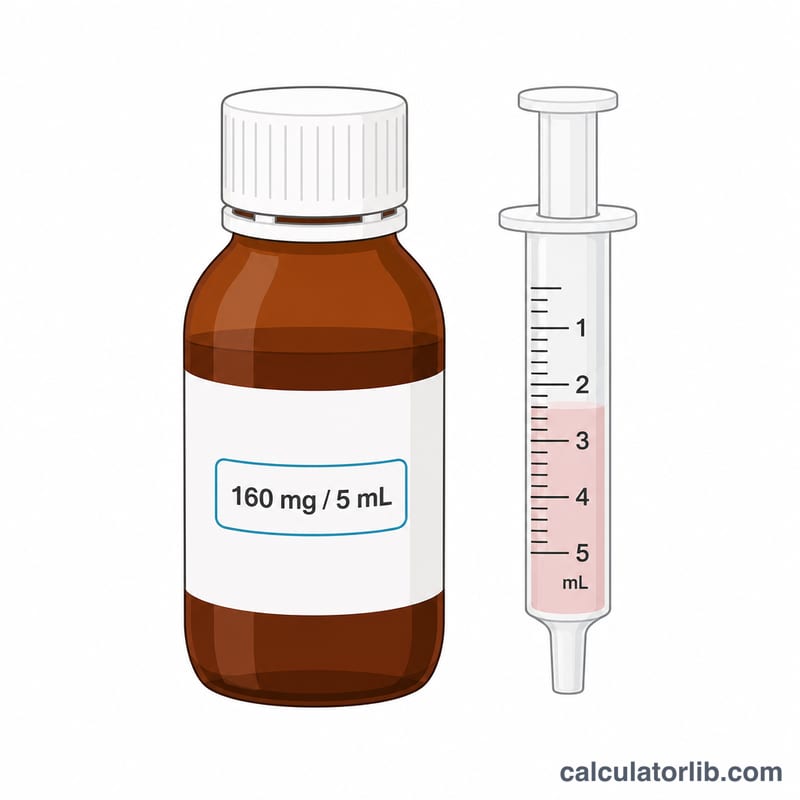
This tool estimates a single dose of infant Tylenol (acetaminophen) based on your child's body weight. Acetaminophen is dosed by weight, not age, because two children of the same age can weigh very different amounts. The standard pediatric range is 10–15 mg per kilogram per dose, and this calculator uses 15 mg/kg as the default target while also showing the full safe range. Dosing guidance here reflects common US pediatric practice and the US infant oral suspension strength of 160 mg/5 mL.
How to use it
Enter your child's weight and choose kilograms or pounds. Leave the dose per kg at 15 mg/kg (or lower it within the 10–15 range if advised). The concentration defaults to 32 mg/mL, which equals the standard 160 mg per 5 mL infant suspension; change it only if your product label states a different strength. The calculator returns the dose in both milligrams and milliliters, plus the acceptable range.
The formula explained
First the dose in milligrams is found: mg = weight in kg × mg/kg. If you entered pounds, weight is converted with 1 lb = 0.4536 kg. Then the liquid volume is computed: mL = mg ÷ concentration. With the 32 mg/mL suspension, every 32 mg of medicine is contained in 1 mL of liquid.
$$\text{Dose (mL)} = \frac{W \times \text{Dose (mg/kg)}}{\text{Concentration (mg/mL)}}$$ $$\text{where}\quad W = \text{Weight (kg)}$$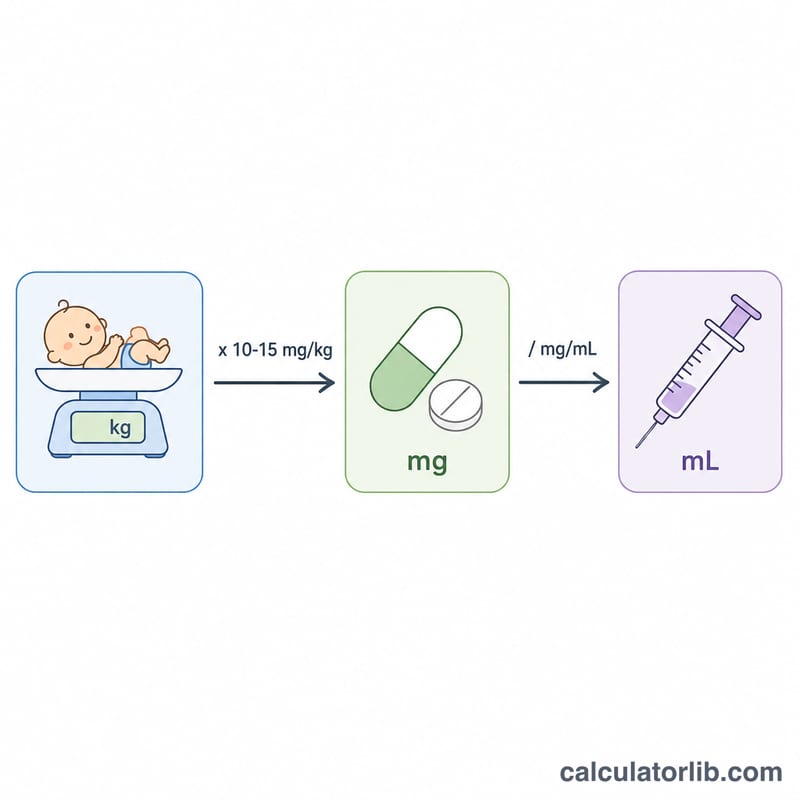
Worked example
A baby weighs 8 kg. At 15 mg/kg the dose is \(8 \times 15 = 120\) mg. Using the 160 mg/5 mL (32 mg/mL) suspension: \(120 \div 32 = 3.75\) mL. The 10–15 mg/kg range would be 80–120 mg, or 2.5–3.75 mL.
Infant Acetaminophen Dose by Weight Chart (160 mg/5 mL)
This chart applies the formula \(\text{Dose (mL)} = \frac{ W \times \text{mg/kg} }{ 32 }\) at the low end (10 mg/kg) and high end (15 mg/kg) of the labeled per-dose range, using the US infant suspension of 160 mg per 5 mL (32 mg/mL). Pound values are rounded to the nearest whole pound.
| Weight (kg) | Weight (lb) | Dose at 10 mg/kg (mg) | Dose at 15 mg/kg (mg) | Volume at 10 mg/kg (mL) | Volume at 15 mg/kg (mL) |
|---|---|---|---|---|---|
| 4 | 9 | 40 | 60 | 1.25 | 1.88 |
| 5 | 11 | 50 | 75 | 1.56 | 2.34 |
| 6 | 13 | 60 | 90 | 1.88 | 2.81 |
| 8 | 18 | 80 | 120 | 2.5 | 3.75 |
| 10 | 22 | 100 | 150 | 3.13 | 4.69 |
| 12 | 26 | 120 | 180 | 3.75 | 5.63 |
Example: 8 kg × 10 mg/kg = 80 mg, and 80 mg ÷ 32 mg/mL = 2.5 mL; at 15 mg/kg the result is 120 mg = 3.75 mL.
Important: this table is an illustrative calculation of the formula, not a prescription or a personal recommendation. The product label and your child's pediatrician always take precedence over any chart.
Standard Dosing Limits and Intervals
- Per-dose range: 10–15 mg of acetaminophen per kg of body weight.
- Interval: every 4 to 6 hours as needed.
- Maximum number of doses: no more than 5 doses in 24 hours.
- Daily ceiling: a commonly cited maximum is 75 mg/kg per 24 hours, without exceeding 5 doses (5 × 15 mg/kg = 75 mg/kg).
- Young infants: for infants under 12 weeks (about 3 months) of age, fever or pain needs medical evaluation, and acetaminophen should be given only under a clinician's direction.
These limits reflect US pediatric labeling and AAP-style guidance. Other countries may use different products, concentrations, or schedules. Individual advice, including the right dose for a specific child, comes from a pediatrician or pharmacist. This is general information, not professional medical advice.
Interpreting Your Result
The calculator returns a single-dose estimate based on body weight, not a daily total. The 10–15 mg/kg range is the span of per-dose amounts used in US pediatric labeling: lower values give less drug per dose, higher values approach the upper limit for one dose. The calculator does not decide where in the range a particular child should fall.
The volume in mL depends on the product's concentration. The standard US infant suspension is 160 mg per 5 mL, which is \(160 \div 5 = 32\) mg/mL, so \(\text{mL} = \text{mg} \div 32\). A different concentration changes the volume even when the mg dose is the same. For instance, older concentrated infant drops (80 mg per 0.8 mL, or 100 mg/mL) were largely replaced in the US by the 160 mg/5 mL liquid to reduce mix-ups, and chewable or junior-strength tablets contain different amounts per unit and are made for older children. Always check the mg per mL on the actual bottle and enter it in the concentration field.
Dosing syringes and cups have limited markings, so the calculated volume (for example 3.13 mL) may fall between marks. A measured amount close to the calculated value, within the labeled range, is what the markings allow; use only the device that came with the product and follow the label's weight or age instructions.
Going over the labeled maximum dose or number of doses can cause acetaminophen toxicity, which can seriously damage the liver. Acetaminophen is also in many combination cold and flu products, so check labels to avoid giving it twice. This is general information, not medical advice; contact a pediatrician, pharmacist, or poison control service for guidance about a specific child.
FAQ
How often can I give it? Acetaminophen can usually be given every 4–6 hours, with no more than 5 doses in 24 hours. Follow your pediatrician's instructions.
My infant is under 3 months old — is this safe? Do not give acetaminophen to infants under 12 weeks without first speaking to a doctor, as fever in young infants needs evaluation.
What if my product is a different strength? Always check the label. Children's liquid is often the same 160 mg/5 mL, but chewables and other forms differ. Enter the correct mg/mL or ask your pharmacist.