
What Is a Pack Year?
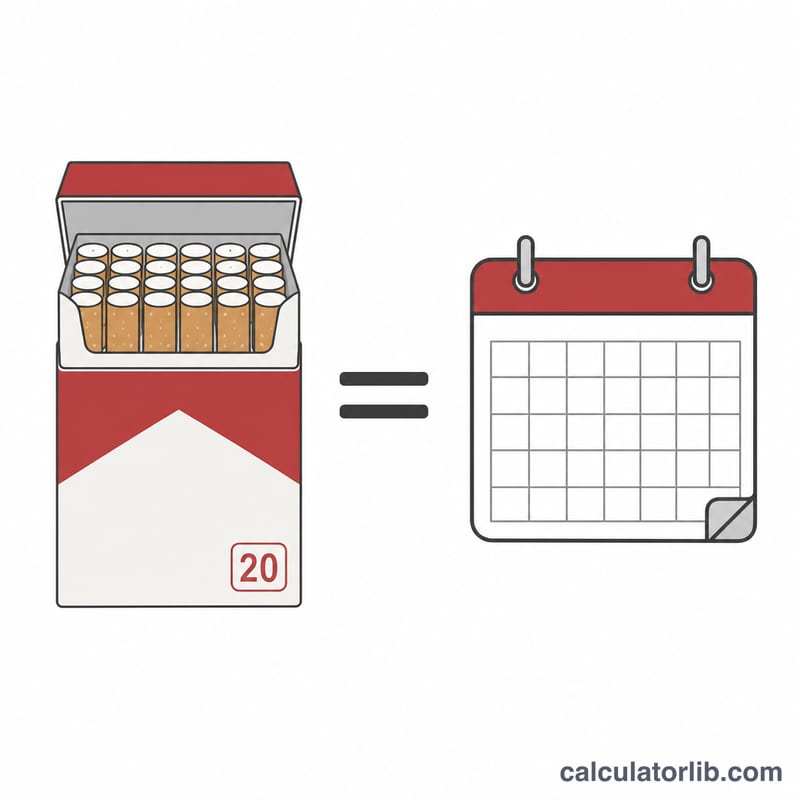
A pack year is a standardized way to quantify how much tobacco a person has smoked over their lifetime. One pack year is defined as smoking one pack — 20 cigarettes — every day for one full year. Clinicians use pack years to estimate cumulative exposure and to assess risk for smoking-related conditions such as lung cancer and chronic obstructive pulmonary disease (COPD). Many lung cancer screening guidelines reference pack-year thresholds (commonly 20 or 30 pack years) when deciding who should undergo low-dose CT scanning.
How to Use This Calculator
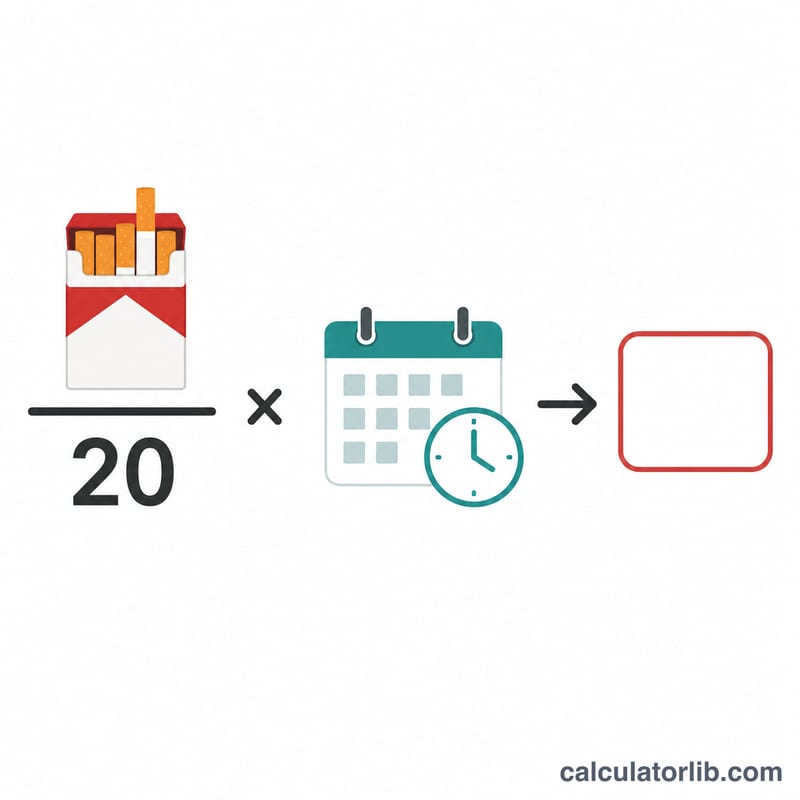
Enter the average number of cigarettes you smoke (or smoked) per day, then enter the total number of years you have smoked. The calculator divides cigarettes per day by 20 to convert to packs per day, then multiplies by the years smoked to give your total pack years. If your habit varied over time, use a reasonable daily average.
The Formula
The calculation is simple:
$$\text{Pack Years} = \frac{\text{Cigarettes per day}}{20} \times \text{Years smoked}$$The division by 20 reflects that a standard pack contains 20 cigarettes.
Worked Example
Suppose someone smoked 30 cigarettes per day for 25 years. That is \(30 \div 20 = 1.5\) packs per day. Multiplying by 25 years gives
$$1.5 \times 25 = 37.5 \text{ pack years}$$— above many screening thresholds.
FAQ
Does quitting reduce my pack years? No. Pack years measure cumulative past exposure and do not decrease after you quit, though quitting still lowers your future health risk significantly.
What if I smoked different amounts at different times? Use a weighted average of cigarettes per day, or calculate each period separately and add the pack years together.
Is a higher pack year always worse? Generally, higher pack years correlate with greater risk, but individual risk also depends on age, genetics, and time since quitting. Always discuss results with a healthcare professional.