
What Is a Pack-Year?
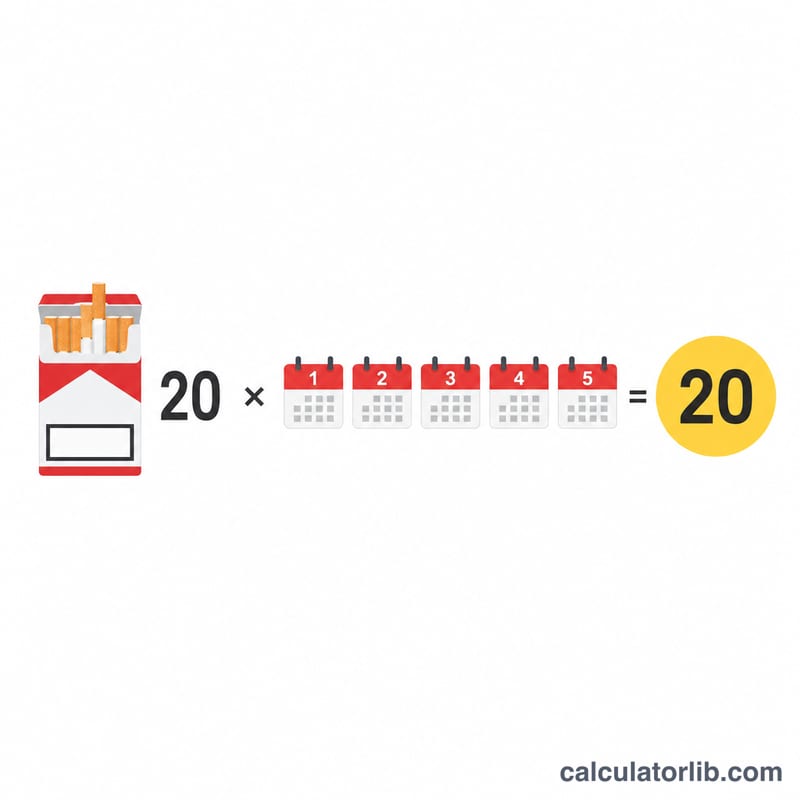
A pack-year is a standard unit used by clinicians to quantify a person's lifetime tobacco exposure. One pack-year is defined as smoking one pack of cigarettes (20 cigarettes) per day for one year. Because risk for lung cancer, COPD and other smoking-related diseases scales with total exposure, pack-years offer a single comparable number regardless of whether someone smoked heavily for a short time or lightly for many years.
How to Use This Calculator
Enter the average number of cigarettes you smoke (or smoked) per day and the total number of years you have smoked. The calculator divides the daily cigarette count by 20 to get packs per day, then multiplies by the number of years to give your total pack-years. If your habit changed over time, estimate an overall average for each value.
The Formula Explained
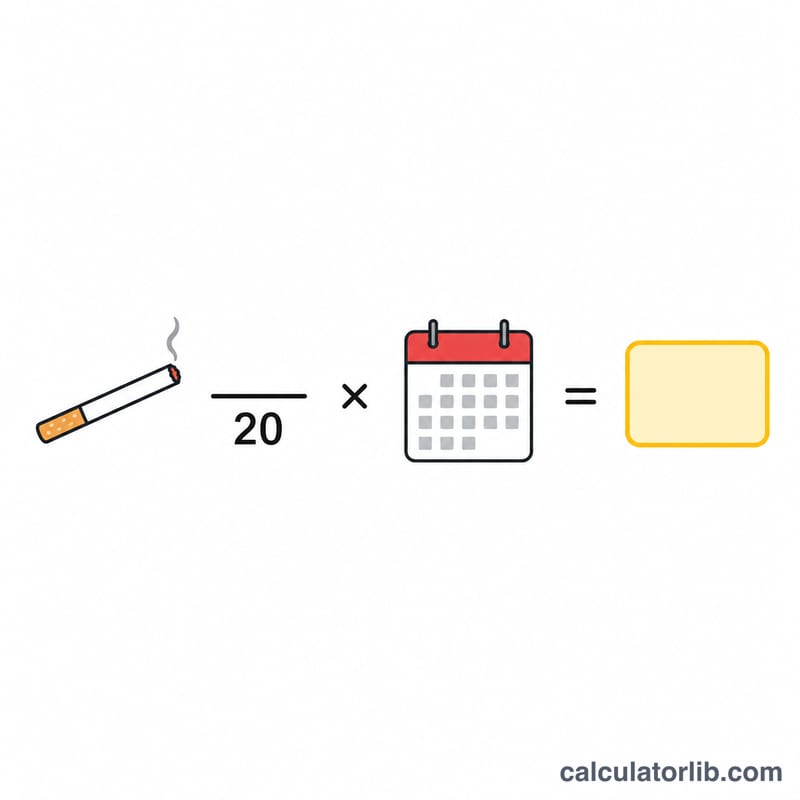
The calculation is straightforward: $$\text{Pack-Years} = \frac{\text{Cigarettes per day}}{20} \times \text{Years smoked}$$. The division by 20 converts cigarettes into packs, since a standard pack contains 20 cigarettes.
Worked Example
Suppose someone smoked 30 cigarettes per day for 25 years. Packs per day = \(30 \div 20 = 1.5\). Pack-years:
$$\text{Pack-Years} = \frac{30}{20} \times 25 = 1.5 \times 25 = 37.5$$A history of 20 or more pack-years is a common threshold used in lung cancer screening guidelines.
FAQ
Why does a higher pack-year number matter? Greater cumulative exposure is associated with higher risk of lung cancer, emphysema and heart disease, and many screening programs use pack-year thresholds to decide eligibility.
What if I quit smoking? Pack-years measure past exposure, so they do not decrease after quitting — but quitting still substantially lowers future risk over time.
Is this a medical diagnosis? No. This tool is for educational estimation only. Discuss your smoking history and screening options with a healthcare professional.