
What it is
This calculator estimates the minimum number of survey respondents you need to estimate a population proportion within a chosen margin of error and confidence level. It is the standard formula used in market research, polling, and clinical surveys when the outcome is a percentage (e.g. "what share of people say yes").
How to use it
Pick your confidence level (90%, 95%, or 99%), enter the expected proportion as a percentage, and enter your desired margin of error as a percentage. If you have no prior estimate of the proportion, use 50% — this is the most conservative value and yields the largest required sample.
The formula explained
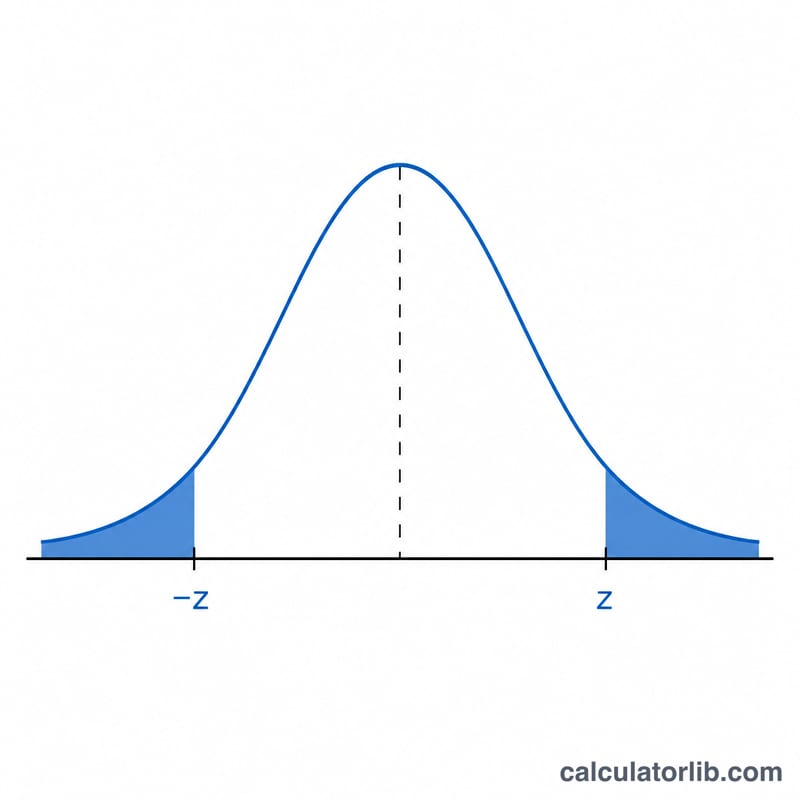
The sample size is $$n = \left\lceil \frac{\text{Z}^{2} \cdot \text{p}\,(1 - \text{p})}{\text{e}^{2}} \right\rceil$$ Here \(z\) is the standard normal critical value (1.645 for 90%, 1.96 for 95%, 2.576 for 99%), \(p\) is the expected proportion as a decimal, and \(E\) is the margin of error as a decimal. Because a sample must be a whole number, the result is rounded up.
Worked example
For 99% confidence (\(z = 2.576\)), \(p = 30\%\) (0.30), and \(E = 4\%\) (0.04): $$n = 2.576^{2} \times 0.30 \times 0.70 / 0.04^{2} = 6.635776 \times 0.21 / 0.0016 = 1.39351296 / 0.0016 \approx 870.95$$ Rounded up, you need 871 respondents.
FAQ
Why use 50% if I don't know the proportion? \(p(1-p)\) is largest at \(p = 0.5\), so it gives the safest (largest) sample size.
Does this account for population size? No — this is the infinite-population formula. For small populations apply a finite population correction.
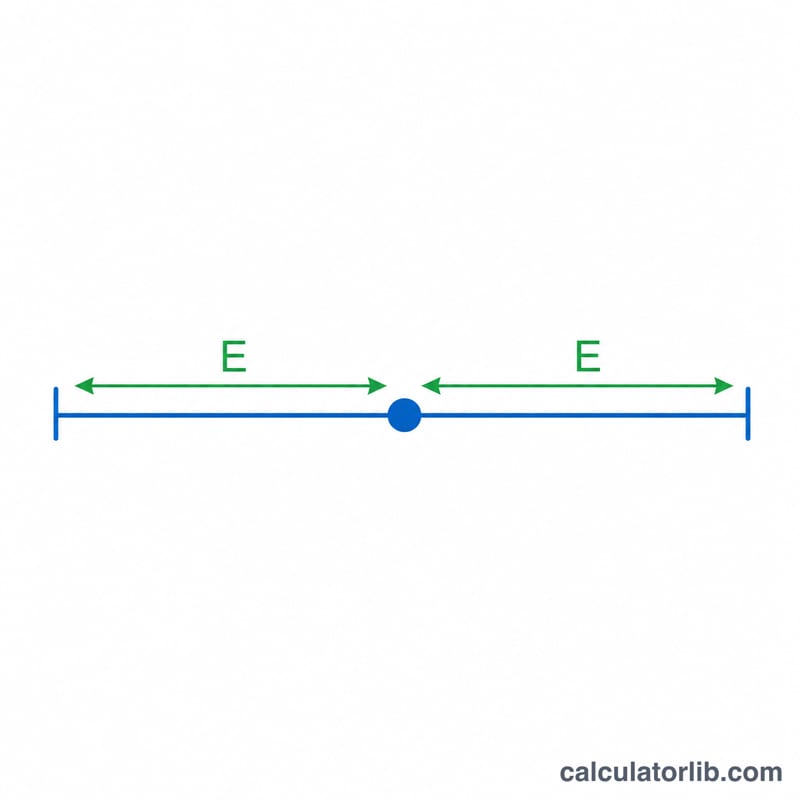
What is the margin of error? It is the ± range around your estimate at the chosen confidence level.