
What is a P-Value from a Z-Score?
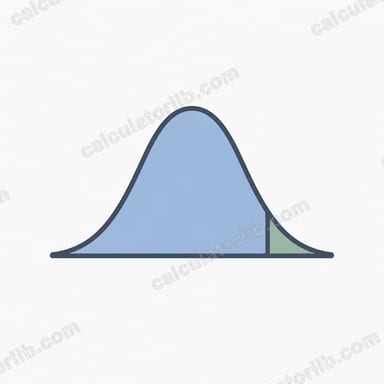
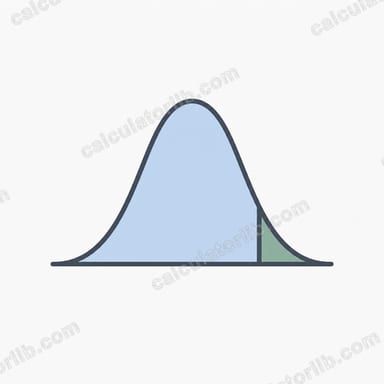
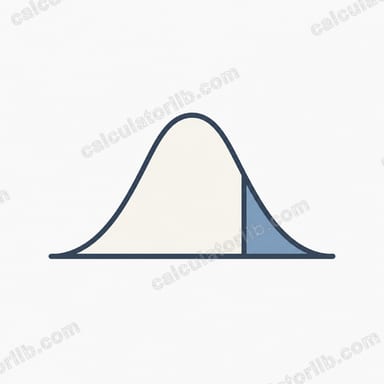
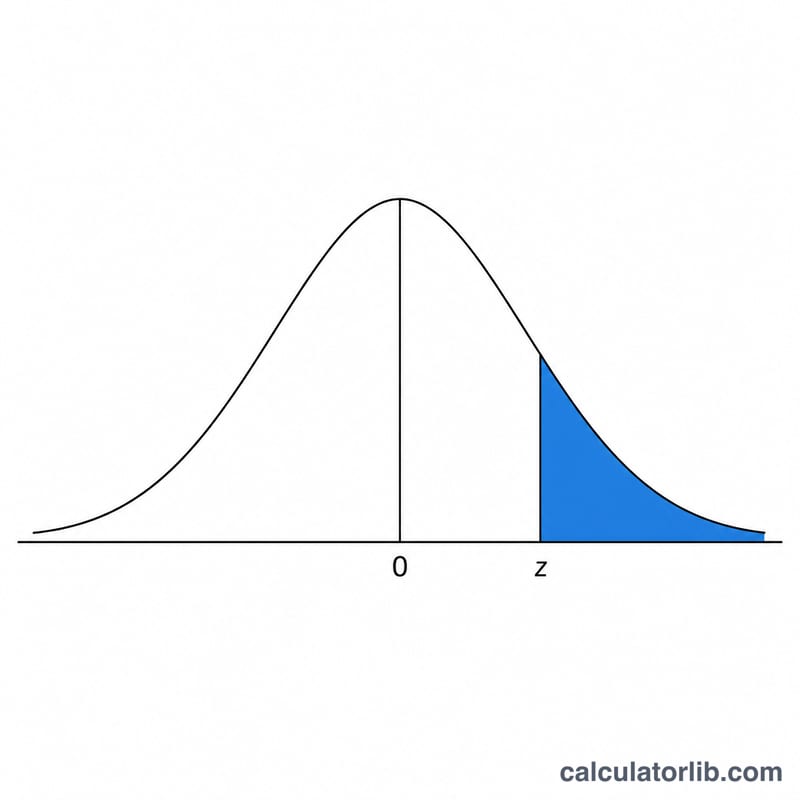
The P-value is the probability of observing a test statistic at least as extreme as the one you measured, assuming the null hypothesis is true. When your test statistic follows a standard normal distribution, you can convert a Z-score directly into a P-value using the cumulative distribution function \(\Phi\). A small P-value (commonly below 0.05) suggests the result is statistically significant.
How to Use This Calculator
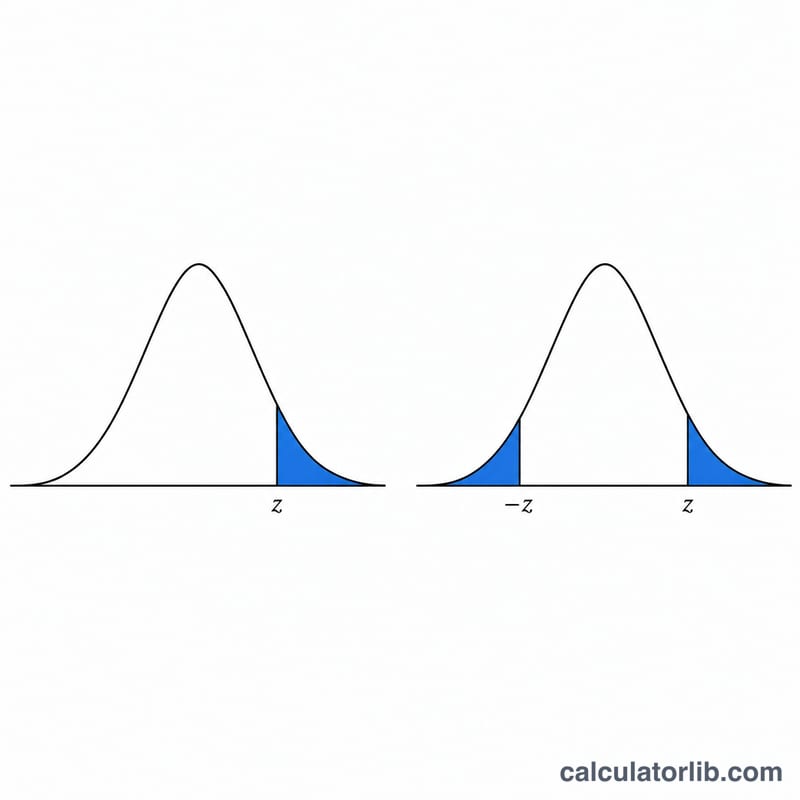
Enter your Z-score (positive or negative) and choose whether your test is one-tailed or two-tailed. The calculator returns the corresponding P-value along with \(\Phi(|z|)\), the cumulative probability. Use a two-tailed test when you are interested in deviations in either direction, and a one-tailed (right-tailed) test when you only care about an effect in one direction.
The Formula Explained
For a two-tailed test, the P-value is $$p = 2\left[1 - \Phi\left(\left|\text{Z-Score}\right|\right)\right]$$ doubling the upper-tail area because extreme values on both sides count. For a one-tailed (right) test, the P-value is $$p = 1 - \Phi\left(\text{Z-Score}\right)$$ the area to the right of \(z\). Here \(\Phi\) is the standard normal CDF, computed using the Abramowitz & Stegun rational approximation for high accuracy.
Worked Example
Suppose \(z = 1.96\) with a two-tailed test. The upper-tail area \(1 - \Phi(1.96) \approx 0.0250\), so the two-tailed P-value is $$2 \times 0.0250 = 0.0500$$ This matches the classic 95% confidence threshold: a Z-score of \(\pm 1.96\) corresponds to \(p \approx 0.05\).
FAQ
What does a P-value of 0.03 mean? If you used a 0.05 significance level, \(p = 0.03\) is below the threshold, so you would reject the null hypothesis.
Should I use one-tailed or two-tailed? Use two-tailed unless you have a strong, pre-specified directional hypothesis. Two-tailed is more conservative.
Does the sign of z matter? For two-tailed tests, only \(|z|\) matters. For one-tailed (right) tests, a negative \(z\) yields a P-value greater than 0.5.