
What Is Complement Probability?
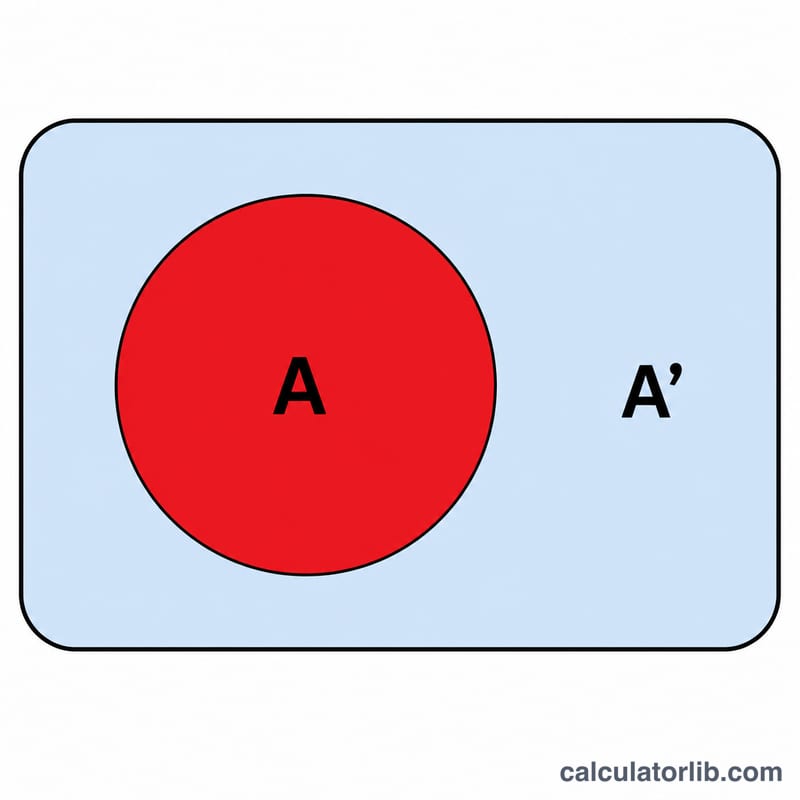
In probability theory, the complement of an event A is the event that A does not happen, written as A' (or Ac). Because something either happens or it doesn't, the probability of an event and the probability of its complement always add up to 1. This gives the simple but powerful complement rule: $$P(A') = 1 - P(A)$$
How to Use This Calculator
Enter the probability of your event, \(P(A)\), as a decimal between 0 and 1. For example, a 25% chance is entered as 0.25. The calculator returns \(P(A')\), the probability the event does not occur, shown both as a decimal and a percentage. It also confirms that the two probabilities sum to 1.
The Formula Explained
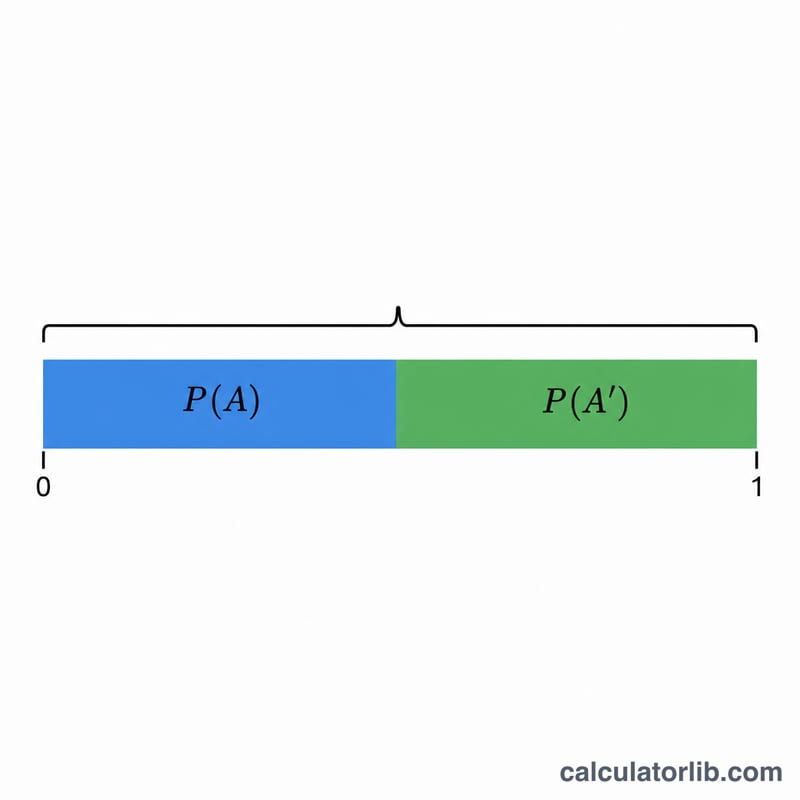
The complement rule comes directly from the axiom that the total probability of all possible outcomes equals 1. Since an event A and its complement A' together describe every possibility, \(P(A) + P(A') = 1\). Rearranging gives \(P(A') = 1 - P(A)\). The complement rule is especially handy when computing "at least one" probabilities, where finding the complement (none occur) is far easier than summing many cases.
Worked Example
Suppose the chance of rain tomorrow is \(P(A) = 0.30\) (30%). The chance it does not rain is the complement: $$P(A') = 1 - 0.30 = 0.70$$ or 70%. As a check, \(0.30 + 0.70 = 1\), confirming the result.
FAQ
Can P(A) be greater than 1? No. Probabilities range from 0 to 1 (0% to 100%). Values outside this range are clamped.
What is the complement of a certain event? If \(P(A) = 1\), the event is certain and its complement \(P(A') = 0\) — it is impossible for it not to occur.
Why use complements? They simplify "at least one" problems: \(P(\text{at least one}) = 1 - P(\text{none})\), which is often much easier to compute directly.