
What this calculator does
The Baby Age in Weeks and Months Calculator turns your child's date of birth into the way pediatricians and parenting books usually count infant age: weeks plus leftover days, and completed calendar months. Newborn growth and milestones are often tracked weekly, while vaccinations and developmental checks are scheduled by month, so having both at once is handy.
How to use it
Enter your baby's date of birth and the "as of" date (today by default). The tool reports the age in whole weeks, the extra days beyond those full weeks, the number of completed months, and the total days old.
The formula explained
First we compute the total number of days between the two dates. Dividing by 7 and rounding down gives whole weeks; the remainder (total days minus \(7 \times \text{weeks}\)) gives the leftover days. Completed months are counted from the calendar: \(\text{months} = 12 \times (\text{years difference}) + (\text{month difference})\), and we subtract one month if today's day-of-month is earlier than the birth day-of-month, meaning the current month is not yet complete.
$$\begin{gathered} \text{Weeks} = \left\lfloor \frac{D}{7} \right\rfloor, \quad \text{Days} = D - 7\left\lfloor \frac{D}{7} \right\rfloor \\[1.5em] \text{where}\quad \left\{ \begin{aligned} D &= \text{As of Date} - \text{Date of Birth} \;\; (\text{days}) \end{aligned} \right. \end{gathered}$$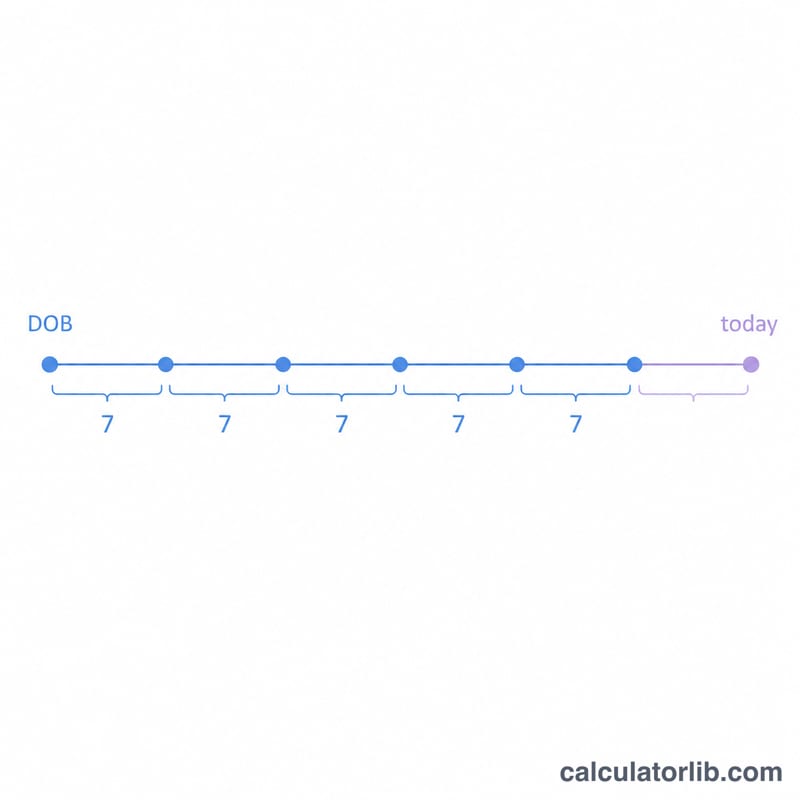
Worked example
Born 1 Jan 2024, as of 1 Mar 2024. That span is 60 days. \(60 \div 7 = 8\) weeks with a remainder of 4 days (\(8 \times 7 = 56\), \(60 - 56 = 4\)). Completed months: \((2024-2024)\times 12 + (3-1) = 2\), and since the day-of-month (1) is not earlier than the birth day (1), no reduction — so 2 months. Result: 8 weeks and 4 days, 2 months, 60 days total.
Infant Age Milestones by Week and Month
Pediatric well-child visits and vaccinations in the United States generally follow the schedule recommended by the American Academy of Pediatrics (AAP) and the CDC. The table below lists the typical ages at which checkups and immunizations are scheduled during the first 18 months. Exact timing varies — always confirm your own child's schedule with your pediatrician.
| Age | Approx. weeks | Well-child visit | Typical CDC-recommended vaccines |
|---|---|---|---|
| Birth | 0 | Newborn exam | Hepatitis B (1st dose) |
| 1 month | ~4 weeks | 1-month checkup | Hepatitis B (2nd dose, if not at birth) |
| 2 months | ~9 weeks | 2-month checkup | DTaP, Hib, IPV (polio), PCV, RV (rotavirus) |
| 4 months | ~17 weeks | 4-month checkup | DTaP, Hib, IPV, PCV, RV (2nd doses) |
| 6 months | ~26 weeks | 6-month checkup | DTaP, PCV, RV; influenza yearly; COVID-19 per guidance |
| 9 months | ~39 weeks | 9-month checkup | Developmental screening; catch-up doses as needed |
| 12 months | ~52 weeks | 12-month checkup | MMR, Varicella, Hepatitis A, Hib, PCV (booster window) |
| 15 months | ~65 weeks | 15-month checkup | DTaP, Hib, PCV (booster doses) |
| 18 months | ~78 weeks | 18-month checkup | Hepatitis A (2nd dose); developmental/autism screening |
These are typical schedules for general reference only. Vaccine combinations, catch-up timing, and visit dates should always be discussed with and confirmed by your pediatrician.
Age Across Different As-Of Dates
Using a fixed date of birth of January 1, 2024, the table shows how the same baby's age looks in total days, whole weeks plus leftover days, and completed calendar months for several as-of dates. Because a month averages about 4.35 weeks (not exactly 4), the weeks count and the months count steadily drift apart as the baby gets older.
| As-of date | Total days | Whole weeks + days | Completed months |
|---|---|---|---|
| Feb 1, 2024 | 31 | 4 weeks, 3 days | 1 month |
| Mar 1, 2024 | 60 | 8 weeks, 4 days | 2 months |
| Jul 1, 2024 | 182 | 26 weeks, 0 days | 6 months |
| Jan 1, 2025 | 366 | 52 weeks, 2 days | 12 months |
Notice that at 12 months the baby is 52 weeks and 2 days old, not exactly 48 weeks (12 × 4). The extra weeks accumulate because most months are longer than four weeks. 2024 includes February 29, so the one-year span totals 366 days.
Key Terms Explained
- Chronological age
- The actual elapsed time since the moment of birth, measured forward to the as-of date. This is what the calculator reports — it does not adjust for prematurity.
- Completed (calendar) months
- The number of whole calendar months that have fully passed since birth. A baby born on the 1st reaches "1 month" on the 1st of the following month, regardless of how many days that month has. Partial months are not counted until completed.
- Whole weeks
- The total days of age divided by 7, rounded down: \(\lfloor D/7 \rfloor\). Each week is exactly 7 days, so weeks accumulate at a steady rate (unlike calendar months, which vary in length).
- Leftover days
- The remainder after counting whole weeks: \(D - 7\lfloor D/7 \rfloor\), a value from 0 to 6. Combined with whole weeks, this gives the exact age (e.g. "8 weeks, 4 days").
- As-of date
- The reference date on which the age is measured. By default this is today, but you can set it to any date to find the baby's age at a past or future point.
- Corrected / adjusted age
- For babies born premature, adjusted (corrected) age subtracts the number of weeks born early from the chronological age, so developmental expectations are based on the original due date. For example, a 16-week-old born 4 weeks early has a corrected age of about 12 weeks. This tool reports only chronological age; to convert, use an adjusted age calculator.
FAQ
Why don't weeks and months line up exactly? Weeks are a fixed 7-day unit, but months vary from 28 to 31 days, so a baby can be "2 months" yet not exactly 8 weeks.
Does it handle leap years? Yes — the day count is based on actual calendar dates, so February 29 is included automatically.
Can I check age on a past or future date? Yes, just change the "as of" date to any date you like.