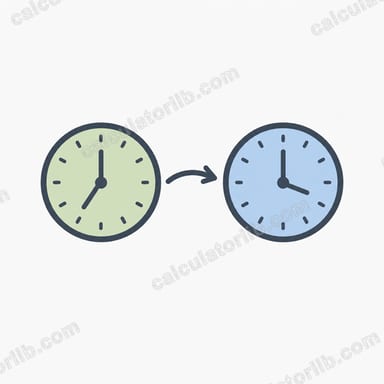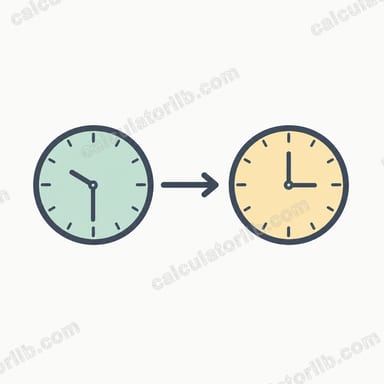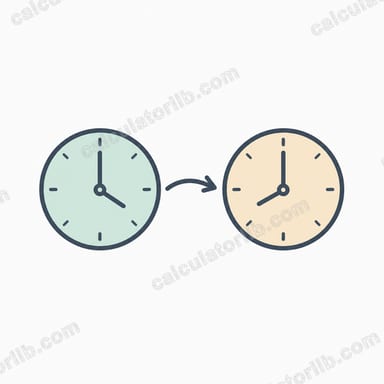

What is the PST to CST Converter?
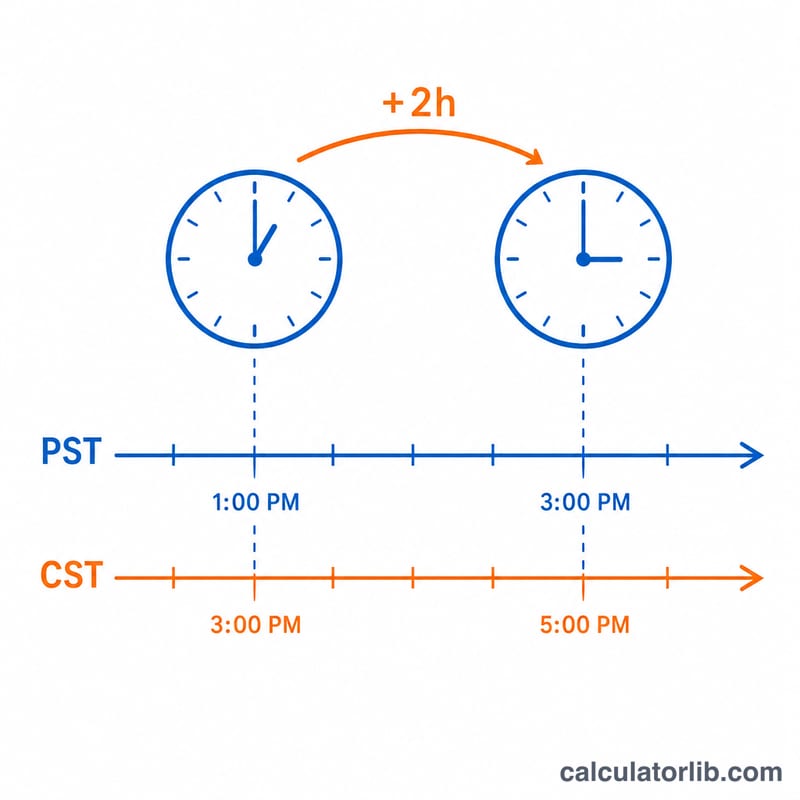
This tool converts a time in Pacific Standard Time (PST) to the equivalent time in Central Standard Time (CST). These are two of the standard time zones used in North America. PST corresponds to UTC−8 and CST corresponds to UTC−6, which means CST is always 2 hours ahead of PST. When it is noon in Los Angeles (PST), it is 2:00 PM in Chicago (CST).
How to use it
Enter the hour (0–23, in 24-hour format) and the minute for the Pacific time you want to convert. The calculator adds two hours and shows the matching Central time. If the result rolls past midnight, the tool flags it as the next day; if it goes below midnight, it shows the previous day.
The formula explained
The conversion is simply:
\(\text{CST} = \text{PST} + 2 \text{ hours}\)
Internally the calculator converts the input to total minutes since midnight, adds 120 minutes, then wraps the result within a 24-hour (1440-minute) day. Any whole-day overflow is tracked separately so you know whether the date changed.
$$\text{CST} = \left(\text{Hour (PST)} \times 60 + \text{Minute} + 120\right) \bmod 1440$$
Worked example
Suppose it is 11:30 PM (23:30) PST. Total minutes = \(23 \times 60 + 30 = 1410\). Add 120 \(\rightarrow 1530\) minutes. Since \(1530 \geq 1440\), subtract 1440 to get \(90\) minutes = 1:30 AM CST the next day.
FAQ
Is CST always 2 hours ahead of PST? Yes — both zones observe the same daylight-saving schedule, so the 2-hour gap stays constant year-round (PST/CST in winter, PDT/CDT in summer, still 2 hours apart).
What about PDT to CDT? The same +2-hour rule applies during daylight saving time.
Why 24-hour format? Using 0–23 hours avoids AM/PM ambiguity and makes midnight crossovers clear.