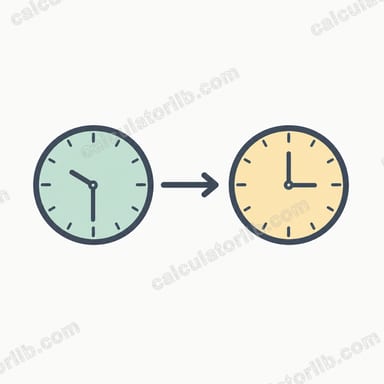
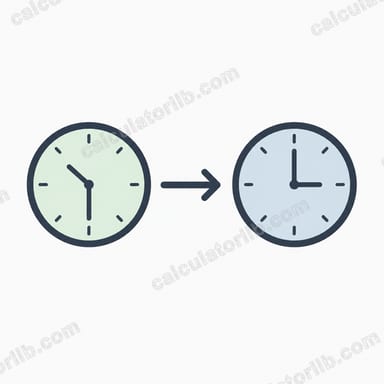
This tool converts a time given in India Standard Time (IST, UTC+5:30) to Pacific Standard Time (PST, UTC−8:00). The fixed offset between the two zones is exactly 13 hours and 30 minutes, so the rule is simply PST = IST − 13.5 hours. Note: PST is the winter (standard) time on the US/Canada Pacific coast. During daylight saving (PDT, UTC−7) the gap shrinks to 12.5 hours — this calculator uses the standard PST offset.
PST is 13.5 hours behind IST.
How to use it
Enter the IST hour using a 24-hour clock (0–23) and the minute (0–59). The calculator subtracts 13 hours 30 minutes and shows the matching PST time, along with a note telling you whether the result lands on the previous, same, or next calendar day.
The formula explained
We first express IST as minutes after midnight: \(t = \text{hour} \times 60 + \text{minute}\). We subtract 810 minutes (\(13.5 \times 60\)). Because the result can be negative or exceed a day, we wrap it with a modulo-1440 operation to keep it inside a single 24-hour window, and track the day offset separately.
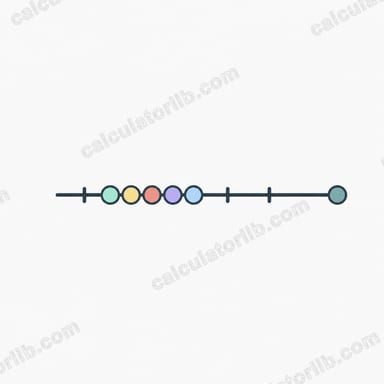
Aligning the IST and PST day bars visualizes the 13.5-hour shift.
Worked example
Suppose it is 10:30 IST. In minutes: \(10\times60 + 30 = 630\). Subtract 810 → \(-180\). Wrapping: \((-180 + 1440) = 1260\) minutes = 21 hours 0 minutes. So 10:30 IST = 21:00 (9:00 PM) PST on the previous day.
Advertisement
PST vs PDT: How the Gap Changes Through the Year
India does not observe daylight saving time and keeps UTC+5:30 all year. The Pacific zone of the United States does change its clock, so the gap between IST and Pacific time shifts by one hour during the year.
Period
Pacific zone
UTC offset
Gap behind IST
10:30 IST becomes
Winter (standard time)
PST
UTC−8
13 h 30 min
21:00 on the previous day
Summer (daylight saving time)
PDT
UTC−7
12 h 30 min
22:00 on the previous day
Worked check: \(10{:}30 - 13{:}30 = -3{:}00\), and \(-3{:}00 + 24{:}00 = 21{:}00\) on the previous day (PST). For PDT: \(10{:}30 - 12{:}30 = -2{:}00\), and \(-2{:}00 + 24{:}00 = 22{:}00\) on the previous day.
US daylight saving time starts on the second Sunday of March and ends on the first Sunday of November. Between those dates the Pacific zone is on PDT, so use the 12:30 gap. This tool converts to PST (the 13:30 gap), so during the summer months add one hour to its result to get the local Pacific time. Other countries have different daylight saving rules, so these dates apply to the United States.
FAQ
How many hours is IST ahead of PST? IST is 13 hours 30 minutes ahead of PST.
What about daylight saving (PDT)? When the Pacific zone observes PDT (UTC−7), the difference is 12 hours 30 minutes. This converter assumes standard PST.
Why does the date sometimes change? Because of the large 13.5-hour offset, an IST morning often corresponds to the previous evening in PST.
Calculate time differences across the globe with this Time Zone Converter. Easily compare multiple time zones, plan international calls, and avoid scheduling conflicts for seamless global communication.
Calculate UTC time effortlessly with UTC Time Converter. Input local time, select time zone from options, and instantly convert to Coordinated Universal Time (UTC). Simplify global time coordination now!
12:00 UTC is 6:00 AM CST (UTC−6) in winter and 7:00 AM CDT (UTC−5) from March to November. Pick a date and UTC time; the converter applies the right offset that day.
Convert Pacific Standard Time (PST) to Central Standard Time (CST) instantly. CST is 2 hours ahead of PST. Enter any hour and minute to get the result.
Calculate your total stock return including capital gains and dividends. Enter purchase price, sale price, and dividends to see your percentage return and profit.