
What is the Average Sleep Per Night Calculator?
This tool turns a week of sleep logs into a single, easy-to-understand number: your average hours of sleep per night. Instead of guessing whether you're getting enough rest, you enter how long you slept each night and the calculator returns your weekly mean along with your total sleep for the week.
How to use it
Enter the number of hours you slept for each of the seven nights (Monday through Sunday). Use decimals for partial hours — for example, enter 7.5 for seven and a half hours. Leave a night blank if you didn't track it; only the nights you fill in are counted toward the average. Click calculate to see your average sleep per night.
The formula explained
The math is a simple arithmetic mean: add up all the nightly sleep hours you entered, then divide by the number of nights counted.
$$\text{avg} = \frac{\text{sum of nightly hours}}{\text{number of nights}}$$
If you record fewer than seven nights, the divisor adjusts automatically so the average still reflects only the nights you logged.
Worked example
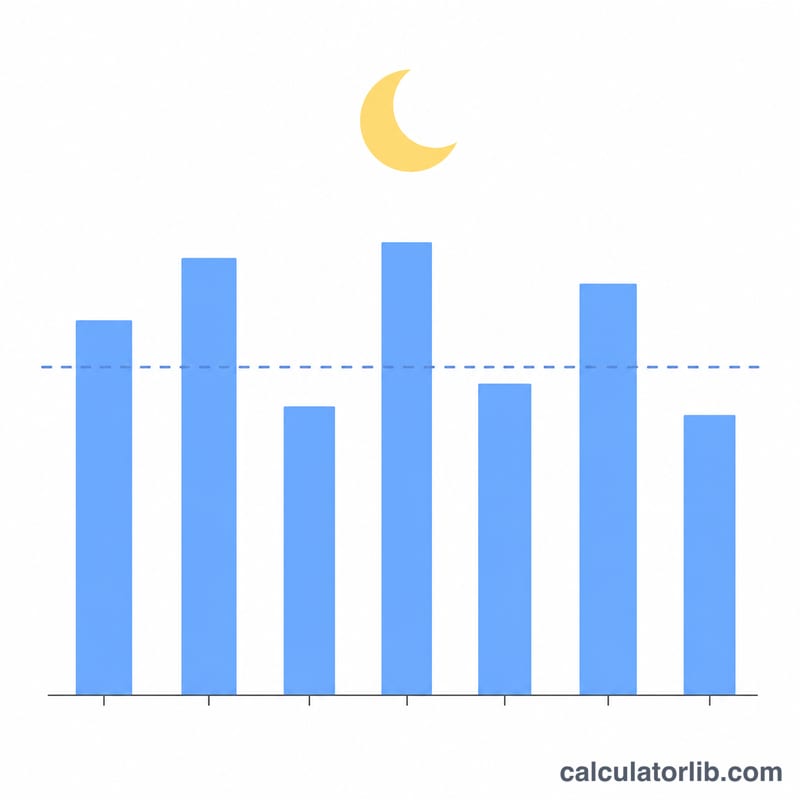
Suppose your week looks like this: 7, 7, 6.5, 7, 6, 8.5, 8 hours. The total is $$7 + 7 + 6.5 + 7 + 6 + 8.5 + 8 = 50$$ hours across 7 nights. Dividing 50 by 7 gives about \(7.14\) hours per night — close to the commonly recommended 7–9 hours for adults.
Recommended Sleep Ranges by Age
The amount of sleep a person needs changes substantially across the lifespan. The ranges below reflect the widely cited recommendations published by the National Sleep Foundation, which express healthy sleep as a band of hours per 24-hour day (including naps for younger groups) rather than a single number.
| Age group | Approximate age | Recommended sleep per day |
|---|---|---|
| Newborn | 0–3 months | 14–17 hours |
| Infant | 4–11 months | 12–15 hours |
| Toddler | 1–2 years | 11–14 hours |
| Preschool | 3–5 years | 10–13 hours |
| School-age | 6–13 years | 9–11 hours |
| Teenager | 14–17 years | 8–10 hours |
| Young adult | 18–25 years | 7–9 hours |
| Adult | 26–64 years | 7–9 hours |
| Older adult | 65+ years | 7–8 hours |
These bands describe typical healthy ranges for the general population. Individual needs vary, and some people feel well rested at the edges of a range. The figures for the youngest groups include daytime naps, while the adult ranges generally refer to total sleep within a 24-hour period.
Interpreting Your Weekly Average
For adults, established guidance places the healthy target at 7–9 hours of sleep per night. Once you have entered your seven nightly totals, the calculator reports your weekly mean — the sum of all nights divided by 7 — which smooths out the natural variation between a short Tuesday and a long Saturday and gives a clearer picture than any single night.
As a worked example, suppose your nightly hours were 6, 7, 6.5, 7, 6, 9, and 8.5. The total is 50 hours, so the average is \(50 \div 7 \approx\) 7.14 hours per night — within the recommended adult band.
- Within 7–9 hours: Your average falls inside the range most adults need. This generally suggests your overall sleep quantity aligns with established recommendations, though sleep quality and timing also matter.
- Below 7 hours: A weekly average under the lower bound may indicate insufficient sleep. Consistently short sleep is associated in the research literature with reduced daytime alertness and other effects.
- Above 9 hours: Routinely averaging more than the upper bound can be normal for some people but, when it represents a change, is sometimes worth noting alongside other factors.
Cumulative sleep debt. Sleep debt is the running difference between the sleep you need and the sleep you actually get. If an adult needs 8 hours but averages 6.5, the shortfall is about 1.5 hours per night, accumulating to roughly 10.5 hours of debt across a week. Because debt builds gradually, a single weekend of extra sleep does not fully "repay" a week of deficits, which is why tracking a weekly average is more informative than looking at one night.
Why consistency matters. Two people can share the same weekly average yet sleep very differently — one steady at 7.5 hours every night, the other swinging between 5 and 10. A regular schedule with similar bed and wake times supports a stable sleep–wake rhythm, so consistency is as meaningful as the total. Looking at the spread of your seven entries alongside the mean highlights nights that pull your average up or down.
This information is general and educational, not medical advice. If you have ongoing concerns about your sleep, consult a qualified healthcare professional.
FAQ
How many hours of sleep do I need? Most adults need 7–9 hours per night, though needs vary by age and individual.
What if I skip a night? Leave that field blank — the calculator only divides by the number of nights you actually entered.
Can I use naps? Add nap time into the night's total if you want total daily sleep, but for nightly averages enter only your main sleep period for consistency.