What is the CST to EST Converter?
This tool converts a time in Central Standard Time (CST) to Eastern Standard Time (EST). The continental United States uses several time zones, and the Central and Eastern zones are neighbors. EST sits one hour ahead of CST, so any clock reading in Chicago, Dallas or Houston is one hour behind the same moment in New York, Atlanta or Miami.
How to use it
Enter the hour (0–23) and minutes for the Central Time you want to convert. The calculator adds one hour and shows the equivalent Eastern Time. Times that cross midnight wrap around correctly — for example 23:30 CST becomes 00:30 EST.
The formula explained
CST is UTC−6 and EST is UTC−5. The difference between the two offsets is exactly one hour, so:
$$\text{EST} = \text{CST} + 1 \text{ hour}$$
More precisely, with times expressed in minutes:
$$T = \left( \text{Hour (CST)} \times 60 + \text{Minute} + 60 \right) \bmod 1440$$where
$$\left\{ \begin{aligned} \text{EST Hour} &= \left\lfloor \frac{T}{60} \right\rfloor \\ \text{EST Minute} &= T \bmod 60 \end{aligned} \right.$$This applies to standard time. During spring and summer, both zones observe daylight saving as CDT (UTC−5) and EDT (UTC−4) — the one-hour gap stays the same, only the labels change.
Worked example
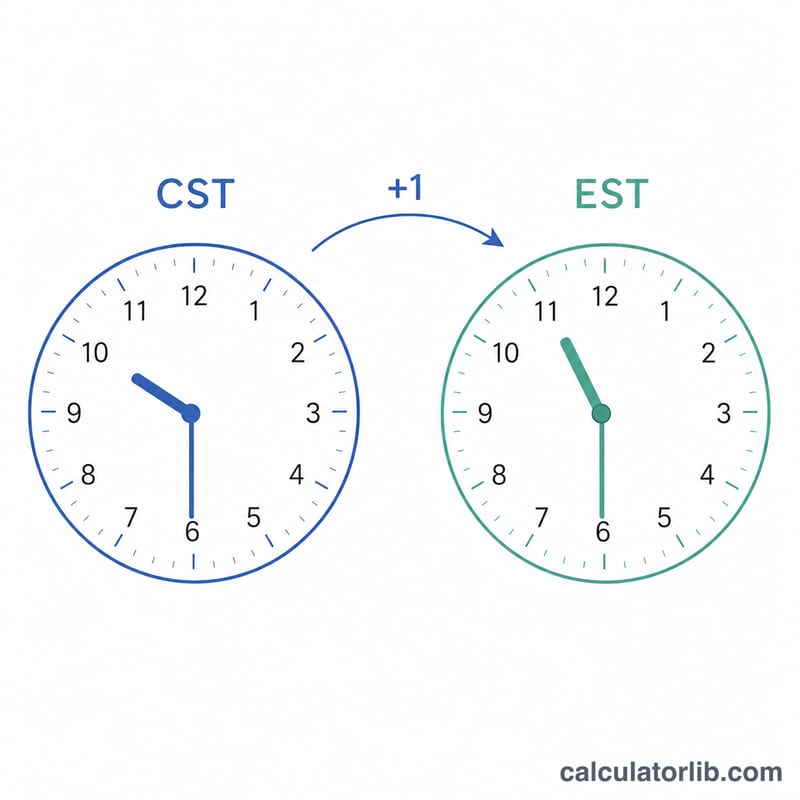
Suppose a meeting is scheduled for 9:00 AM CST. In 24-hour form that is 09:00. Adding one hour gives \(09:00 + 1 = 10:00\), so the meeting is at 10:00 AM EST. Likewise, 14:45 CST converts to 15:45 EST (3:45 PM).
CST to EST Quick Conversion Table
Eastern Standard Time (EST, UTC−5) is exactly 1 hour ahead of Central Standard Time (CST, UTC−6). To convert, add 1 hour to the CST time. The calculator does this in minutes: \(\text{EST} = (\text{hour} \times 60 + \text{minute} + 60) \bmod 1440\), so any result past midnight wraps to the next day.
| CST (12-hour) | CST (24-hour) | EST (12-hour) | EST (24-hour) | Date |
|---|---|---|---|---|
| 12:00 AM | 00:00 | 1:00 AM | 01:00 | Same day |
| 2:00 AM | 02:00 | 3:00 AM | 03:00 | Same day |
| 4:00 AM | 04:00 | 5:00 AM | 05:00 | Same day |
| 6:00 AM | 06:00 | 7:00 AM | 07:00 | Same day |
| 8:00 AM | 08:00 | 9:00 AM | 09:00 | Same day |
| 10:00 AM | 10:00 | 11:00 AM | 11:00 | Same day |
| 11:00 AM | 11:00 | 12:00 PM | 12:00 | Same day |
| 12:00 PM | 12:00 | 1:00 PM | 13:00 | Same day |
| 2:00 PM | 14:00 | 3:00 PM | 15:00 | Same day |
| 4:00 PM | 16:00 | 5:00 PM | 17:00 | Same day |
| 6:00 PM | 18:00 | 7:00 PM | 19:00 | Same day |
| 8:00 PM | 20:00 | 9:00 PM | 21:00 | Same day |
| 10:00 PM | 22:00 | 11:00 PM | 23:00 | Same day |
| 11:00 PM | 23:00 | 12:00 AM | 00:00 | Next day |
Example of the rollover: 11:00 PM CST is \(23 \times 60 + 0 + 60 = 1440\) minutes, and \(1440 \bmod 1440 = 0\), which is 12:00 AM (00:00) EST on the following calendar date. Any CST time from 11:00 PM to 11:59 PM rolls into the next day in EST.
Time Zone Terms: CST, EST, CDT, EDT, UTC
- UTC (Coordinated Universal Time)
- The global time standard from which all civil time zones are measured. It does not change with the seasons.
- UTC offset
- The number of hours (and sometimes minutes) a local time is ahead of (+) or behind (−) UTC. For example, UTC−6 means local time is 6 hours behind UTC.
- CST (Central Standard Time)
- UTC−6. The standard (non-daylight) time in the Central time zone of North America, used in winter in places such as most of the central United States and parts of Canada.
- CDT (Central Daylight Time)
- UTC−5. The Central zone's daylight saving time, used in summer.
- EST (Eastern Standard Time)
- UTC−5. The standard time in the Eastern time zone of North America, used in winter.
- EDT (Eastern Daylight Time)
- UTC−4. The Eastern zone's daylight saving time, used in summer.
- Daylight saving time (DST)
- The practice of moving clocks forward one hour for part of the year (in the United States, from March to November) to shift daylight into the evening. Not every region observes it.
Summer caution: While daylight saving time is in effect, CDT and EST share the same UTC offset (UTC−5). However, the real-world gap between Central and Eastern clocks stays one hour year-round, because both zones shift together: CST (UTC−6) to EST (UTC−5) in winter, and CDT (UTC−5) to EDT (UTC−4) in summer. This converter applies the standard-time rule, adding 1 hour from CST to EST. If you are scheduling in summer, remember that people in these zones will usually say "Central" and "Eastern" without specifying standard or daylight, and the one-hour difference still holds.
FAQ
Is EST ahead of or behind CST? EST is ahead by one hour. When it is 12:00 noon in Central Time, it is 1:00 PM in Eastern Time.
Does daylight saving change the difference? No. Both zones shift together, so the gap remains one hour year-round (CDT to EDT).
Which cities use these zones? CST: Chicago, Houston, Dallas, New Orleans. EST: New York, Washington D.C., Atlanta, Miami.