
What is the EST to CST Converter?
This tool converts a time in Eastern Standard Time (EST) to its equivalent in Central Standard Time (CST). Both are time zones used in the United States and Canada. Central Time always sits exactly one hour behind Eastern Time, so 3:00 PM EST is 2:00 PM CST. This converter applies to the standard-time offset; during daylight saving the labels become EDT and CDT, but the one-hour gap between the two zones stays the same.
How to use it
Enter the hour in 24-hour format (0–23) and the minutes (0–59) for the Eastern time you want to convert. The calculator subtracts one hour and wraps the result around midnight when needed, returning the matching Central time in HH:MM format. Minutes are never changed because the zones differ only by whole hours.
The formula explained
The core rule is simply CST = EST − 1 hour. To keep the result on a valid 24-hour clock we use modular arithmetic: \(\text{CST} = (\text{EST} - 1 + 24) \bmod 24\). Adding 24 before taking the remainder ensures that subtracting an hour from 00:00 correctly produces 23:00 (the previous day) rather than a negative number.
$$\text{CST Hour} = \left(\left(\text{Hour (EST)} - 1\right) \bmod 24 + 24\right) \bmod 24 \qquad \text{CST Minute} = \text{Minute}$$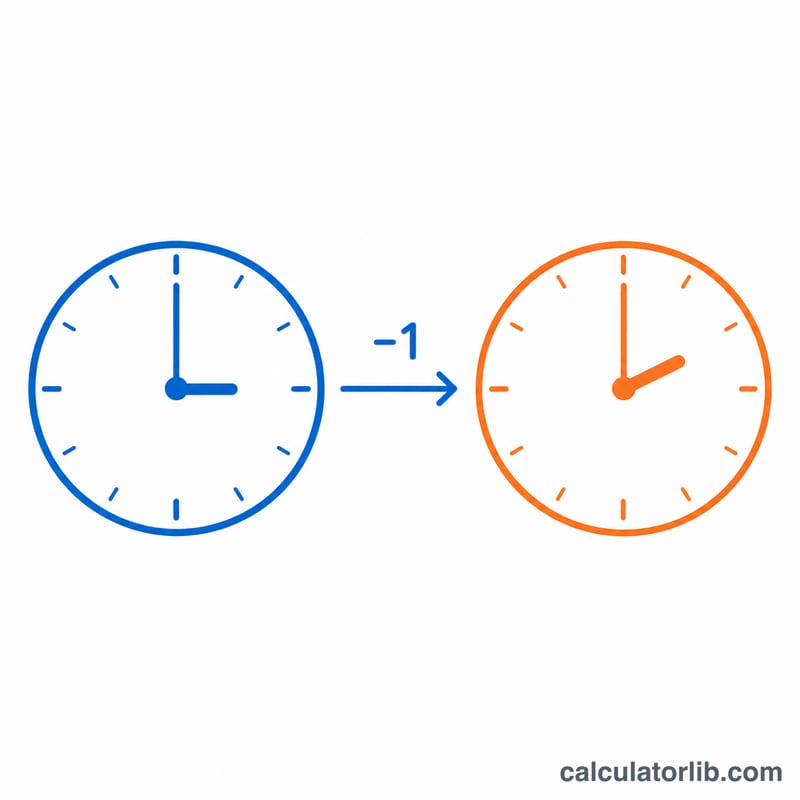
Worked example
Suppose it is 1:00 PM in New York, which is 13:00 in 24-hour format. Subtracting one hour gives 12, so the Central time is 12:00, or 12:00 PM in Chicago. For a midnight edge case, 00:30 EST becomes \((0 - 1 + 24) \bmod 24 = 23\), giving 23:30 CST on the previous day.
FAQ
Is CST always one hour behind EST? Yes — Eastern Time is always exactly one hour ahead of Central Time, both during standard time and daylight saving time.
Do the minutes change? No. The offset between these zones is a whole hour, so the minute value is identical in both.
What about EDT and CDT? During daylight saving (mid-March to early November) the zones are called EDT and CDT, but they are still one hour apart, so this converter still applies.