
What Is the VO2 Max from Resting Heart Rate Calculator?
This calculator estimates your VO2 max — the maximum amount of oxygen your body can use during intense exercise — using only your age and resting heart rate. VO2 max is one of the best single indicators of aerobic fitness and cardiovascular health. Higher values generally mean a stronger, more efficient heart and better endurance capacity.
How to Use It
Enter your age in years and measure your resting heart rate (RHR) in beats per minute. For the most accurate RHR, measure it first thing in the morning before getting out of bed, or after sitting quietly for several minutes. Click calculate to see your estimated VO2 max in mL/kg/min.
The Formula Explained
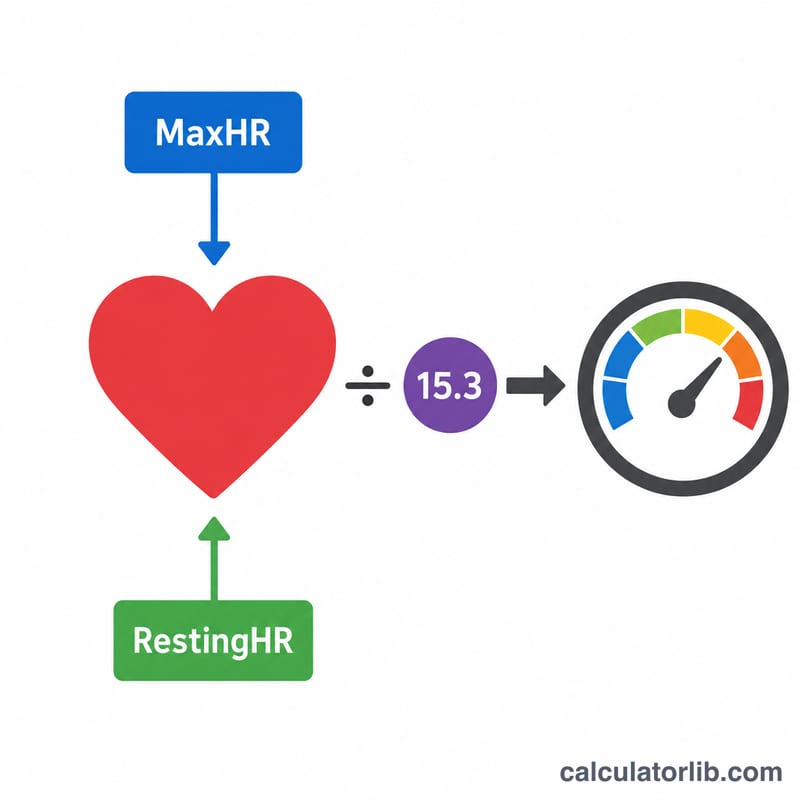
This tool uses the Uth–Sørensen–Overgaard–Pedersen equation: $$\text{VO}_2\text{max} = 15.3 \times \frac{\text{MaxHR}}{\text{RestingHR}}$$. Maximum heart rate is estimated as \(220 - \text{age}\). The ratio of max to resting heart rate reflects your heart's reserve capacity — a low resting rate combined with a high max rate produces a higher VO2 max estimate.
Worked Example
Suppose you are 30 years old with a resting heart rate of 60 bpm. Your estimated max heart rate is \(220 - 30 = 190\) bpm. Then $$\text{VO}_2\text{max} = 15.3 \times \frac{190}{60} = 15.3 \times 3.1667 \approx 48.45 \text{ mL/kg/min},$$ an above-average value for that age.
FAQ
How accurate is this estimate? It is a rough screening estimate. A laboratory test with gas analysis is far more precise, but this method is convenient and useful for tracking trends over time.
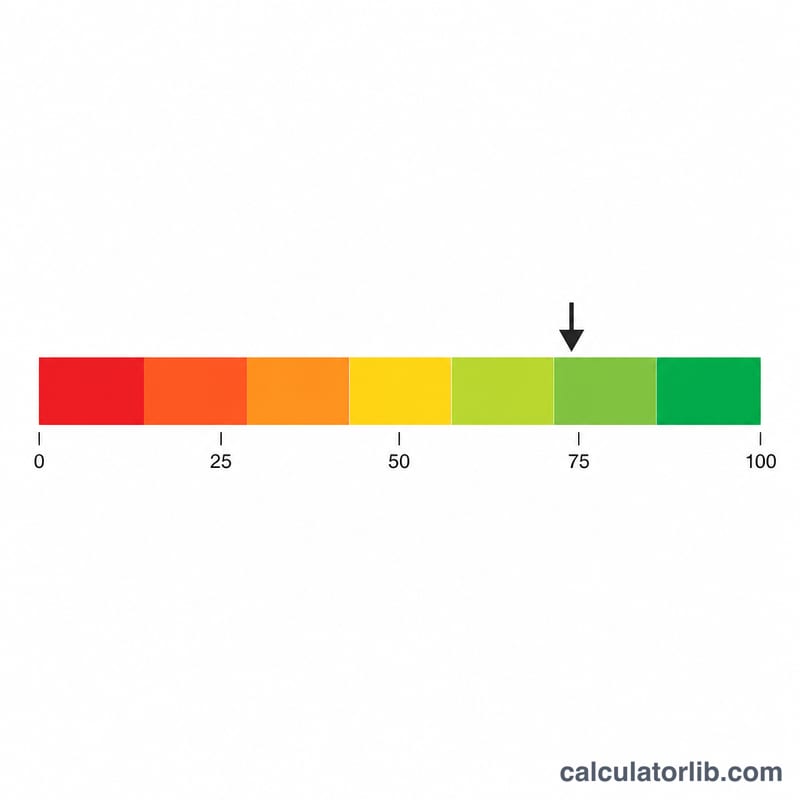
What is a good VO2 max? Values vary by age and sex. For adults, roughly 35–45 is average, while well-trained athletes often exceed 55–60 mL/kg/min.
How can I improve my VO2 max? Regular aerobic and interval training lowers resting heart rate and increases aerobic capacity, which raises this estimate.