
What this calculator does
The Calories Burned by Steps Calculator turns your daily step count into an estimate of the energy you have burned walking. Instead of using a flat "one calorie per step" rule, it accounts for your body weight and your stride length (derived from your height), which are the two biggest factors in how much energy walking actually costs.
How to use it
Enter the number of steps you have taken (for example from a phone or fitness tracker), your body weight in kilograms, and your height in centimetres. The calculator estimates your stride length, converts steps into distance, and multiplies by an energy cost factor to return calories (kcal) burned.
The formula explained
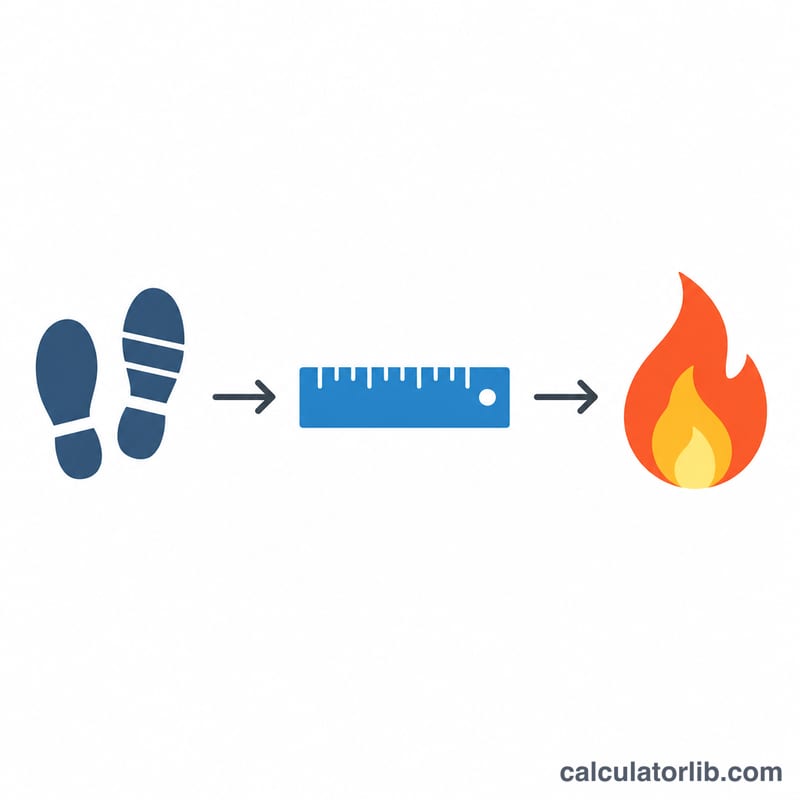
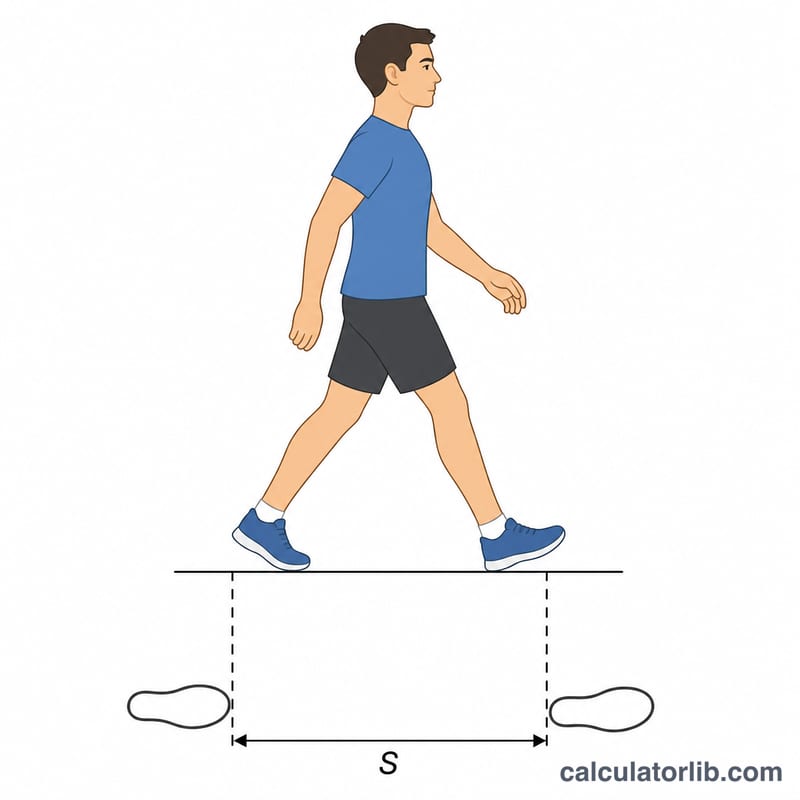
First, stride length is approximated as 41.5% of your height: stride = height \times 0.415 \div 100 (in metres). Distance is then steps \times stride, converted to kilometres. Walking costs roughly 0.57 kcal per kilogram of body weight per kilometre, so the final estimate is distance(km) \times 0.57 \times weight(kg). Heavier people and longer strides burn more energy per step.
$$\text{Calories} = \frac{\text{Steps} \times \left(\frac{\text{Height (cm)} \times 0.415}{100}\right)}{1000} \times 0.57 \times \text{Weight (kg)}$$
Worked example
Suppose you walk 10,000 steps, weigh 70 kg and are 170 cm tall. Stride = \(170 \times 0.415 \div 100 = 0.7055 \text{ m}\). Distance = \(10{,}000 \times 0.7055 = 7{,}055 \text{ m} = 7.055 \text{ km}\). Calories = \(7.055 \times 0.57 \times 70 \approx\) 281.5 kcal.
FAQ
Is this exact? No — it is an estimate. Actual calorie burn depends on walking speed, terrain, fitness and metabolism.
Why use height? Height predicts stride length, which determines how far each step carries you and therefore the total distance and energy used.
Does walking faster burn more? Brisk walking generally burns more per minute, but the total energy to cover a given distance changes only modestly, which is why distance-based estimates work well for daily totals.