What is the Steps to Calories Calculator?
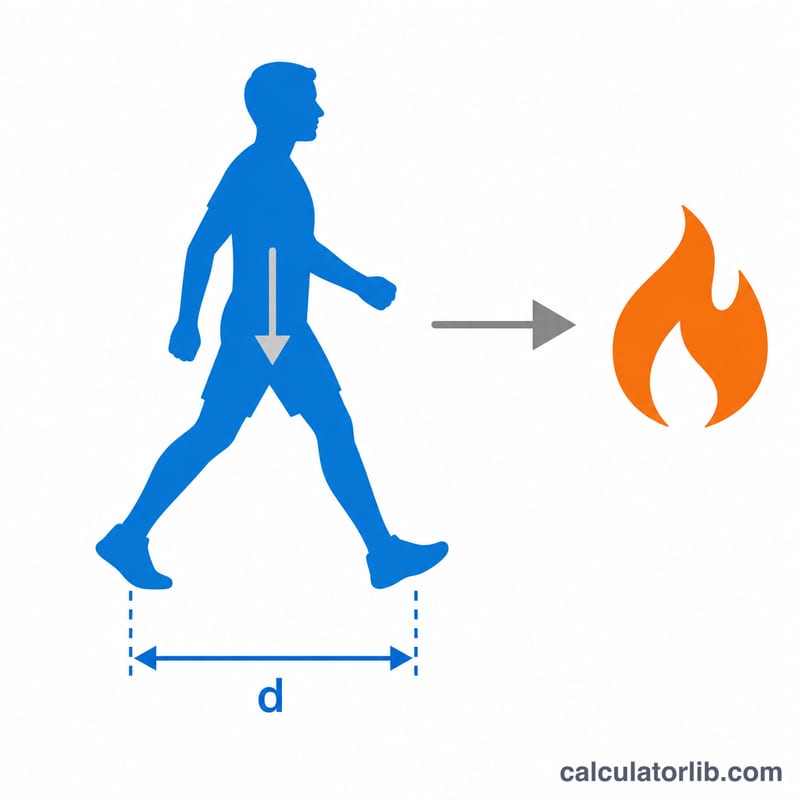
This calculator turns your daily step count into an estimate of how many calories (kcal) you burned walking. Because energy expenditure depends on how much you weigh and how far each step carries you, it factors in both your body weight and your stride length. It is useful for anyone tracking activity from a pedometer, phone, or fitness watch who wants a quick energy estimate.
How to use it
Enter three values: your total number of steps, your body weight in kilograms, and your stride length in metres. Average adult stride length is roughly 0.7–0.8 m (about your height in cm × 0.43 ÷ 100). Press calculate to see estimated calories burned, the distance you walked, and your calories per kilometre.
The formula explained
The estimate uses $$\text{kcal} = \text{steps} \times \text{weight}_{kg} \times \text{stride}_{m} \times 0.000484$$ The constant \(0.000484\) bundles together the metabolic cost of moving body mass over distance for typical level walking. Multiplying steps by stride gives total distance, and multiplying by weight scales the energy cost to your body — heavier people and longer strides burn more per step.
Worked example
Suppose you take 10,000 steps, weigh 70 kg, and have a 0.75 m stride. $$\text{Calories} = 10000 \times 70 \times 0.75 \times 0.000484 = \mathbf{254.1\ \text{kcal}}$$ $$\text{Distance} = 10000 \times 0.75 \div 1000 = 7.5\ \text{km}$$ giving about \(33.88\) kcal per km.
Calories Burned at Different Step Counts and Body Weights
This calculator converts steps into energy using a single proportional relationship — more steps, more body mass and a longer stride all raise the work done per walk:
$$\text{kcal} = \text{steps} \times \text{weight (kg)} \times \text{stride (m)} \times 0.000484$$The table below applies that formula at a fixed stride of 0.75 m, which is a reasonable average for an adult of about 175 cm. Distance is simply \(\text{steps} \times 0.75 \div 1000\) km. For example, 10,000 steps for a 70 kg walker gives \(10000 \times 70 \times 0.75 \times 0.000484 = 254.1\) kcal.
| Steps | Distance (km) | 55 kg | 70 kg | 85 kg | 100 kg |
|---|---|---|---|---|---|
| 2,000 | 1.50 | 39.9 kcal | 50.8 kcal | 61.7 kcal | 72.6 kcal |
| 5,000 | 3.75 | 99.8 kcal | 127.1 kcal | 154.3 kcal | 181.5 kcal |
| 7,500 | 5.63 | 149.7 kcal | 190.6 kcal | 231.4 kcal | 272.3 kcal |
| 10,000 | 7.50 | 199.7 kcal | 254.1 kcal | 308.6 kcal | 363.0 kcal |
| 15,000 | 11.25 | 299.5 kcal | 381.2 kcal | 462.8 kcal | 544.5 kcal |
Two patterns are worth noting. First, the relationship is strictly linear: doubling the steps doubles the calories, and a 100 kg walker burns about 1.8 times as much as a 55 kg walker over the same route. Second, all figures are active calories only — the energy attributed to the walking itself. They exclude resting metabolism, the several hundred to roughly two thousand kilocalories a body spends per day simply staying alive, so these numbers must never be added to a full daily expenditure figure as if they were separate.
Typical Stride Length and Steps per Kilometre by Height
If you have not measured your stride, a common rule of thumb estimates it from standing height for ordinary walking:
$$\text{stride (m)} \approx \text{height (m)} \times 0.43$$The table applies that rule across a range of adult heights and converts it into steps per kilometre, \(1000 \div \text{stride}\), plus the distance that 10,000 steps would actually cover at each stride.
| Height | Estimated stride | Steps per kilometre | Distance of 10,000 steps |
|---|---|---|---|
| 150 cm | 0.65 m | ≈ 1,540 | 6.5 km |
| 160 cm | 0.69 m | ≈ 1,450 | 6.9 km |
| 170 cm | 0.73 m | ≈ 1,370 | 7.3 km |
| 180 cm | 0.77 m | ≈ 1,300 | 7.7 km |
| 190 cm | 0.82 m | ≈ 1,220 | 8.2 km |
Three clarifications matter for using these numbers correctly.
- "Stride" here means one step. In this calculator — and in the table above — stride is the step-to-step distance, heel strike of one foot to heel strike of the other. Some gait literature uses "stride" for a full two-step cycle, which is about twice as long. If you use that definition by mistake, your distance and calorie figures will roughly double.
- Walking stride is shorter than running stride. The same person who takes 0.73 m steps while walking may cover well over a metre per step when running, so these height-based values should not be reused for a run.
- The rule is an approximation. Leg length relative to height, hip mobility, footwear, terrain, age and walking speed all shift real stride length. People walking slowly, carrying something, or walking on uneven ground take noticeably shorter steps than the table suggests.
For a genuinely accurate figure, use the measured 10-step test described in the FAQ: mark a start point, walk ten natural steps, measure the total distance to where your trailing foot lands, and divide by ten. That single measurement will do more for the accuracy of your calorie estimate than any refinement of the height rule.
FAQ
Is this exact? No — it is an approximation. Real burn varies with terrain, pace, incline, and fitness, so treat it as a useful ballpark.
How do I find my stride length? Walk 10 steps, measure the distance, and divide by 10. Or estimate as \(\text{height(cm)} \times 0.43\), converted to metres.
Does it include resting calories? No. This estimates the active calories from walking only, not your baseline metabolic rate.