
What Are Maintenance Calories?
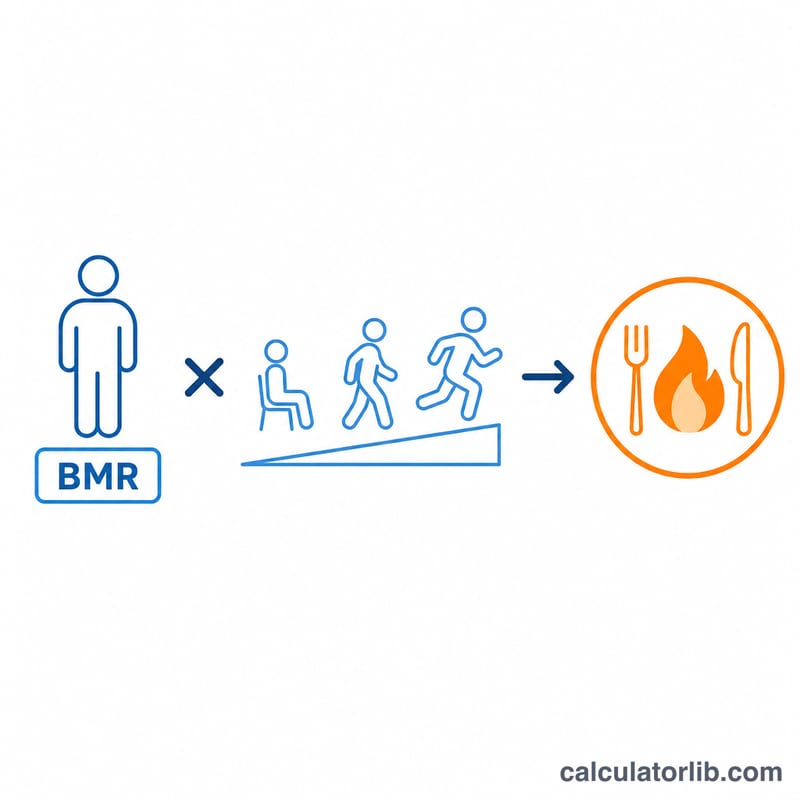
Your maintenance calories — also called Total Daily Energy Expenditure (TDEE) — are the number of calories you need each day to keep your weight stable. Eat that amount and your weight holds steady; eat more and you gain, eat less and you lose. This calculator estimates maintenance calories from your Basal Metabolic Rate (BMR) and how active you are.
How to Use It
Enter your gender, weight in kilograms, height in centimetres and age. Then pick the activity level that best matches your typical week. The calculator computes your BMR with the Mifflin-St Jeor equation, multiplies it by an activity factor (PAL), and shows your maintenance calories along with suggested targets for losing or gaining weight.
The Formula Explained
First we estimate resting energy use:
$$\text{BMR} = 10 \times \text{weight(kg)} + 6.25 \times \text{height(cm)} - 5 \times \text{age} + s$$ where \(s = +5\) for men and \(s = -161\) for women.
Then maintenance calories $$\text{Maintenance kcal} = \text{BMR} \times \text{PAL}$$ The PAL (Physical Activity Level) factors used are: Sedentary \(1.2\), Lightly active \(1.375\), Moderately active \(1.55\), Very active \(1.725\), Extra active \(1.9\). A daily deficit of about 500 kcal corresponds to roughly 0.5 kg of fat loss per week.
Worked Example
A 30-year-old man weighing 70 kg and 175 cm tall: $$\text{BMR} = 10 \times 70 + 6.25 \times 175 - 5 \times 30 + 5 = 700 + 1093.75 - 150 + 5 = 1648.75 \text{ kcal}$$ If he is lightly active (PAL 1.375), $$\text{maintenance} = 1648.75 \times 1.375 \approx 2267 \text{ kcal/day}$$ To lose weight he might aim for about 1767 kcal/day.
Activity Level (PAL) Factors
Your TDEE is your BMR multiplied by a Physical Activity Level (PAL) factor. Pick the row that best matches both your structured exercise and your everyday movement (job, errands, walking). When in doubt, choose the lower of two adjacent levels — most people overestimate how active they are.
| Activity level | PAL multiplier | Typical weekly pattern |
|---|---|---|
| Sedentary | 1.2 | Desk job, little or no exercise; mostly sitting throughout the day. |
| Lightly active | 1.375 | Light exercise or sport 1–3 days/week, or a job with some standing/walking. |
| Moderately active | 1.55 | Moderate exercise or sport 3–5 days/week. |
| Very active | 1.725 | Hard exercise or sport 6–7 days/week, or a physically demanding job. |
| Extra active | 1.9 | Very hard daily training, a physical job plus training, or twice-daily workouts. |
Key Terms Explained
- TDEE (Total Daily Energy Expenditure)
- The total calories you burn in a day, equal to BMR + TEF + EAT + NEAT. Also called maintenance calories.
- BMR (Basal Metabolic Rate)
- The calories your body uses at complete rest to sustain basic functions like breathing, circulation and cell repair.
- PAL (Physical Activity Level)
- A multiplier (1.2–1.9) applied to BMR to account for movement and exercise, producing your TDEE.
- NEAT (Non-Exercise Activity Thermogenesis)
- Calories burned through everyday non-workout movement — walking, standing, fidgeting and daily tasks.
- TEF (Thermic Effect of Food)
- The energy used to digest, absorb and metabolize the food you eat, usually about 10% of intake.
- Maintenance calories
- The intake at which your body weight stays stable — numerically equal to your TDEE.
- Deficit
- Eating fewer calories than your TDEE, which causes the body to use stored energy and lose weight.
- Surplus
- Eating more calories than your TDEE, which provides extra energy for weight and muscle gain.
FAQ
Is this accurate? It is a solid estimate. Real needs vary with body composition, genetics and NEAT, so adjust based on real-world weight trends over 2-3 weeks.
Which activity level should I pick? Be honest — most people overestimate. If you sit most of the day with a few light workouts, "Lightly active" is usually right.
Why Mifflin-St Jeor? Research shows it predicts resting energy expenditure more accurately for most people than the older Harris-Benedict equation.