
What is a Brine Calculator?
A brine calculator tells you exactly how much salt to add to a given amount of water to reach a target salt concentration. It is an essential tool for fermenting vegetables, pickling, curing meats, and brining poultry. This tool uses the common "percent by weight of water" method favored in lacto-fermentation, where the salt is measured as a percentage of the water weight.
How to Use It
Enter the weight of your water in grams and your desired brine strength as a percentage. The calculator returns the grams of salt to dissolve, plus the total weight of the finished brine. Use a kitchen scale for accuracy — measuring salt by volume is unreliable because salt crystals vary greatly in density.
The Formula Explained
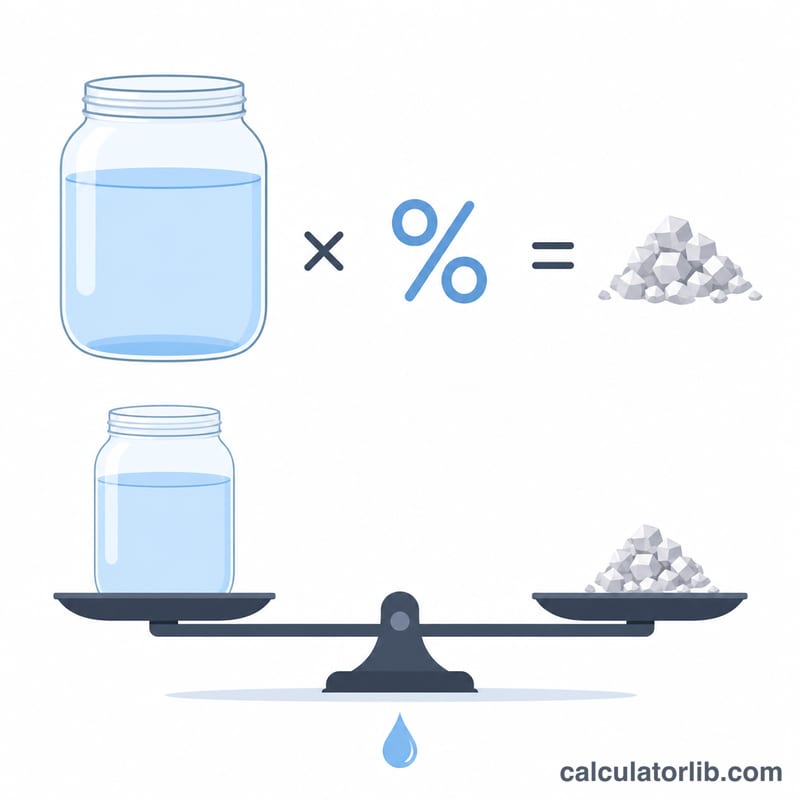
The core formula is simple: $$\text{Salt (g)} = \text{Water (g)} \times \frac{\text{Brine Strength (\%)}}{100}$$ A 5% brine means the salt weighs 5% of the water. The total brine weight is the water plus the added salt.
Worked Example
Suppose you have 1,000 g of water and want a 5% brine for fermenting cucumbers. $$\text{Salt} = 1{,}000 \times \frac{5}{100} = \mathbf{50\ \text{g of salt}}$$ The total brine weight is \(1{,}000 + 50 = 1{,}050\ \text{g}\).
Brine Strength Reference Chart
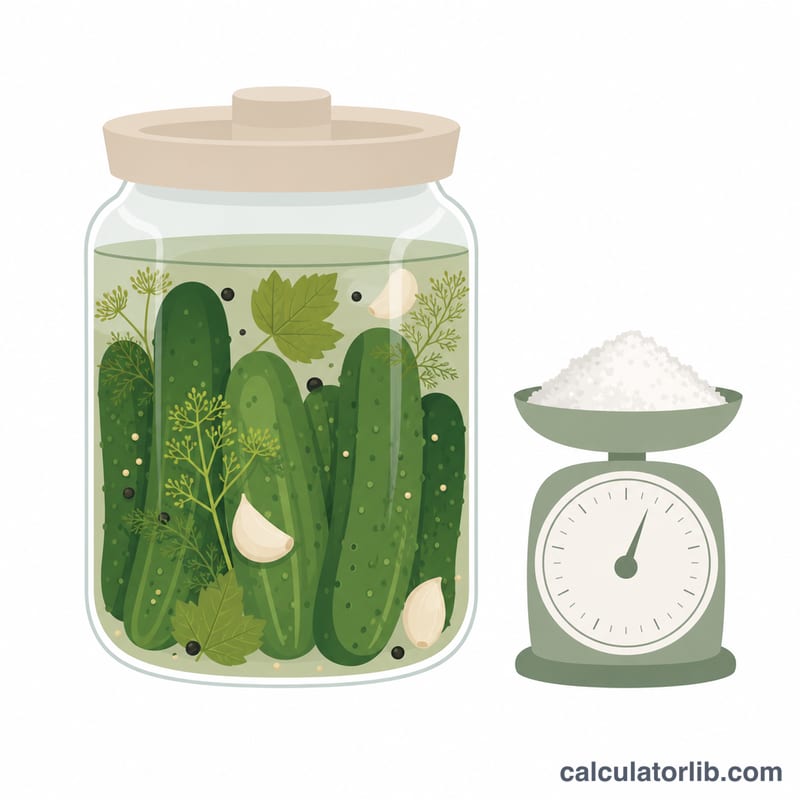
Brine strength is expressed as a salt-by-weight percentage: the grams of salt divided by the grams of water, times 100. Different foods call for different concentrations because salt both controls which microbes thrive and affects final texture and flavor. The chart below lists widely used ranges for pickling and lacto-fermentation.
| Food / Preparation | Recommended brine | What this range achieves |
|---|---|---|
| Sauerkraut (cabbage) | 2–2.5% | Encourages a clean, sour lactic ferment while keeping the cabbage crisp; low enough to let beneficial bacteria dominate quickly. |
| Most vegetable ferments (carrots, beets, cauliflower) | 2–3% | A reliable all-purpose range that suppresses spoilage organisms yet allows a brisk, tangy fermentation. |
| Hot peppers (fermented) | 3–5% | Slightly higher salt slows fermentation a touch and helps firm pepper flesh for sauces and pastes. |
| Cucumbers / dill pickles | 3.5–5% | Keeps cucumbers crunchy and guards against the soft, mushy spoilage cucumbers are prone to. |
| Long-cure or extra-tart pickles | 5–8% | Strong brine for slow, extended fermentation and longer shelf storage; produces firmer, saltier results. |
| Olives | 5–8% | High salt is needed to cure bitter raw olives safely over weeks to months. |
Percentages here are salt as a fraction of the water weight, the convention most home fermenters use. If a recipe specifies salt as a percentage of total vegetable-plus-water weight instead, the numbers will differ slightly.
Salt Weight to Volume Conversions
Recipes sometimes give salt by the tablespoon, but salts differ enormously in density depending on crystal size. The figures below are approximate grams per level tablespoon.
| Salt type | Approx. grams per tablespoon |
|---|---|
| Table salt (fine) | ~18 g |
| Pickling / canning salt | ~16 g |
| Fine sea salt | ~15 g |
| Morton kosher salt | ~15 g |
| Diamond Crystal kosher salt | ~9–10 g |
Notice that a tablespoon of Diamond Crystal weighs nearly half as much as a tablespoon of table salt because its flakes are large and airy. That is why a recipe that works with one brand can come out far too salty or too weak with another if you measure by volume.
Caution: volume measurements vary with crystal size, humidity, and how tightly the salt is packed. For accurate brine percentages, weigh both your water and your salt on a kitchen scale rather than relying on spoons or cups. Any pure, additive-free salt (no anti-caking agents or added iodine) is suitable for fermenting.
FAQ
What brine percentage should I use? Most vegetable ferments use 2–5%. Long ferments and saltier pickles use 5–8%. Always follow a trusted recipe.
Should salt be a percent of water or total weight? This calculator uses percent of water weight, the most common ferment convention. Some recipes use total weight (water + vegetables); check which your recipe means.
What salt should I use? Use pure salt without anti-caking agents or iodine, such as pickling, kosher, or sea salt, for clear, reliable brines.