What Is the Rice to Water Ratio Calculator?
This tool tells you exactly how much water to add when cooking rice. The classic rule is "two parts water to one part rice," but different rice types absorb water differently. Brown rice needs more water and longer cooking, while basmati and jasmine need less to stay light and separate. Enter how much rice you are cooking, pick the rice type, and the calculator does the math instantly.
How to Use It
Enter the amount of rice in cups, select your rice type from the dropdown, and read off the water amount. If you have a recipe with a different ratio, choose "Custom ratio" and type in your own water-to-rice number. The result also converts the water into milliliters and shows the total volume your pot will hold so you can pick the right pan.
The Formula Explained
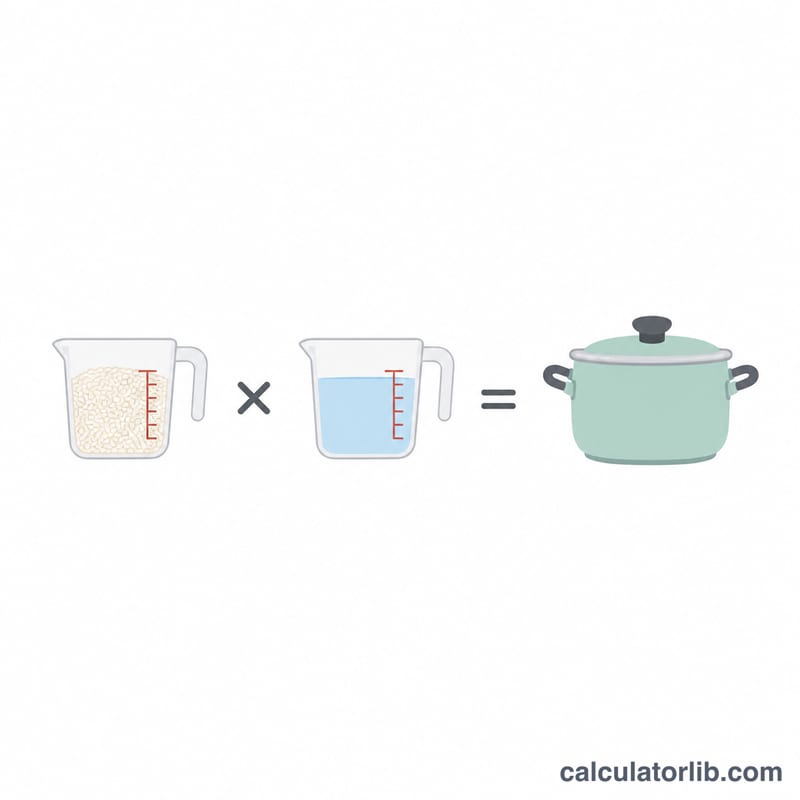
The calculation is simple: $$\text{Water} = \text{Rice} \times \text{Ratio}$$ For 1 cup of white rice at a 2:1 ratio you need 2 cups of water. The ratio is the only variable that changes by rice type — white long grain uses 2, basmati and jasmine use about 1.25, and brown rice uses around 2.25 because the bran layer absorbs more.
Worked Example
Suppose you cook 2 cups of brown rice. Brown rice uses a 2.25:1 ratio, so $$\text{Water} = 2 \times 2.25 = 4.5 \text{ cups}$$ (about 1,065 ml). The total volume in the pot before cooking is \(2 + 4.5 = 6.5\) cups, so use a pot of at least 3 liters to avoid boil-over.
Rice Type Water Ratio Chart
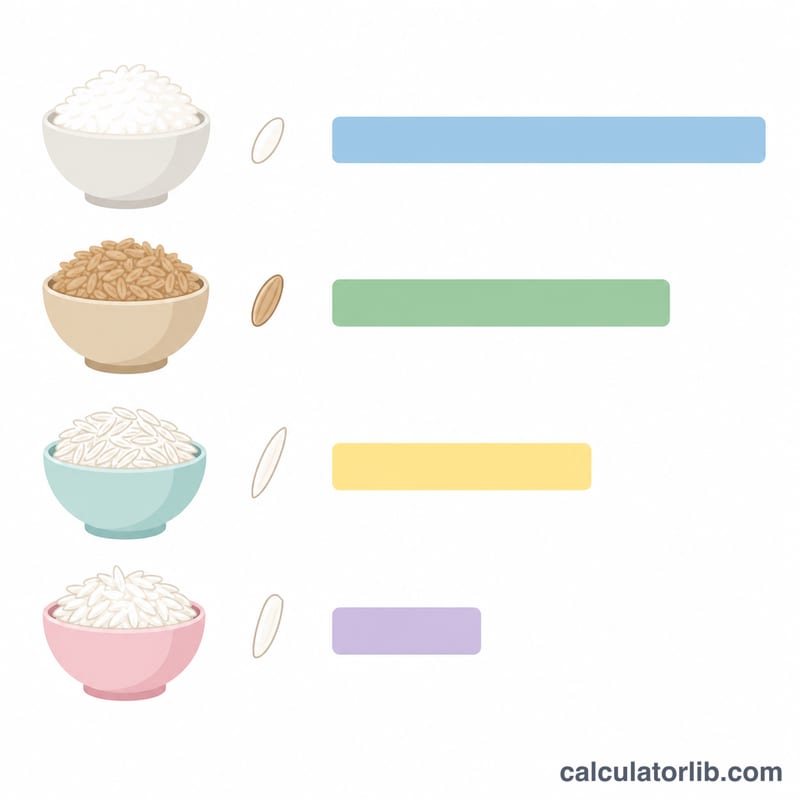
The table shows typical stovetop starting points for 1 cup of dry rice. Ratios are approximate and vary by brand, rice age, pot, and method (a rice cooker usually loses less steam, so it often needs slightly less water than a stovetop pot). Always check the package directions as well.
| Rice type | Water per 1 cup rice (cups) | Simmer time (min) | Rest time (min) |
|---|---|---|---|
| White long grain | 2 (some brands 1.75) | 15–18 | 10 |
| Basmati | 1.25–1.5 | 12–15 | 5–10 |
| Jasmine | 1.25–1.5 | 12–15 | 10 |
| Brown | 2–2.5 | 40–45 | 10 |
| Short-grain / sushi | 1–1.25 (rinsed) | 15–18 | 10–15 |
| Parboiled | 2–2.25 | 20–25 | 5–10 |
| Wild rice | 3 | 45–55 | 5–10 |
The calculator uses \(\text{Water} = \text{Rice} \times \text{Ratio}\), so you can pick a preset or enter your own custom ratio.
Water Needed for Common Rice Amounts
Each value follows Water = Rice × Ratio, with 1 US cup = 236.6 ml. For example, 2 cups of white rice at 2:1 gives \(2 \times 2 = \) 4 cups of water.
| Dry rice (cups) | White (2:1) water | Basmati/jasmine (1.25:1) water | Brown (2.25:1) water |
|---|---|---|---|
| 0.5 | 1 cup (≈236.6 ml) | 0.625 cup (≈147.9 ml) | 1.125 cups (≈266.2 ml) |
| 1 | 2 cups (≈473.2 ml) | 1.25 cups (≈295.8 ml) | 2.25 cups (≈532.4 ml) |
| 1.5 | 3 cups (≈709.8 ml) | 1.875 cups (≈443.6 ml) | 3.375 cups (≈798.5 ml) |
| 2 | 4 cups (≈946.4 ml) | 2.5 cups (≈591.5 ml) | 4.5 cups (≈1064.7 ml) |
| 3 | 6 cups (≈1419.6 ml) | 3.75 cups (≈887.3 ml) | 6.75 cups (≈1597.1 ml) |
Substitution example for brown rice: \(3 \times 2.25 = 6.75\) cups, and \(6.75 \times 236.6 \approx 1597.1\) ml. Values in ml are rounded to one decimal.
Practical Cooking Tips
- Choose the right pot size. Rice roughly triples in volume as it cooks, so the pot should hold about 3 times the dry volume of rice plus the water, with some headroom. 1 cup of dry rice fits comfortably in a 1.5–2 quart pot.
- Fine-tune by 1/4 cup. If your rice came out too firm or dry, add about 1/4 cup more water per cup of rice next time. If it was soft or mushy, reduce by about 1/4 cup per cup of rice. Change only one thing at a time.
- Use a tight lid. Escaping steam changes the effective ratio. If your lid is loose, cover the pot with a layer of foil or a cloth under the lid, and keep the heat low once it simmers. Avoid lifting the lid during cooking.
- Rest the rice off the heat. Leave it covered for about 10 minutes after cooking so moisture redistributes, then fluff with a fork.
- Adjust for altitude. At high elevations (roughly above 3,000 ft / 900 m), water boils at a lower temperature, so rice may need a little more water (start with about 1/4 cup extra per cup of rice) and a longer cooking time.
- Account for older rice. Rice stored for a long time is drier and can absorb more water. If a bag has been in the pantry for a year or more, try slightly more water than the chart suggests.
These are general cooking guidelines; results vary by rice brand, pot, and stove, so treat the calculated amount as a starting point.
FAQ
Why does brown rice need more water? The intact bran and germ layers slow water absorption and require longer cooking, so extra water prevents drying out.
Do these ratios work for a rice cooker? Yes — the same ratios apply, though many rice cookers run slightly more efficient, so you can reduce water by about 10% if rice comes out too wet.
Should I rinse my rice first? Rinsing removes surface starch for fluffier rice. It does not significantly change the water ratio, but very wet rinsed rice may need a touch less water.