
What Is the Bedridden Patient Height Calculator?
Many patients in clinical or long-term care settings cannot stand to have their height measured directly — including those who are bedridden, paralyzed, have severe contractures, or cannot cooperate. This calculator estimates a person's standing height (stature) from their knee height and age using the well-known Chumlea equations, allowing nurses, dietitians, and clinicians to compute BMI, dosing, and nutritional requirements when a direct measurement is impossible.
How to Use It
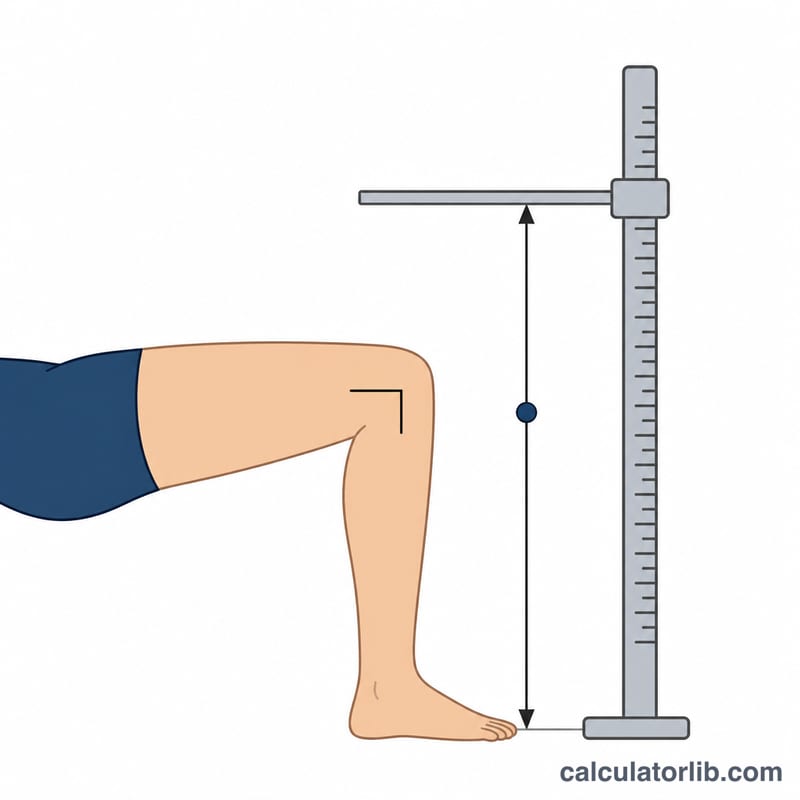
Select the patient's gender, enter their age in years, and measure knee height in centimeters. Knee height is measured with the knee and ankle each bent at a 90° angle — the distance from the bottom of the heel to the top of the thigh just above the knee. Enter that value and the calculator returns estimated height in both centimeters and inches.
The Formula Explained
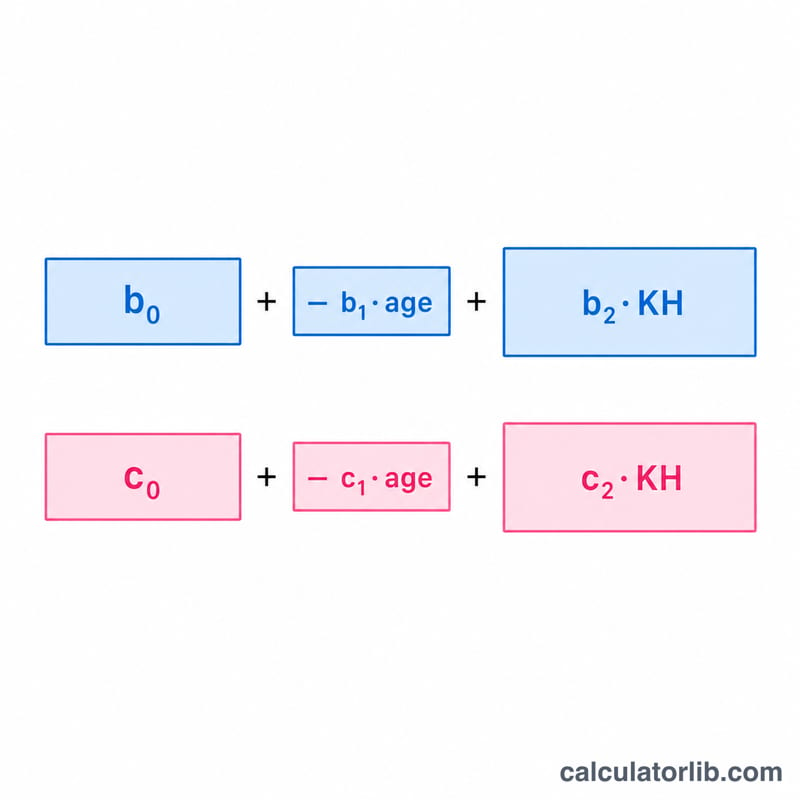
The estimates use the Chumlea regression equations:
Male: $$\text{Height (cm)} = 64.19 - 0.04 \times \text{Age} + 2.02 \times \text{Knee Height}$$
Female: $$\text{Height (cm)} = 84.88 - 0.24 \times \text{Age} + 1.83 \times \text{Knee Height}$$
Knee height correlates strongly with stature and changes little with the spinal compression and posture changes that affect measured height in older adults, making it a reliable proxy.
Worked Example
A 70-year-old male with a knee height of 50 cm: $$64.19 - 0.04 \times 70 + 2.02 \times 50 = 64.19 - 2.8 + 101 = 162.39 \text{ cm}$$ (about 63.9 inches).
Interpreting Your Estimated Height
The value returned is a statistical estimate of standing height, not a direct measurement. The Chumlea equations were derived by regressing measured stature against knee height and age in reference populations, and each equation carries a standard error of the estimate (SEE) of roughly 3–4 cm. In practical terms, the true height of an individual will usually fall within about ±7–8 cm of the estimate (approximately two standard errors), so the figure is best treated as a working approximation rather than an exact number.
This uncertainty propagates into any downstream calculation that uses height:
- BMI: Because BMI divides weight by height squared, a height error of a few centimetres shifts BMI by roughly 1 unit near typical adult heights — enough to move a borderline patient between weight categories. Interpret estimated BMI cautiously and alongside other nutritional markers.
- Ideal and adjusted body weight: IBW formulas scale with height, so the same percentage uncertainty carries through to weight-based targets.
- Body surface area and weight-based dosing: BSA and many drug doses depend on height, so an estimated stature introduces a corresponding margin of error that may matter for narrow-therapeutic-index agents.
Best practice is to record the height as estimated from knee height (Chumlea) in the clinical record, note the method and date, and re-measure directly if the patient later becomes able to stand. When precision is critical, repeat the knee-height measurement and average readings to reduce measurement error.
This section is general information about how the estimate is used and is not personal medical advice. Clinical decisions should be made by a qualified professional who can account for the full patient context.
Key Terms & Variables
- Knee height
- The vertical distance from the sole of the foot (heel) to the anterior surface of the thigh just above the patella, measured with the leg bent. It is the primary input to the Chumlea equations and is recorded in centimetres.
- Stature / standing height
- A person's total height measured from the floor to the top of the head while standing erect — the quantity the calculator estimates for patients who cannot stand.
- 90° measurement position
- The standardized posture for taking knee height: the patient lies supine (or sits) with the knee and the ankle each flexed to a 90° angle. A sliding knee-height caliper is placed under the heel and over the thigh to read the distance.
- Chumlea equations
- Sex-specific linear regression equations published by Chumlea and colleagues that predict standing height from knee height and age. They are widely used in geriatric, rehabilitation and nutritional assessment when direct height measurement is impractical.
- Standard error (SEE)
- The standard error of the estimate quantifies the typical scatter of true heights around the value predicted by the regression. For these equations it is approximately 3–4 cm, defining the expected accuracy of the estimate.
- Bedridden / non-ambulatory
- Describes patients confined to bed or otherwise unable to stand or walk, for whom conventional stadiometer height measurement is not feasible — the population these estimating equations are designed for.
FAQ
How accurate is this estimate? The Chumlea equations have a standard error of roughly ±3–4 cm. It is an estimate, not a substitute for a stadiometer when one can be used.
What units should I use? Enter knee height in centimeters. The result is shown in centimeters and converted to inches.
Does it work for children? These equations were derived for adults; they are not validated for pediatric patients.