
What is ABSI?
A Body Shape Index (ABSI) is a metric developed by Krakauer & Krakauer (2012) that quantifies abdominal adiposity by combining waist circumference with BMI and height. Unlike BMI alone, a high ABSI indicates that a person carries more weight around the midsection than expected for their size — a pattern linked in research to higher mortality risk, independent of overall body mass.
How to use this calculator
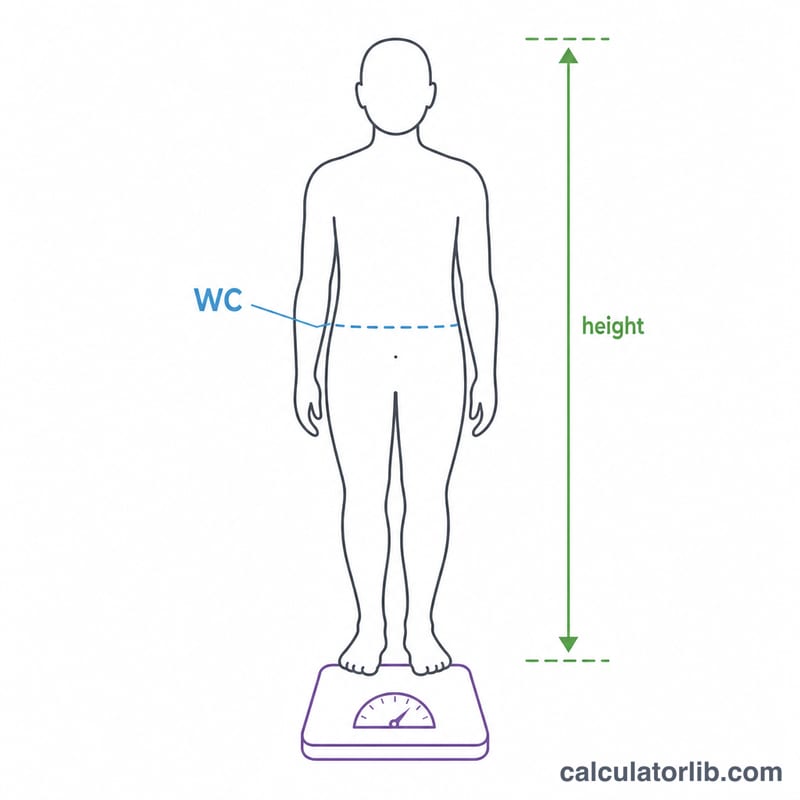
Enter your weight in kilograms, height in centimetres and waist circumference in centimetres (measured at the level of the navel). The calculator converts height and waist to metres, computes your BMI, and returns your ABSI. Lower ABSI values are generally more favourable; you can compare your value against population norms for your age and sex.
The formula explained
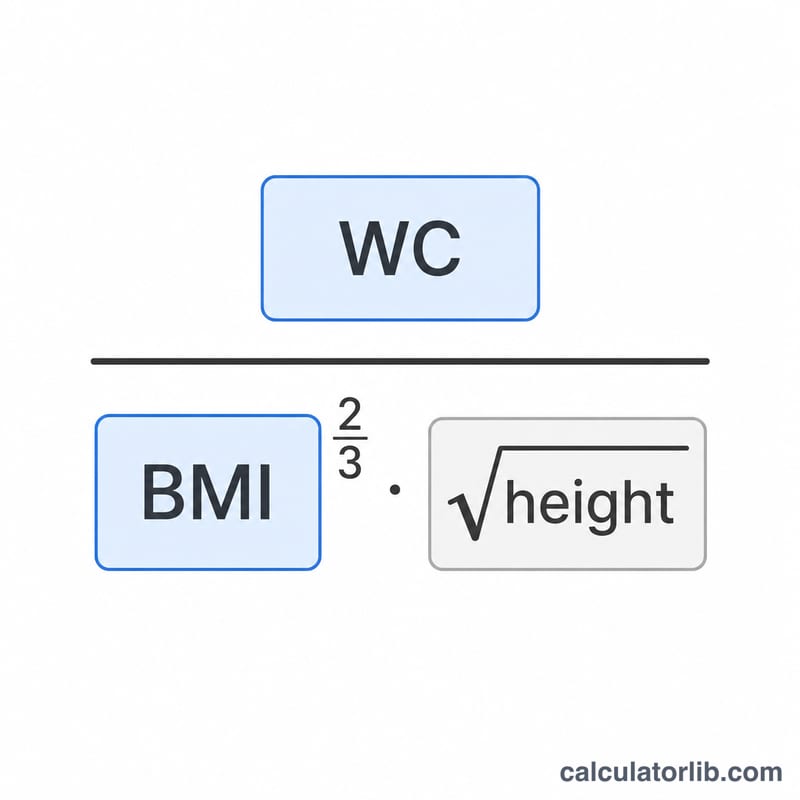
The index is defined as $$\text{ABSI} = \dfrac{WC}{BMI^{2/3} \cdot \sqrt{height}}$$ where waist circumference (WC) and height are expressed in metres and BMI is in kg/m². The \(BMI^{2/3}\) and \(height^{1/2}\) terms scale out the portions of waist size that are simply explained by body size, isolating the "extra" abdominal bulk.
Worked example
Consider a person weighing 70 kg, 175 cm tall, with an 85 cm waist. Height = 1.75 m, waist = 0.85 m. $$BMI = \frac{70}{1.75^2} = 22.857$$ \(BMI^{2/3} \approx 8.1056\) and \(\sqrt{1.75} \approx 1.3229\). $$\text{ABSI} = \frac{0.85}{8.1056 \times 1.3229} \approx 0.07926 \ \text{m}^{11/6}\cdot\text{kg}^{-2/3}$$
ABSI Z-Score and Risk Category Thresholds
A Body Shape Index (ABSI) was introduced by Nir Krakauer and Jesse Krakauer in 2012 using U.S. National Health and Nutrition Examination Survey (NHANES) data. Because raw ABSI values are difficult to interpret on their own, the result is converted to a z-score — the number of standard deviations a person's ABSI sits above or below the mean for their sex and age. The z-score is calculated as:
$$z = \frac{\text{ABSI} - \text{ABSI}_{\text{mean}}}{\text{SD}_{\text{ABSI}}}$$
The mean and standard deviation depend on sex and age band. The values below are representative population reference figures (ABSI expressed in m11/6 kg−2/3, the natural units when waist and height are in metres and BMI in kg/m2). ABSI rises gradually with age in both sexes.
| Sex | Age band | Mean ABSI | SD |
|---|---|---|---|
| Men | 20–29 | 0.0789 | 0.0049 |
| 30–49 | 0.0805 | 0.0051 | |
| 50–69 | 0.0824 | 0.0053 | |
| 70+ | 0.0843 | 0.0055 | |
| Women | 20–29 | 0.0762 | 0.0048 |
| 30–49 | 0.0780 | 0.0050 | |
| 50–69 | 0.0805 | 0.0053 | |
| 70+ | 0.0827 | 0.0056 |
The z-score is then mapped to a five-level risk classification, where risk refers to the relative likelihood of premature mortality associated with body shape:
| ABSI z-score range | Risk category | Meaning |
|---|---|---|
| z < −1.0 | Very low | Well below average abdominal bulk for age/sex |
| −1.0 ≤ z < −0.5 | Low | Below average |
| −0.5 ≤ z ≤ +0.5 | Average | Typical for the population |
| +0.5 < z ≤ +1.0 | High | Above average |
| z > +1.0 | Very high | Well above average abdominal bulk for age/sex |
Worked example. Consider a 45-year-old man with waist 94 cm, height 178 cm and weight 82 kg. Converting to metres: WC = 0.94 m, H = 1.78 m, and BMI = 82 / 1.78² = 25.88 kg/m². Then:
$$\text{ABSI} = \frac{0.94}{25.88^{2/3}\,\sqrt{1.78}} = \frac{0.94}{8.787 \times 1.334} \approx 0.0802$$
Using the men 30–49 reference (mean 0.0805, SD 0.0051): \(z = (0.0802 - 0.0805)/0.0051 \approx -0.06\), which falls in the average category.
Interpreting Your ABSI Result
ABSI was designed to capture a dimension of body shape that BMI and weight alone miss: how much of your mass is concentrated around the abdomen relative to what would be expected for your height and overall size. By dividing waist circumference by a combination of BMI and height, ABSI is largely independent of height, weight and BMI, so two people with an identical BMI can have very different ABSI values if one carries more weight centrally.
Your result is most usefully read as a z-score relative to the population mean for your sex and age:
- Around average (z between −0.5 and +0.5): your waist is about what is typical for someone of your size and age. Mortality risk attributable specifically to body shape is close to the population baseline.
- Higher than average (positive z): in the original Krakauer & Krakauer analysis and subsequent cohort studies, a higher ABSI was associated with a greater rate of premature death, and this association persisted after adjusting for BMI. A high or very high z-score indicates relatively more central (abdominal) bulk than expected, which tracks with visceral fat — the metabolically active fat linked to cardiovascular and metabolic risk.
- Lower than average (negative z): a below-average ABSI suggests comparatively less abdominal bulk for your body size and, in the research, corresponds to a lower body-shape-related mortality risk.
Because ABSI isolates abdominal shape, it complements rather than replaces other measures. It is often most informative alongside BMI and a simple waist-to-height ratio, where a value at or below 0.5 is commonly used as a low-risk reference point. Reviewing these together gives a fuller picture than any single number.
Two practical cautions on interpretation. First, ABSI is a statistical, population-level association: a high z-score signals elevated average risk across many people, not a diagnosis or a personal forecast. Second, accurate waist measurement matters — measure at a consistent landmark (such as the level of the navel or midway between the lowest rib and the top of the hip bone), at the end of a normal exhalation, without compressing the skin, as small differences in waist alter the result.
This is general educational information, not medical advice. ABSI does not diagnose any condition and cannot account for your full health picture. For an assessment of your individual risk and any decisions about diet, exercise or treatment, consult a qualified healthcare professional.
FAQ
What is a good ABSI? ABSI is best interpreted relative to age- and sex-specific population averages; values well below the mean suggest lower abdominal-fat risk.
Does ABSI replace BMI? No — it complements BMI by capturing body shape and fat distribution that BMI misses.
Where do I measure my waist? Measure around the abdomen at the level of the navel, after a normal exhale, with the tape snug but not compressing the skin.