
What is BMI?
Body Mass Index (BMI) is a simple, widely used screening measure that relates a person's weight to their height. It gives a single number that helps classify whether someone is underweight, at a healthy weight, overweight, or obese. While it does not directly measure body fat, BMI is a quick and convenient indicator used by health professionals worldwide as a first-line assessment.
How to use this calculator
Enter your weight in kilograms and your height in centimetres, then read your BMI and weight category. The calculator converts your height to metres automatically, so you only need centimetres. For the most accurate result, weigh yourself without heavy clothing and measure your height standing straight.
The formula explained
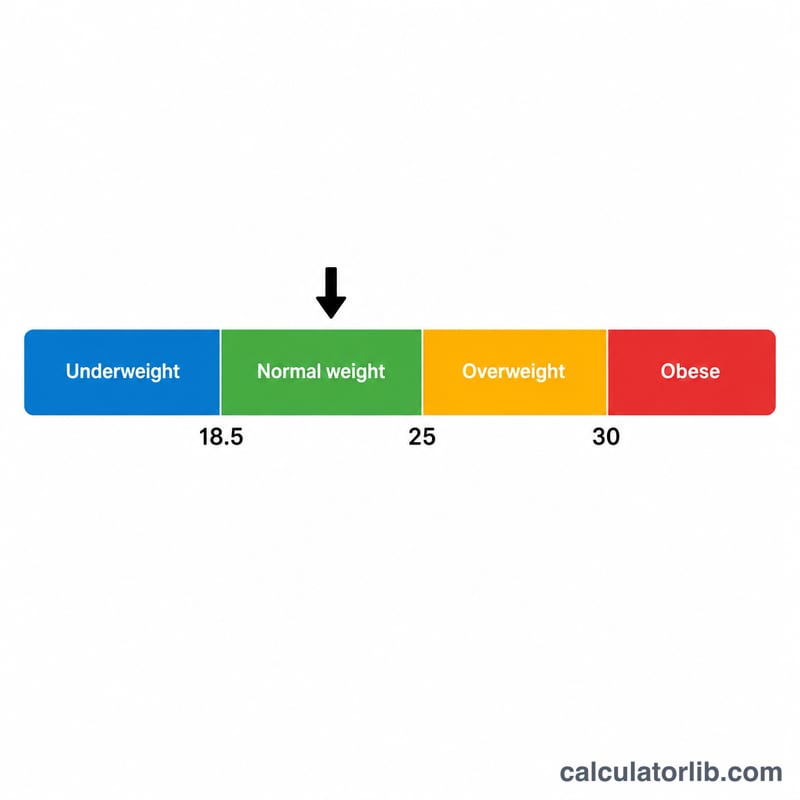
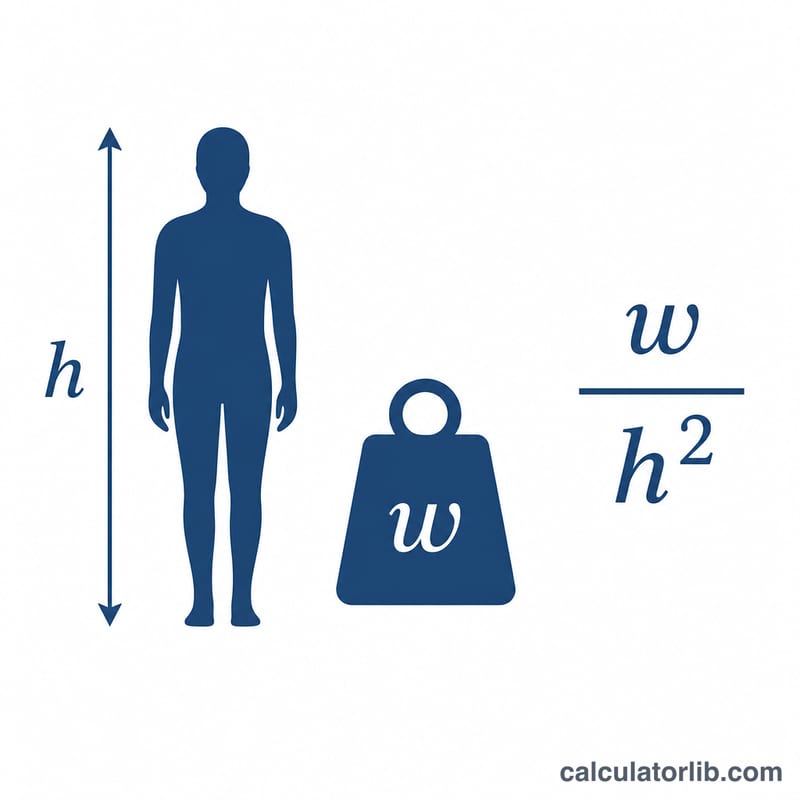
BMI is calculated as weight in kilograms divided by the square of height in metres: $$\text{BMI} = \dfrac{\text{weight (kg)}}{\text{height (m)}^2}$$. Because height is squared, a small change in height has a larger effect on the result than the same change in weight. The standard World Health Organization (WHO) categories are: under 18.5 = underweight, 18.5–24.9 = normal, 25–29.9 = overweight, and 30 or above = obese.
Worked example
Suppose you weigh 70 kg and are 175 cm tall. First convert height: \(175 \text{ cm} = 1.75 \text{ m}\). Then square it: $$1.75 \times 1.75 = 3.0625$$ Finally divide: $$70 \div 3.0625 = 22.86$$ A BMI of 22.86 falls in the "Normal weight" range.
WHO BMI Categories and Health Risk
The World Health Organization (WHO) classifies adult Body Mass Index into the standard categories below. BMI is reported in units of kg/m² and the same thresholds apply to both men and women. The risk descriptors refer to relative risk of weight-related conditions (such as type 2 diabetes, hypertension and cardiovascular disease) at the population level.
| BMI range (kg/m²) | WHO category | Relative health risk |
|---|---|---|
| Below 18.5 | Underweight | Increased (risk of nutritional deficiency, low bone mass) |
| 18.5 – 24.9 | Normal weight | Least risk (reference range) |
| 25.0 – 29.9 | Overweight (pre-obese) | Increased |
| 30.0 – 34.9 | Obese Class I | Moderate |
| 35.0 – 39.9 | Obese Class II | Severe |
| 40.0 and above | Obese Class III | Very severe |
BMI is calculated with the standard formula \(\text{BMI} = \dfrac{\text{weight (kg)}}{(\text{height (m)})^2}\). For example, a person of 70 kg and 175 cm has a BMI of 22.9, placing them in the Normal weight range.
Interpreting Your BMI Result
BMI is a population screening tool, not a diagnostic test. It estimates whether a person's weight may be associated with elevated health risk relative to their height, but it cannot, on its own, determine an individual's health.
- Underweight (<18.5): may indicate insufficient energy intake, an underlying condition, or simply a naturally lean build. Worth reviewing nutrition and overall health.
- Normal (18.5–24.9): the range associated with the lowest population-level risk of weight-related disease.
- Overweight (25–29.9): a flag that further assessment (diet, activity, waist measurement) may be useful.
- Obese (≥30): associated with progressively higher risk; higher classes warrant closer attention to cardiometabolic health.
Key limitations. BMI uses only weight and height, so it does not distinguish muscle from fat. Muscular athletes can register as "overweight" despite low body fat, while older adults who have lost muscle may have a "normal" BMI yet carry excess fat. BMI also does not account for fat distribution — abdominal (visceral) fat carries more risk than fat on the hips and thighs. Risk thresholds can differ by ethnicity; for some Asian populations, increased risk begins at lower BMI values.
Because of this, BMI is best read alongside complementary measures such as waist circumference, waist-to-height ratio, waist-to-hip ratio, or a direct body-fat estimate. These help reveal whether a given BMI reflects fat, muscle, or its location on the body.
This is general information and not medical advice. For an assessment of your own health, consult a qualified healthcare professional.
FAQ
Is BMI accurate for athletes? Not always. Muscular individuals may have a high BMI yet low body fat, since muscle weighs more than fat. BMI is a population screening tool, not a diagnosis.
Does BMI apply to children? Standard adult categories do not apply to children and teens; they use age- and sex-specific percentile charts instead.
What is a healthy BMI? For most adults a BMI between 18.5 and 24.9 is considered healthy, but consult a healthcare provider for personalised advice.