
What this calculator does
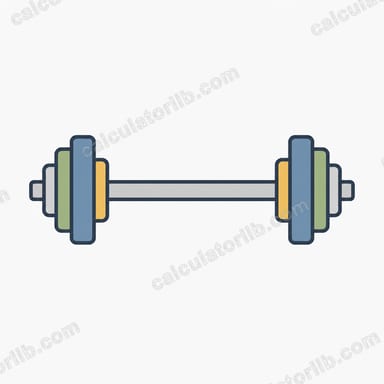
The Barbell Plate Loading Calculator tells you exactly which weight plates to slide onto each side of a barbell so the total matches your target lift. Instead of doing mental math between sets, enter your target and the bar weight and get an instant per-side loading plan in pounds or kilograms.
How to use it
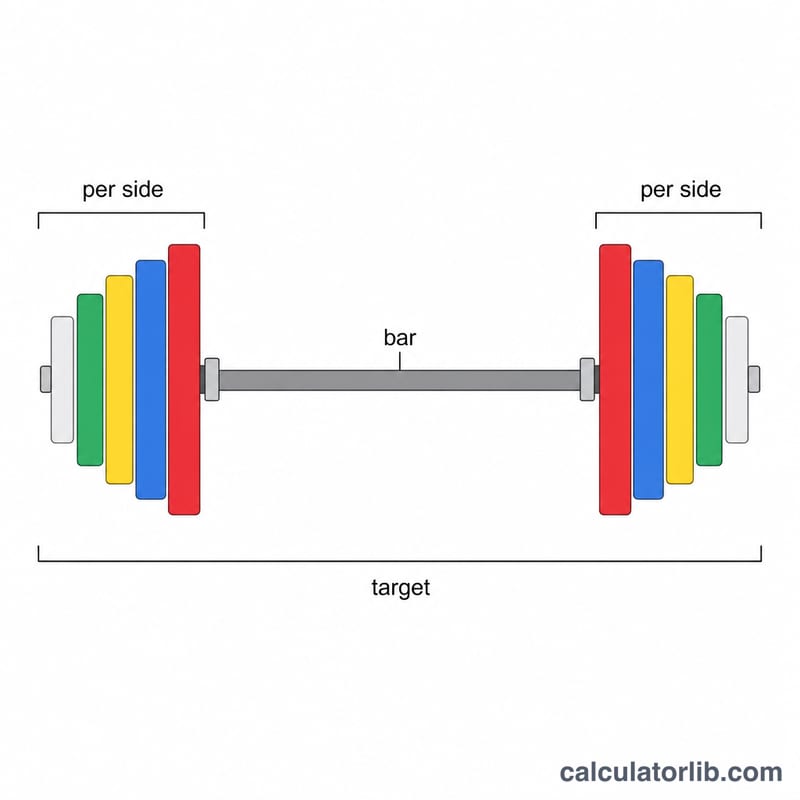
Pick your unit (lb or kg), type your target total weight (for example 225 lb), and enter the bar weight (a standard Olympic bar is 45 lb or 20 kg). The calculator subtracts the bar, splits the remainder evenly between the two sides, then chooses the fewest plates from the standard denominations to build that side.
The formula explained
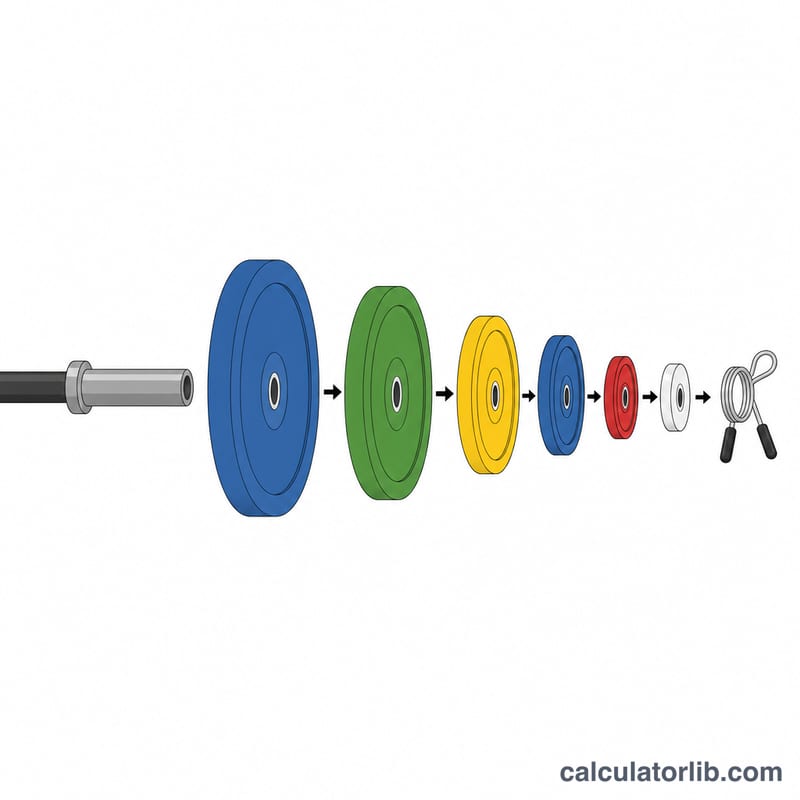
First it finds the weight that must go on each side: $$P = \dfrac{\text{target} - \text{bar}}{2}$$ Then it performs a greedy decomposition, repeatedly taking the largest plate that fits until the side is loaded. Pound plates used are 45, 35, 25, 10, 5 and 2.5; kilogram plates are 25, 20, 15, 10, 5, 2.5, 1.25 and 0.5. Any amount that cannot be matched by available plates is shown as the "unmatched remainder."
Worked example
Target 225 lb on a 45 lb bar: $$\frac{225 - 45}{2} = 90 \text{ lb per side}$$ Greedy loading gives \(2 \times 45 = 90\) lb, so the plan is "2 × 45" on each end, for an actual total of \(45 + 180 = 225\) lb with zero remainder.
FAQ
Why is my target not reachable exactly? If the per-side number isn't a sum of available plates (e.g. an odd half-pound), the calculator shows the closest loadable amount and the leftover remainder.
What bar weight should I use? A standard men's Olympic barbell is 45 lb (20 kg); a women's bar is 35 lb (15 kg); training bars vary, so enter whatever you're using.
Does it count plates per side or total? The plan and per-side number are for ONE side; you load the same on both ends.