
What is the Continuity Equation Flow Rate Calculator?
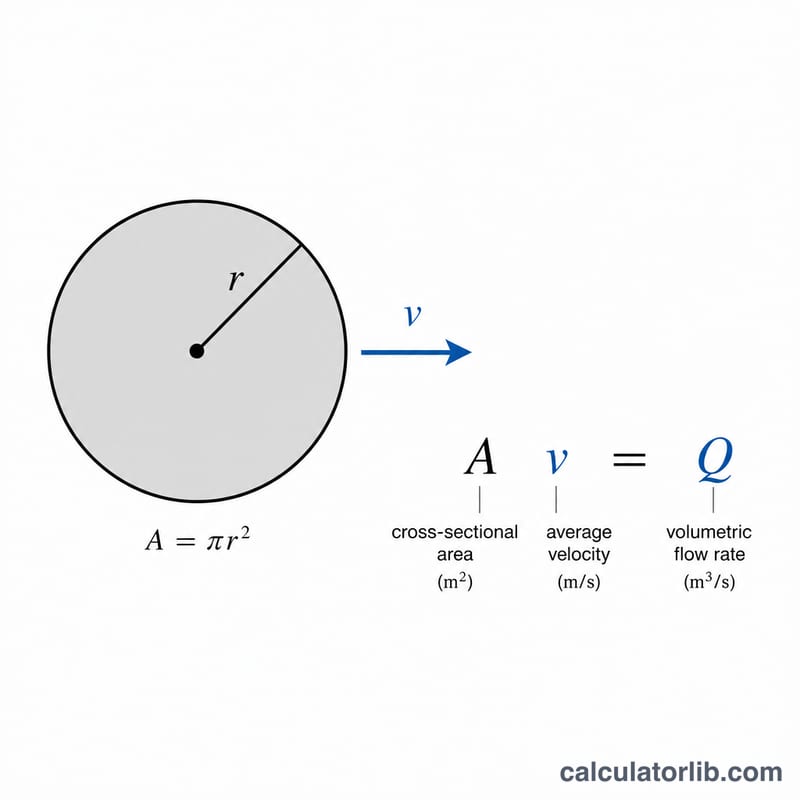
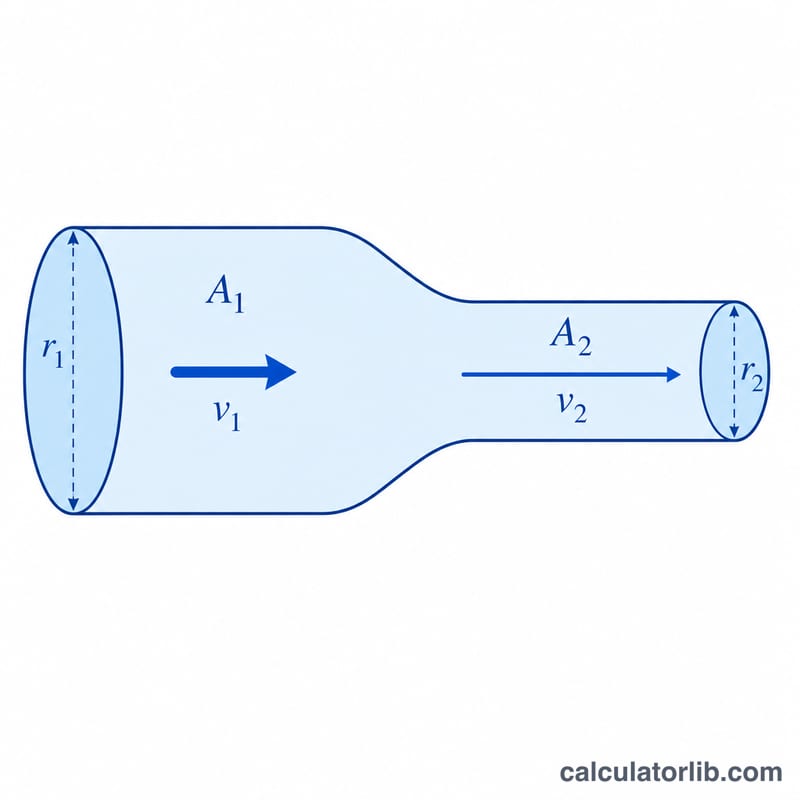
This calculator applies the principle of continuity for an incompressible, steady fluid flow. It computes the volumetric flow rate \(Q = A \cdot v\) through a circular pipe and uses the continuity equation \(A_1 v_1 = A_2 v_2\) to find the fluid velocity after the pipe changes diameter. It is widely used in fluid mechanics, plumbing, HVAC design, and physics coursework.
How to use it
Enter the diameter of the first pipe section and the fluid velocity flowing through it, then enter the diameter of the second pipe section. The calculator returns the conserved volumetric flow rate Q and the new velocity \(v_2\) in the second section, along with both cross-sectional areas.
The formula explained
The cross-sectional area of a circular pipe is \(A = \pi \left(\frac{d}{2}\right)^2\). Flow rate is:
$$Q = A \cdot v = \pi \left(\frac{d}{2}\right)^2 v$$Because mass (and volume, for an incompressible fluid) is conserved, the flow entering must equal the flow leaving:
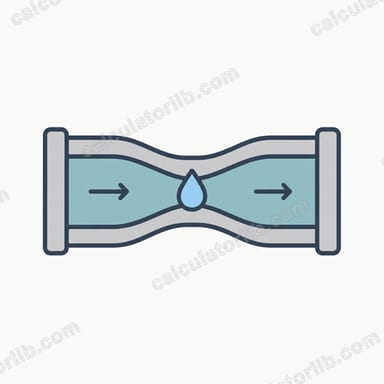
$$A_1 v_1 = A_2 v_2$$Rearranging gives:
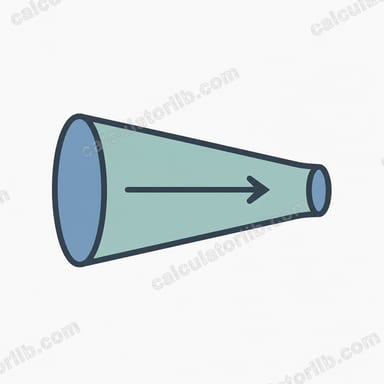
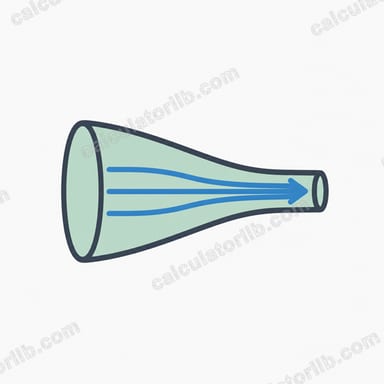
$$v_2 = \frac{A_1 v_1}{A_2}$$A narrower pipe (smaller \(A_2\)) forces a higher velocity, which is why a thumb over a hose nozzle makes water shoot faster.
Worked example
Suppose pipe 1 has diameter 0.1 m with velocity 2 m/s, and pipe 2 has diameter 0.05 m. \(A_1 = \pi (0.05)^2 \approx 0.0078540 \text{ m}^2\), so:
$$Q = 0.0078540 \times 2 \approx 0.0157080 \text{ m}^3/\text{s}$$\(A_2 = \pi (0.025)^2 \approx 0.0019635 \text{ m}^2\). Then:
$$v_2 = \frac{Q}{A_2} \approx \frac{0.0157080}{0.0019635} = 8 \text{ m/s}$$— four times faster, since the diameter halved and area dropped by a factor of four.
FAQ
Does this work for any fluid? The continuity equation here assumes an incompressible fluid (most liquids and low-speed gases) flowing steadily.
Can I use other diameter units? Use any consistent units; results will be in those units (e.g. enter diameters in meters and velocity in m/s to get Q in m³/s).
Why does velocity increase in a narrower pipe? Because flow rate is conserved, a smaller cross-sectional area must be balanced by a higher velocity.