
What is the RC Time Constant?
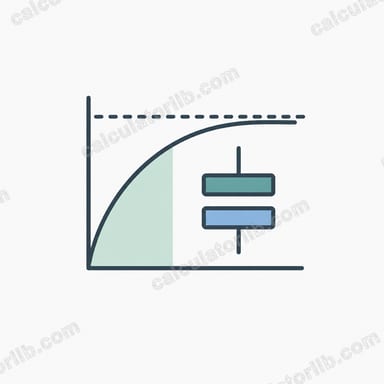
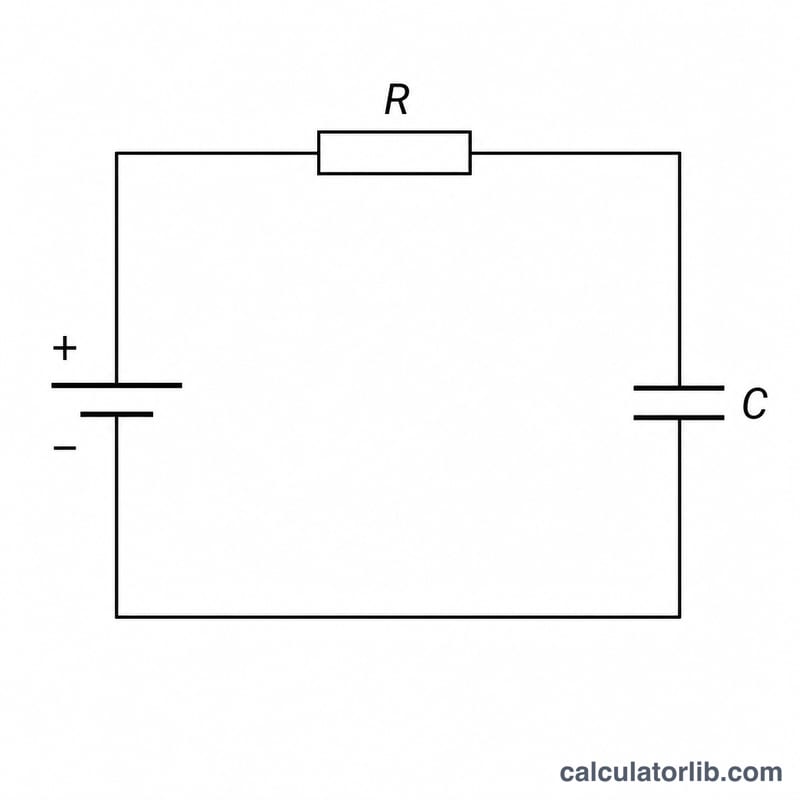
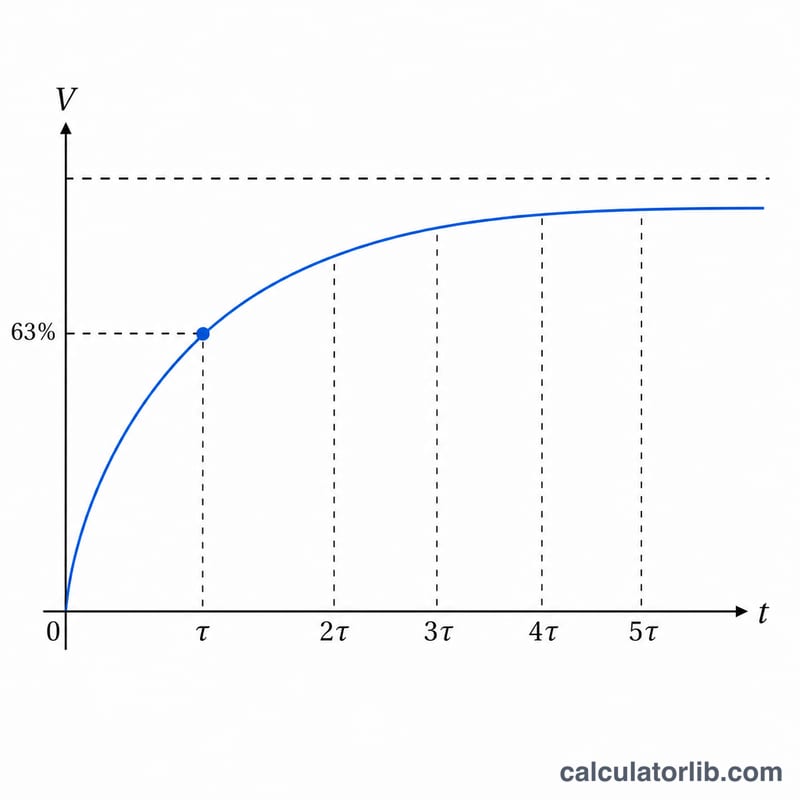
In any circuit containing a resistor (R) and capacitor (C), the time constant τ (tau) describes how quickly the capacitor charges or discharges. It is simply the product of resistance and capacitance: \(\tau = R \cdot C\), measured in seconds. After one time constant a charging capacitor reaches about 63.2% of the supply voltage, and after five time constants (\(5\tau\)) it is considered fully charged (~99.3%).
How to Use This Calculator
Enter the resistance in ohms and the capacitance in microfarads (µF). Optionally enter a supply voltage V₀ and a time t to see the instantaneous capacitor voltage during charging and discharging. The calculator returns τ, the charging and discharging voltages at time t, and the 5τ settling time.
The Formula Explained
The time constant is $$\tau = R \cdot C.$$ Because capacitance is entered in microfarads, it is converted to farads (\(1\,\mu\text{F} = 10^{-6}\,\text{F}\)) before multiplying. The charging curve follows $$V(t) = V_0\left(1 - e^{-t/RC}\right),$$ while the discharging curve follows $$V(t) = V_0 \cdot e^{-t/RC}.$$ The exponential term \(e^{-t/\tau}\) governs how fast the voltage approaches its final value.
Worked Example
Suppose \(R = 1000\,\Omega\) and \(C = 100\,\mu\text{F}\). Then $$\tau = 1000 \times 100\times10^{-6} = 0.1\ \text{s}.$$ With \(V_0 = 5\,\text{V}\) at \(t = 0.1\,\text{s}\) (exactly one τ), the charging voltage is $$5 \times \left(1 - e^{-1}\right) = 5 \times 0.6321 \approx 3.161\ \text{V},$$ and the discharging voltage is $$5 \times e^{-1} \approx 1.839\ \text{V}.$$ Full charge (\(5\tau\)) takes 0.5 s.
FAQ
Why does it take 5 time constants to fully charge? Each τ closes ~63% of the remaining gap. After \(5\tau\) only about 0.7% remains, so engineers treat it as fully charged.
What units should I use? Resistance in ohms and capacitance in microfarads. For kΩ multiply by 1000; for nF divide by 1000 to get µF.
Is the time constant the same for charging and discharging? Yes — \(\tau = R \cdot C\) governs both processes identically.