
What Is the Constant of Proportionality?
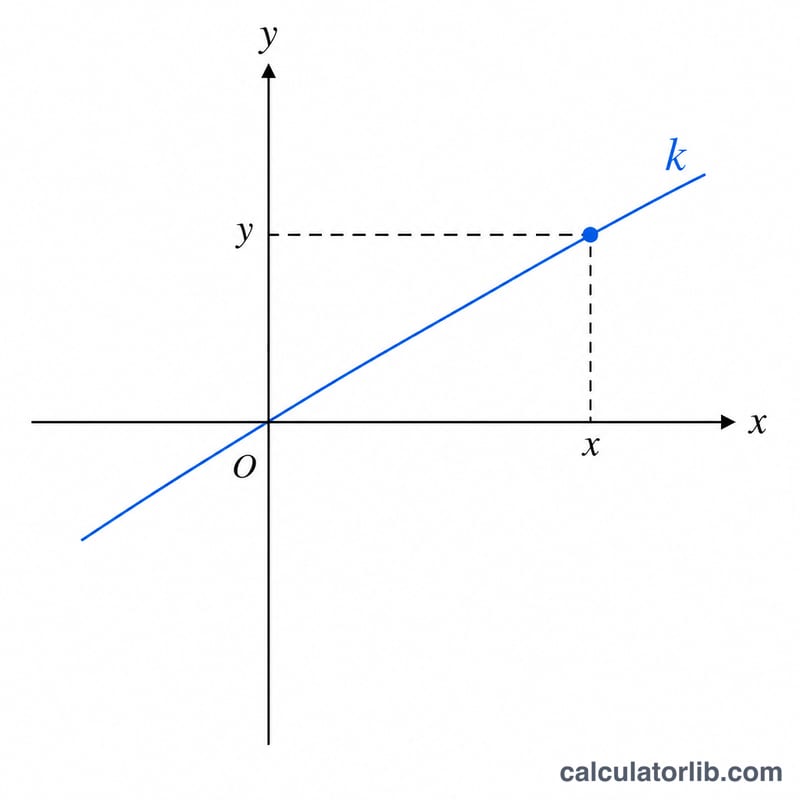
When two quantities are directly proportional, their ratio stays the same no matter how their values change. That fixed ratio is called the constant of proportionality, usually written as k. It tells you how much y changes for every one-unit change in x. This calculator finds k from a single matching pair of values using the simple relationship \(k = y / x\).
How to Use This Calculator
Enter a value for y and a value for x from your proportional relationship, then read off the constant k. The calculator also rebuilds the full proportional equation \(y = k \cdot x\) so you can predict any other pair. Both positive and negative numbers and decimals are supported. If x is zero, k is undefined because division by zero is not allowed.
The Formula Explained
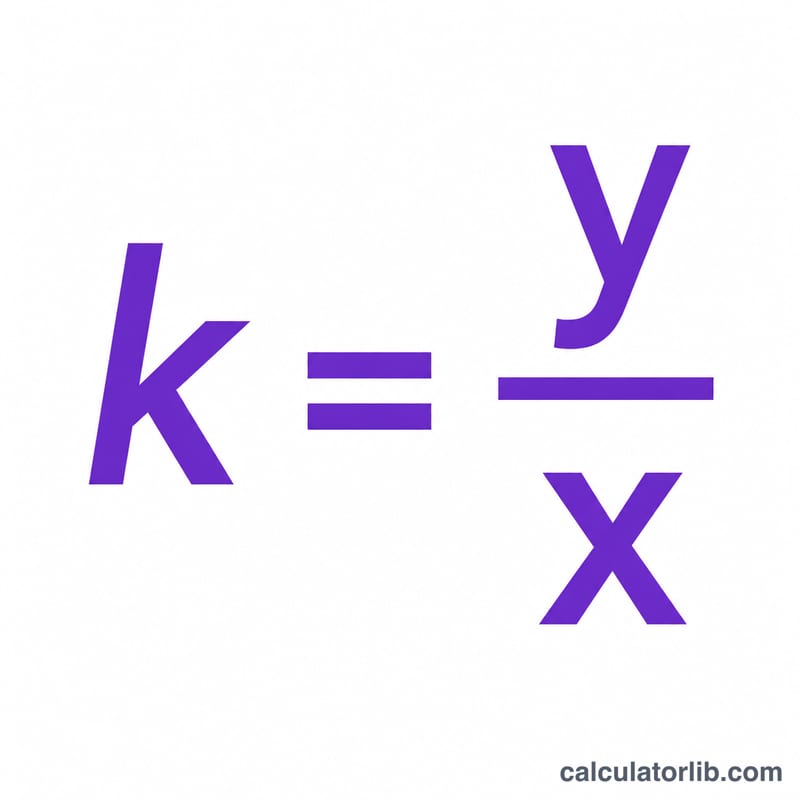
The defining equation of direct proportionality is \(y = kx\). Solving for the constant gives $$k = \frac{y}{x}.$$ As long as the relationship is truly proportional, picking any \((x, y)\) pair returns the same \(k\). For example, if a recipe needs 3 cups of flour for 12 cookies, then \(k = 12 / 3 = 4\) cookies per cup, and \(y = 4x\) predicts the cookie count for any amount of flour.
Worked Example
Suppose \(y = 45\) and \(x = 9\). Then $$k = \frac{45}{9} = 5.$$ The proportional equation becomes \(y = 5x\), so when \(x = 11\), \(y\) would be 55.
FAQ
What if x is 0? The constant is undefined — you cannot divide by zero, so a valid proportional relationship requires a non-zero x.
Can k be negative? Yes. If y and x have opposite signs, k is negative, meaning y decreases as x increases.
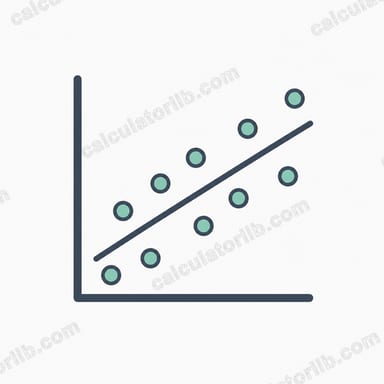
How is k different from slope? For a line through the origin (\(y = kx\)), the constant of proportionality is exactly the slope of the line.