
What is the Midrange?
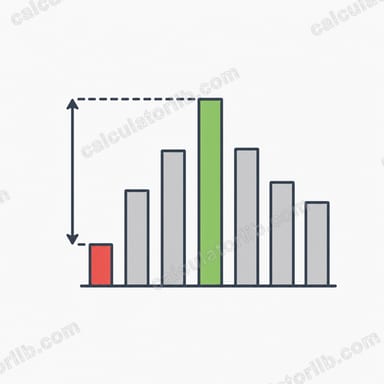
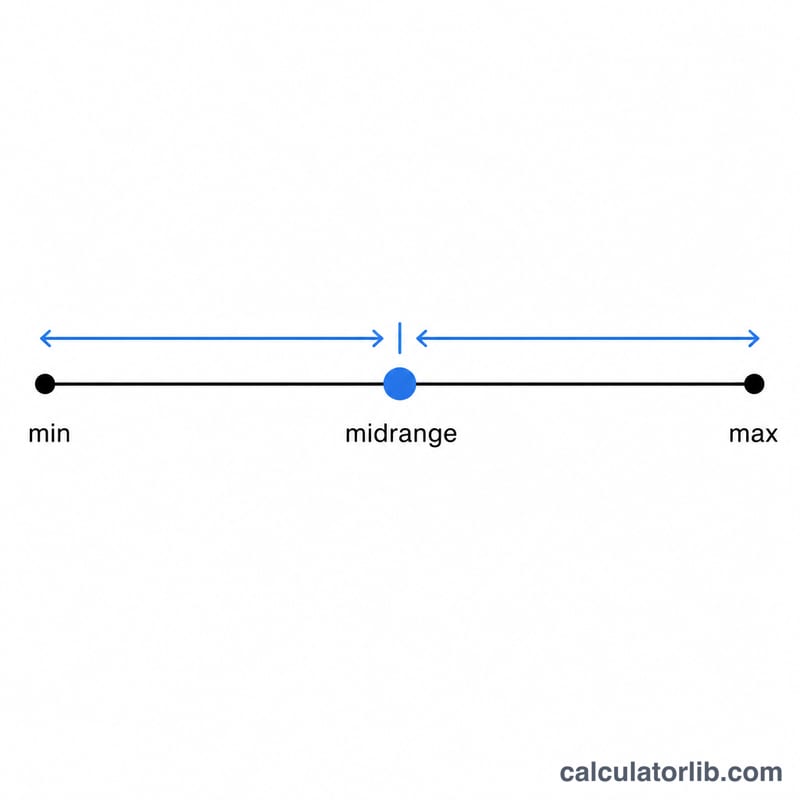
The midrange is one of the simplest measures of central tendency in statistics. It is defined as the average of the highest and lowest values in a data set. Because it depends only on the two most extreme values, it is quick to compute by hand and gives a rough sense of where the "center" of the range lies.
How to Use This Calculator
Enter your numbers separated by commas or spaces (for example 4, 8, 15, 16, 23, 42) and the calculator instantly returns the midrange along with the maximum and minimum values it detected. Negative numbers and decimals are fully supported.
The Formula Explained
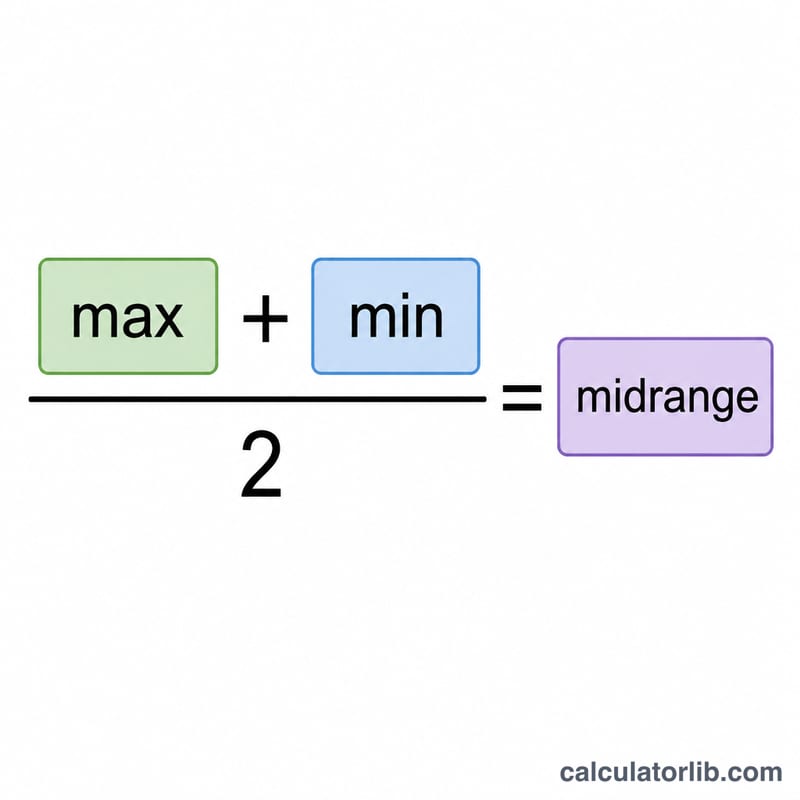
The midrange is calculated as:
$$\text{Midrange} = \frac{\max\!\left(\text{Numbers}\right) + \min\!\left(\text{Numbers}\right)}{2}$$
Only the largest and smallest data points matter — every value in between is ignored. This makes the midrange extremely sensitive to outliers, so it is best used when your data has no extreme values, or alongside other measures like the mean and median.
Worked Example
Suppose your data set is 4, 8, 15, 16, 23, 42. The maximum is 42 and the minimum is 4. The midrange is therefore $$\frac{42 + 4}{2} = \frac{46}{2} = 23.$$ 23. Notice that this is not the same as the mean (which is 18) — a single large value like 42 pulls the midrange upward.
FAQ
Is the midrange the same as the mean? No. The mean averages all values, while the midrange averages only the highest and lowest. They are equal only in symmetric data.
Why is the midrange rarely used? Because it relies on just two values, a single outlier can distort it dramatically, making it less robust than the median.
Can the midrange be a decimal? Yes. If the sum of the max and min is odd, the midrange will end in .5, and decimal inputs produce decimal results.