
What Is the Median Absolute Deviation?
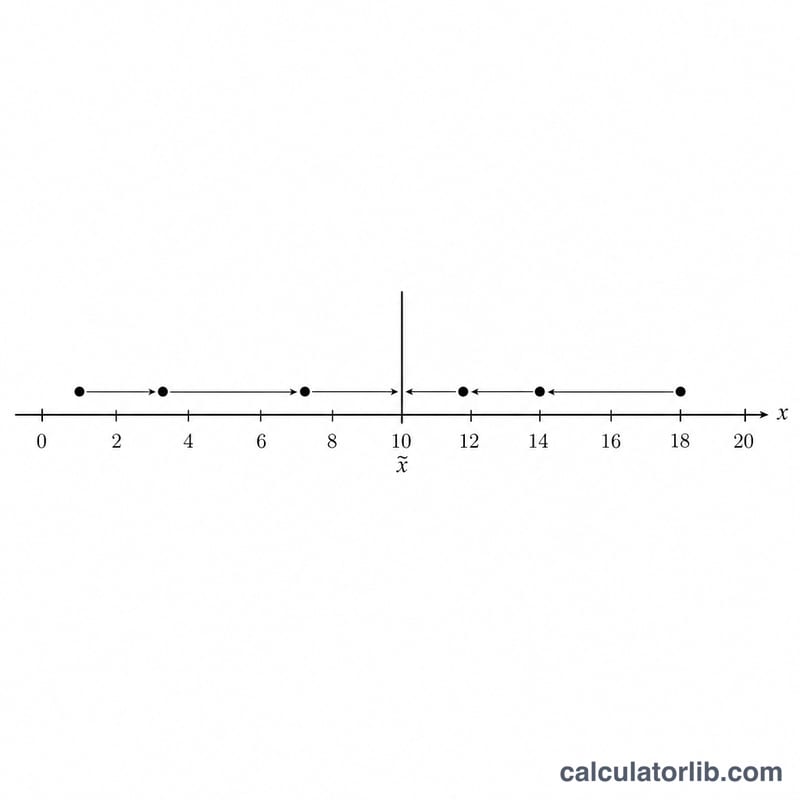
The Median Absolute Deviation (MAD) is a robust measure of statistical dispersion. Unlike the standard deviation, which is heavily influenced by outliers, the MAD is based on medians and therefore resists the effect of extreme values. It tells you the typical distance between each data point and the center of your data.
How to Use This Calculator
Enter your numbers separated by commas or spaces (for example 2, 4, 6, 8, 10) and the calculator returns the MAD along with the data count, the median, and the scaled MAD. The result updates instantly so you can compare data sets quickly.
The Formula Explained
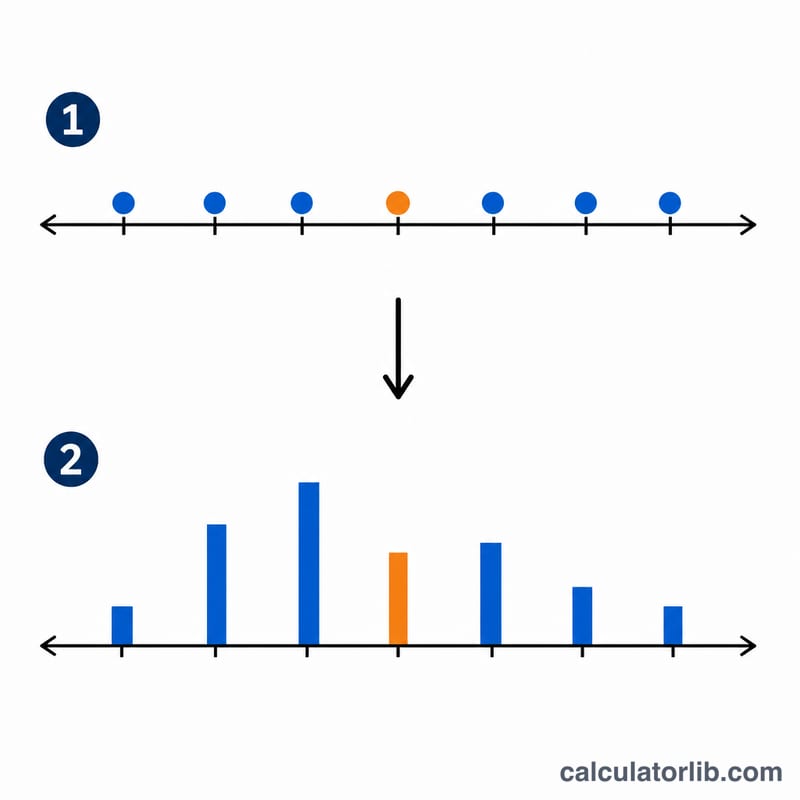
First, find the median of your data set. Then compute the absolute deviation of each value from that median, \(\left|\, x_i - \operatorname{median}(x) \,\right|\). Finally, take the median of those absolute deviations:
$$\text{MAD} = \operatorname{median}\left(\left|\, x_i - \operatorname{median}(x) \,\right|\right)$$
The scaled MAD multiplies the result by the constant \(1.4826\), which makes it a consistent estimator of the standard deviation when the data follow a normal distribution.
Worked Example
Take the data set 1, 2, 3, 4, 5. The median is 3. The absolute deviations are \(|1-3|=2\), \(|2-3|=1\), \(|3-3|=0\), \(|4-3|=1\), \(|5-3|=2\), giving 2, 1, 0, 1, 2. Sorted: 0, 1, 1, 2, 2. The median of these deviations is 1, so the MAD = 1. The scaled MAD is $$1 \times 1.4826 = 1.4826.$$
FAQ
Why use MAD instead of standard deviation? MAD is robust to outliers, making it a better measure of spread for skewed data or data with extreme values.
What does the scaled MAD mean? Multiplying by \(1.4826\) converts the MAD into an estimate of the standard deviation for normally distributed data, allowing direct comparison.
Does the order of my numbers matter? No. The calculator sorts internally, so you can enter values in any order.