
What is a decile?
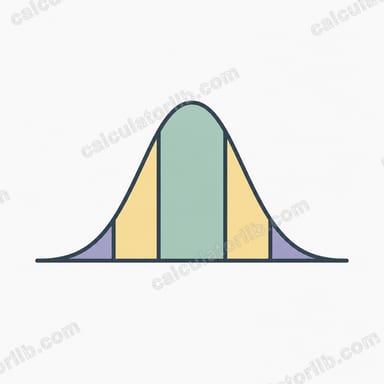
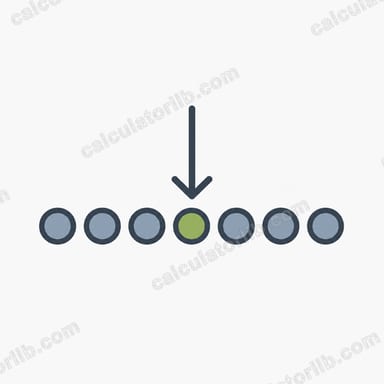
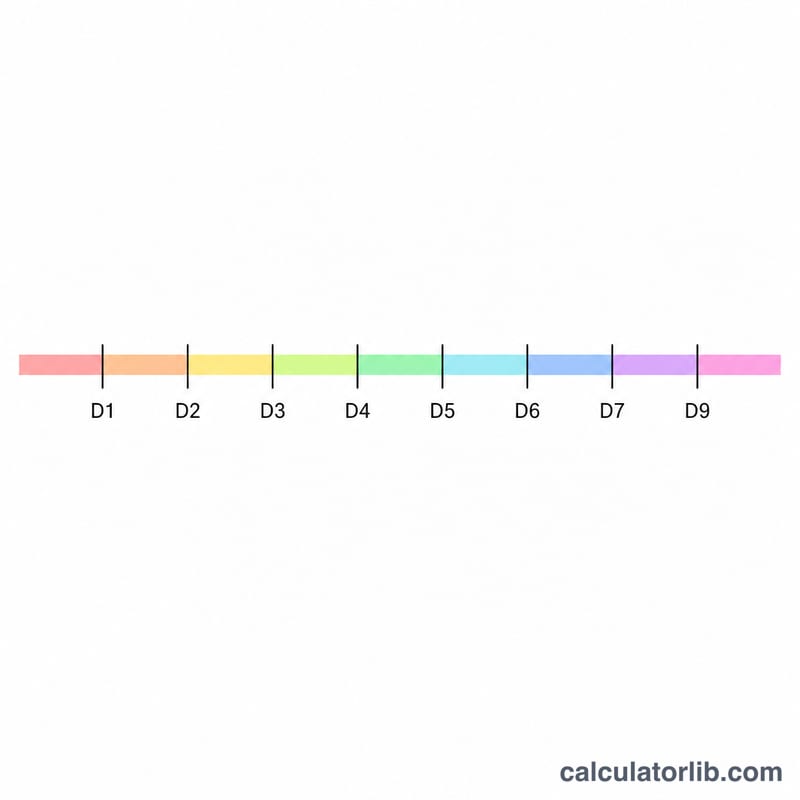
Deciles split an ordered data set into ten equal parts. There are nine deciles, labelled D1 through D9. The first decile (D1) is the value below which 10% of the data fall, D5 is the median (50%), and D9 marks the 90% point. Deciles are widely used in statistics, education (test-score banding), economics (income distribution) and finance to describe how a value ranks within a population.
How to use this calculator
Enter your numbers separated by commas or spaces, then choose which decile you want (k from 1 to 9). The calculator sorts the values, computes the rank position with the formula \(L = k(n+1)/10\), and returns the decile value — interpolating between two data points when the position is not a whole number.
The formula explained
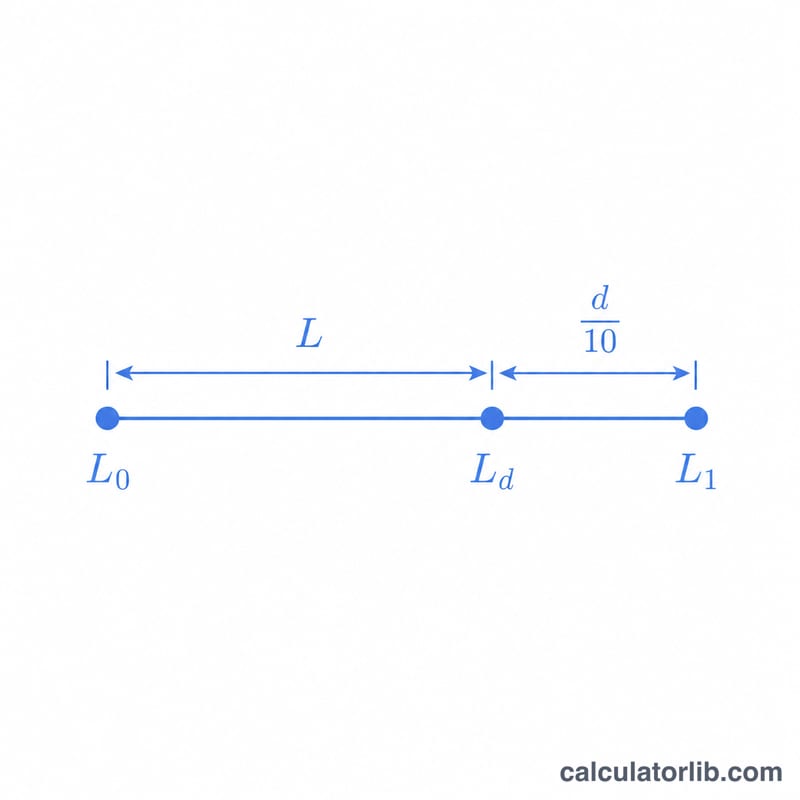
For \(n\) sorted values, the position of the k-th decile is \(L = k(n+1)/10\). If \(L\) is an integer, the decile is simply the value at that rank. If \(L\) falls between ranks (say 3.4), the decile lies 40% of the way from the 3rd value toward the 4th: $$D = x_3 + 0.4\,(x_4 - x_3).$$ Positions at or below 1 use the smallest value; positions at or above \(n\) use the largest.
Worked example
Take the data 2, 4, 6, 8, 10, 12, 14, 16, 18, 20 (\(n = 10\)) and find D3. The position is $$L = 3 \times (10 + 1) / 10 = 3.3.$$ So D3 lies 30% of the way from the 3rd value (6) to the 4th (8): $$D_3 = 6 + 0.3 \times (8 - 6) = 6.6.$$
FAQ
What is the difference between a decile and a percentile? Deciles divide data into 10 parts; percentiles into 100. Dk equals the (10k)-th percentile, so D3 is the 30th percentile.
Why do I get a decimal that isn't in my data? When the computed rank position is not a whole number, the calculator interpolates between the two nearest values, so the result can be a number not present in your original list.
Does the order of my input matter? No — the calculator sorts the data for you, so you can paste numbers in any order.