
What This Calculator Does
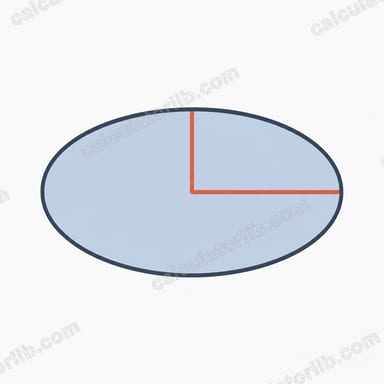
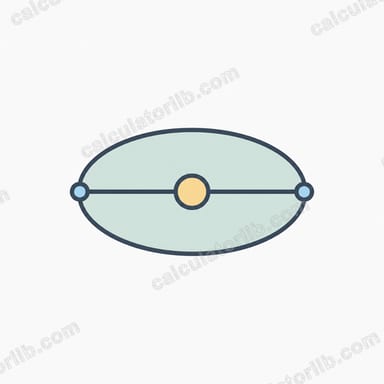
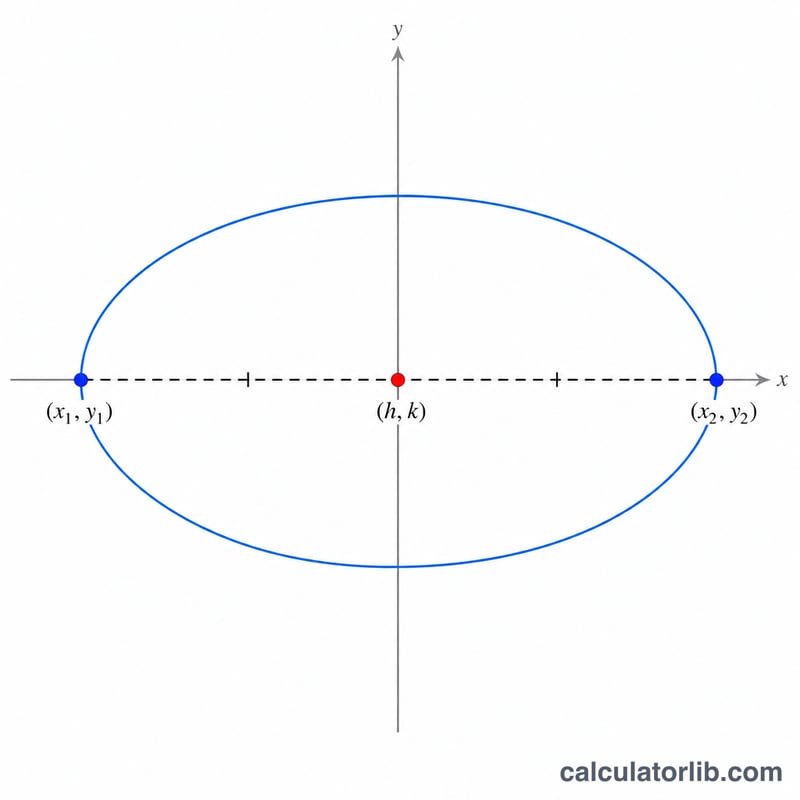
The Center of Ellipse Calculator finds the center point \((h, k)\) of an ellipse from two diametrically opposite endpoints — such as the two vertices (the ends of the major axis) or the two co-vertices (the ends of the minor axis). Because the center always sits exactly halfway between any pair of opposite points, it is simply the midpoint of the two coordinates you enter.
How to Use It
Enter the (x, y) coordinates of two opposite endpoints of the ellipse — for example, the leftmost and rightmost vertices, or the topmost and bottommost co-vertices. Click calculate and the tool returns the center \((h, k)\). The same midpoint logic works regardless of whether the ellipse is wider than it is tall or vice versa.
The Formula Explained
The midpoint formula averages each coordinate independently:
$$(h, k) = \left( \frac{x_1 + x_2}{2},\ \frac{y_1 + y_2}{2} \right)$$
\(h = (x_1 + x_2) / 2\) and \(k = (y_1 + y_2) / 2\).
This \((h, k)\) is the same value that appears in the standard equation of an ellipse, \(\frac{(x - h)^2}{a^2} + \frac{(y - k)^2}{b^2} = 1\). Once you know the center, you can measure the semi-axes \(a\) and \(b\) as the distances from the center to the vertices and co-vertices.
Worked Example
Suppose the vertices are at (−4, 2) and (6, 8). Then $$h = \frac{-4 + 6}{2} = 1 \quad \text{and} \quad k = \frac{2 + 8}{2} = 5,$$ so the center is \((1, 5)\).
FAQ
Do the two points have to be vertices? No — any two opposite points work, as long as they are on opposite ends of the same axis through the center.
Can I use co-vertices instead? Yes. The midpoint of the two co-vertices gives the same center as the midpoint of the two vertices.
What if my ellipse equation is already in standard form? Then the center is read directly: \(\frac{(x - h)^2}{a^2} + \frac{(y - k)^2}{b^2} = 1\) has center \((h, k)\); no calculation needed.