
What is the circumcenter?
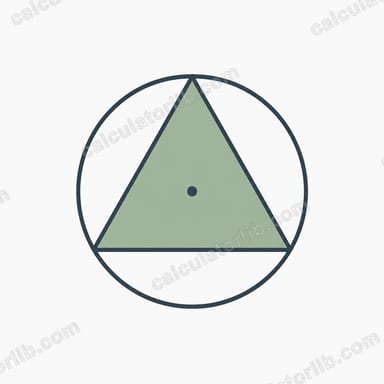
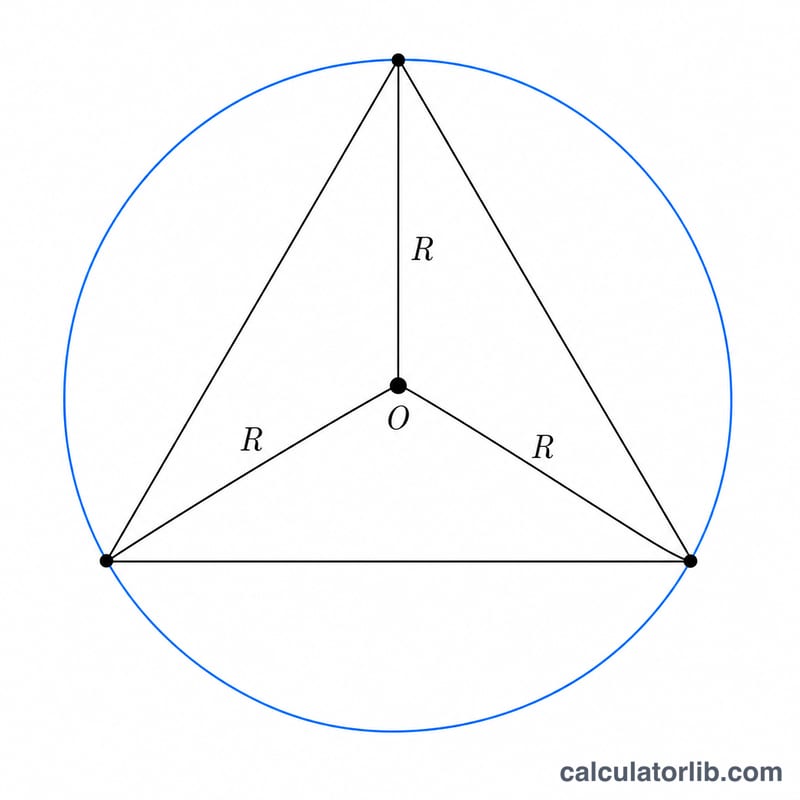
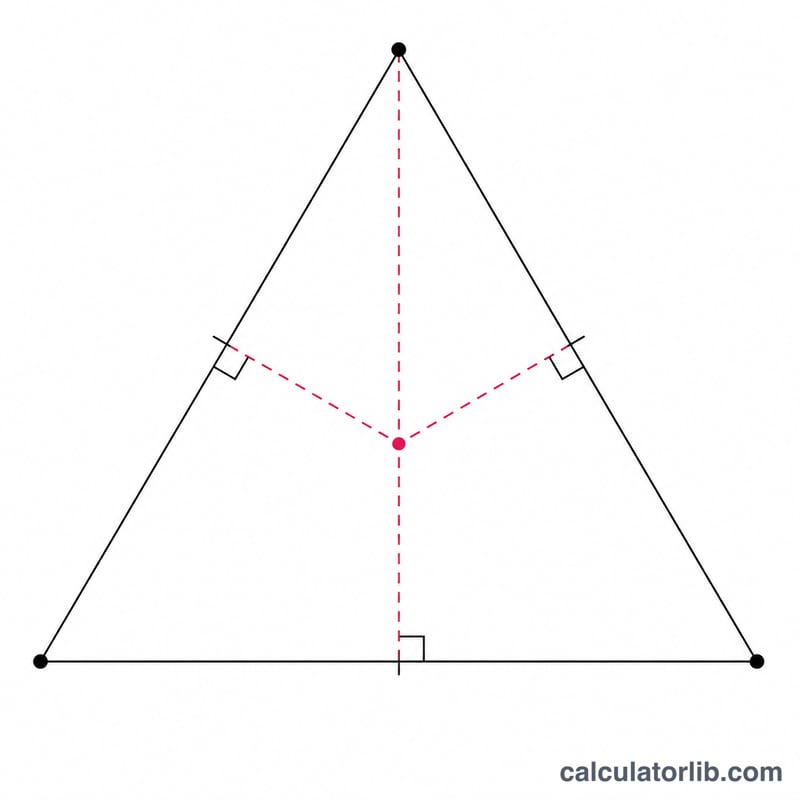
The circumcenter of a triangle is the unique point that is equidistant from all three vertices. It is the center of the circumscribed circle (circumcircle), the circle that passes through every vertex. Geometrically, the circumcenter lies at the intersection of the three perpendicular bisectors of the triangle's sides. This calculator finds it directly from the coordinates of the three vertices and also returns the circumradius.
How to use this calculator
Enter the (x, y) coordinates of the three triangle vertices: \((x_1, y_1)\), \((x_2, y_2)\) and \((x_3, y_3)\). The tool returns the circumcenter coordinates \((U_x, U_y)\) and the circumradius (the distance from the circumcenter to any vertex). If the three points lie on a straight line, no finite circumcenter exists and the calculator reports that the points are collinear.
The formula explained
Start with $$D = 2\left[x_1(y_2-y_3) + x_2(y_3-y_1) + x_3(y_1-y_2)\right].$$ This quantity is twice the signed area determinant; if \(D = 0\) the points are collinear. Using the squared distances of each vertex from the origin, \(s_i = x_i^2 + y_i^2\), the circumcenter is $$U_x = \frac{s_1(y_2-y_3) + s_2(y_3-y_1) + s_3(y_1-y_2)}{D} \qquad \text{and} \qquad U_y = \frac{s_1(x_3-x_2) + s_2(x_1-x_3) + s_3(x_2-x_1)}{D}.$$ The circumradius \(R\) is then the Euclidean distance from \((U_x, U_y)\) to any vertex.
Worked example
Take a right triangle with vertices (0, 0), (4, 0) and (0, 3). Then $$D = 2\left[0\cdot(0-3) + 4\cdot(3-0) + 0\cdot(0-0)\right] = 2\cdot 12 = 24.$$ With \(s_1 = 0\), \(s_2 = 16\), \(s_3 = 9\): $$U_x = \frac{0 + 16\cdot 3 + 9\cdot 0}{24} = \frac{48}{24} = 2,$$ and $$U_y = \frac{0 + 16\cdot 0 + 9\cdot(-4)}{24} = \frac{-36}{24} = 1.5.$$ The circumradius is $$\sqrt{2^2 + 1.5^2} = \sqrt{6.25} = 2.5,$$ which is exactly half the hypotenuse — as expected for a right triangle.
FAQ
Can the circumcenter be outside the triangle? Yes. For obtuse triangles the circumcenter lies outside; for right triangles it lies on the midpoint of the hypotenuse; for acute triangles it lies inside.
What if my points are collinear? Three collinear points cannot lie on a single finite circle, so the circumcenter is undefined and the calculator flags this case.
Does vertex order matter? No. The result is independent of the order in which you enter the three points.